
If you sell digital products on Shopify, you already know one thing — traffic is easy, sales are hard. You can drive thousands of visitors to your store every month, but if your conversion rate isn’t matching industry benchmarks, you’re leaving money on the table. In this guide, we’ll break down the digital product conversion rate benchmark for Shopify stores using AI tools, compare the top AI tools that help boost it, and show you exactly what’s working right now.
What Is a Digital Product Conversion Rate Benchmark for Shopify Stores?
Before diving into numbers, it helps to understand the actual digital product conversion rate benchmark for shopify store landscape and why it’s become such a hot topic among sellers. A conversion rate benchmark is simply the average percentage of store visitors who complete a purchase, measured against similar stores in your niche. For Shopify stores selling digital products — templates, courses, ebooks, software, presets, or SaaS subscriptions — this number tends to differ quite a bit from physical product stores because there’s no shipping friction, but there’s also less trust-building through “touch and feel.”
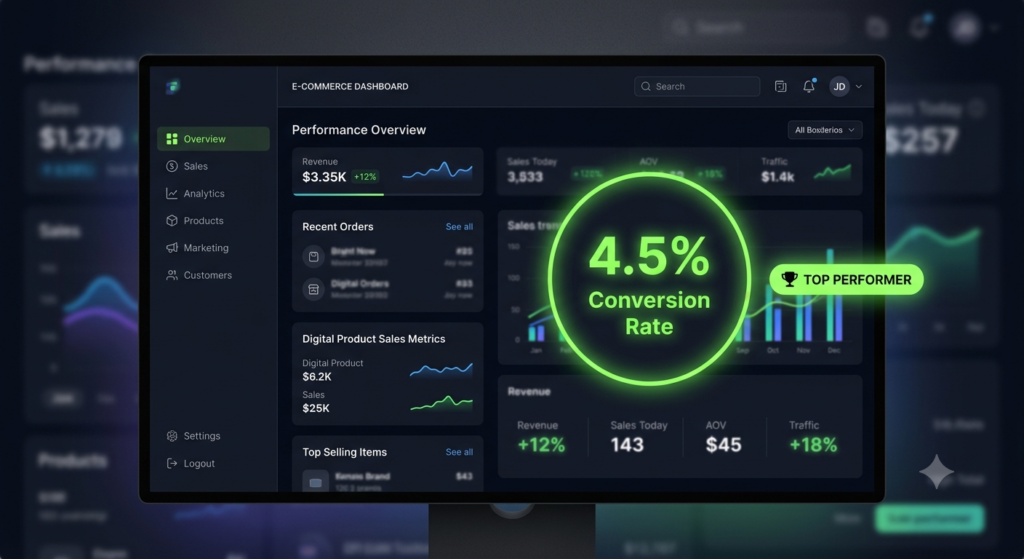
On average, most Shopify stores convert somewhere between 1.5% and 3.5%. Digital product stores that use smart personalization, AI-driven upsells, and optimized checkout flows often push past 4-5%, while stores relying on outdated funnels sit closer to 1%.
Why the Shopify Store Conversion Rate Benchmark Matters for Digital Sellers
Digital products don’t have inventory costs or shipping delays, so sellers assume conversions should be automatically higher. That’s a myth. Buyers still hesitate over digital purchases because of:
- Lack of physical proof before buying
- Refund and piracy concerns
- Overwhelming number of similar digital products online
- Trust issues with new or small Shopify brands
This is exactly where ecommerce conversion optimization, shopify store analytics, and AI-powered personalization tools come into play. Benchmarking helps you understand whether your store’s performance is average, above average, or badly underperforming — and where to focus your energy.
Every serious digital seller should be tracking the digital product conversion rate benchmark for their exact niche, since a generic ecommerce number won’t tell you much about how a Shopify store selling courses or templates should actually perform.
Think of benchmarking as a health check-up for your store. Without it, you’re guessing whether a slow month is a seasonal dip, a broken checkout, or simply weak product-market fit. With a clear benchmark in hand, you can separate normal fluctuation from a real problem, and decide whether the fix is a pricing tweak, a landing page redesign, or a new AI tool altogether. Sellers who skip this step often end up chasing traffic instead of fixing the leaky funnel that’s quietly costing them sales every single day.
It’s also worth noting that traffic quality plays a huge role here. A store pulling in cold social media traffic will almost always show a lower conversion rate than one relying on warm email subscribers or retargeted visitors — so when you benchmark, segment your traffic sources before drawing conclusions.
Digital Product Conversion Rate Benchmark by Category (Shopify Data)
| Digital Product Type | Average Conversion Rate | Top Performer Range |
|---|---|---|
| Online Courses | 1.8% – 2.5% | 4% – 6% |
| Templates & Design Assets | 2.5% – 3.8% | 5% – 7% |
| Ebooks & Guides | 1.2% – 2% | 3% – 4.5% |
| SaaS / Software Bundles | 2% – 3% | 4.5% – 6.5% |
| Presets, Plugins & Add-ons | 3% – 4.5% | 6% – 8% |
These numbers shift depending on traffic source, pricing, and how well the store uses AI shopping assistants, dynamic pricing tools, and behavior-based product recommendations. Keep this digital product conversion rate benchmark for shopify store ai tools table handy as a quick reference whenever you’re auditing your own store’s numbers.
How AI Tools Are Improving the Shopify Store Conversion Rate Benchmark
AI tools have quietly become the biggest lever for improving the digital product conversion rate benchmark for shopify store ai tools track in 2025 and 2026. Instead of guessing what customers want, AI tools analyze real-time browsing behavior, past purchase patterns, and even hesitation signals (like cart abandonment scroll speed) to personalize the shopping experience instantly.

Here are the areas where AI is making the biggest measurable impact:
1. AI-Powered Product Recommendations
Smart recommendation engines suggest the right digital product bundle based on browsing history, increasing average order value and repeat purchases.
2. AI Chatbots for Instant Support
Buyers hesitating on digital purchases often just need quick clarification. AI chat assistants reduce bounce rate by answering objections instantly, 24/7.
3. AI-Driven Email & Retargeting
Automated, behavior-triggered email sequences (abandoned cart, browse abandonment, post-purchase upsells) recover otherwise lost sales without manual effort.
4. Predictive Analytics for Pricing & Offers
AI tools analyze visitor intent to decide who sees a discount, a bundle offer, or a scarcity trigger — maximizing conversion without discounting everyone equally.
5. AI-Optimized Checkout Flows
Reducing form fields, auto-filling details, and offering flexible payment options through AI-guided checkout significantly cuts drop-off at the final step. Even small friction points — like an extra confirmation screen or a slow-loading payment gateway — can quietly kill conversions, and AI checkout tools are built specifically to spot and eliminate these leaks.
6. AI-Generated Content and Landing Pages
Beyond recommendations and support, AI tools now help generate product descriptions, landing page copy, and even A/B test variations automatically. For digital sellers who don’t have a full marketing team, this means faster testing cycles and landing pages that speak more directly to buyer intent — which directly feeds back into a stronger digital product conversion rate benchmark over time.
Comparison Table: Top AI Tools for Shopify Digital Product Stores (Conversion Rate Benchmark)
| Tool | Best For | Key AI Feature | Pricing Tier |
|---|---|---|---|
| Shopify Magic | General store automation | AI copywriting & product descriptions | Free with Shopify plans |
| Klaviyo AI | Email & SMS marketing | Predictive send-time & segmentation | Paid, scales with list size |
| Tidio AI | Customer support | AI chatbot with intent detection | Free tier + paid plans |
| Rebuy Engine | Upsells & recommendations | Personalized product bundling | Paid, revenue-based pricing |
| Octane AI | Quiz-based personalization | AI-driven product matching quizzes | Paid plans |
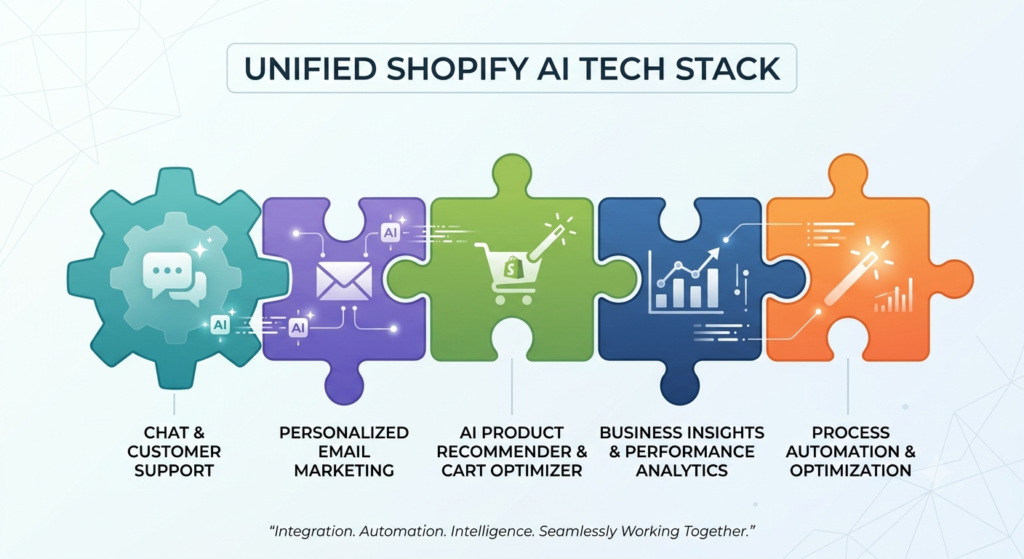
Before picking any tool from this list, weigh it against your own digital product conversion rate benchmark for shopify store ai tools oals, since a tool that works great for course sellers might not move the needle for template shops.
Pros and Cons of Using AI Tools to Boost Conversion Rates
Pros
- Personalizes the shopping journey without manual effort
- Saves time on customer support and email marketing
- Increases average order value through smart upselling
- Provides real-time analytics to make faster decisions
- Works around the clock, unlike human teams
Cons
- Some AI tools have a learning curve for smaller stores
- Costs can add up when using multiple AI apps together
- Over-personalization can feel intrusive to some customers
- Requires clean data to actually perform well
- Not a replacement for strong product-market fit
How to Benchmark and Improve Your Own Store’s Conversion Rate
Use this step-by-step process to apply the digital product conversion rate benchmark for shopify store AI tool framework to your own store:
- Track your baseline using Shopify Analytics or Google Analytics for at least 30 days before making changes.
- Compare against your specific niche, not general ecommerce averages, since digital products behave differently than physical goods.
- Test one AI tool at a time — start with either chat support or email automation, measure impact, then expand.
- Optimize checkout friction by reducing unnecessary steps and offering multiple payment options.
- Use heatmaps and session recordings to understand where visitors hesitate or drop off.
- Re-test pricing and bundling using AI-driven suggestions rather than static discounts.
- Review your benchmark monthly, not just once — AI tools improve with more data, so early results are rarely your ceiling.
- Document every change you make, including the exact date, so you can trace which specific tweak moved your conversion rate up or down.
Most stores make the mistake of changing five things at once and then wondering which one actually worked. Slow, deliberate testing against your baseline benchmark is what separates sustainable growth from lucky spikes.
Common Mistakes That Hurt Your Conversion Rate Benchmark
Even with the right AI tools, a lot of Shopify sellers unknowingly sabotage their own numbers. Here are the mistakes that show up again and again when auditing a store’s digital product conversion rate benchmark:
- Comparing against the wrong niche. A course seller comparing themselves to a template shop’s 5% benchmark will always feel like they’re underperforming, even if their actual numbers are healthy for their category.
- Ignoring mobile experience. A huge share of digital product traffic comes from mobile, and a checkout that isn’t fully optimized for smaller screens can quietly cut conversions in half.
- Overloading the store with too many AI tools at once. Stacking five AI apps without giving each one time to gather data usually creates noise instead of insight, making it impossible to know what’s actually driving the change.
- Not updating benchmarks as the store grows. A benchmark that made sense at 500 monthly visitors won’t necessarily apply once you’re at 10,000 — traffic mix and buyer intent shift as you scale.
- Treating benchmarks as a one-time task. The most successful stores revisit their digital product conversion rate benchmark for shopify store ai tools stack every quarter, adjusting as new AI features roll out and buyer behavior evolves.
Avoiding these mistakes alone can often move a store from an underperforming 1% conversion rate to a healthy 2.5-3% range, even before adding new AI tools into the mix.
Frequently Asked Questions
Q1: What is a good digital product conversion rate benchmark for Shopify store? Anywhere between 2% and 4% is considered solid for most digital product categories, with top performers reaching 5% or higher.
Q2: Do AI tools really improve conversion rates, or is it hype? When implemented correctly and matched to your store’s actual traffic behavior, AI tools consistently show measurable improvements, especially in email recovery and personalized recommendations.
Q3: How long does it take to see results after adding AI tools? Most stores start noticing measurable changes within 2 to 6 weeks, depending on traffic volume and how much data the AI tool needs to learn from.
Q4: Is Shopify Magic enough, or do I need extra AI apps? Shopify Magic is a great starting point for content and descriptions, but most stores eventually add specialized tools for email, chat, or upsells to cover gaps Magic doesn’t handle.
Q5: Does conversion rate benchmarking differ for new stores vs established stores? Yes. New stores typically convert lower initially due to lack of trust signals like reviews and social proof, so benchmarks should be compared against store age and traffic source, not just industry averages alone.
Q6: Should small Shopify stores worry about AI tools, or is this only for bigger brands? Small stores actually benefit the most, since AI tools replace tasks that would otherwise need a full marketing or support team — making it easier to compete on conversion rate even with a modest budget.

Conclusion
Understanding your digital product conversion rate benchmark for shopify store ai tools approach isn’t just a vanity metric — it’s the clearest signal of whether your Shopify store is actually performing or just getting traffic without results. The stores winning right now aren’t necessarily the ones with the biggest ad budgets; they’re the ones using AI tools smartly to personalize, support, and guide customers toward a decision faster. Start by benchmarking honestly, pick one or two AI tools that match your store’s biggest weak point, and build from there. Small, consistent improvements in conversion rate compound fast — and that’s where real, sustainable digital product revenue comes from.
