
Search just doesn’t work the way it used to. Type a question into Google today and there’s a good chance you won’t see ten blue links at all — you’ll see a single, synthesized answer with a handful of citations tucked in. That’s AI Mode, and it’s already reshaping how people find brands online.
Here’s the uncomfortable part: you can be doing everything right in classic SEO and still be completely absent from that answer. So how do you even know if you’re showing up? That’s where AI mode SEO tools come in, and in this guide we’ll walk through the best ones in 2026, how they actually work under the hood, and which AI mode SEO tools make sense depending on what you’re trying to get done The best AI Mode SEO Tools help brands monitor visibility across Google AI Mode and other AI search engines.
What Are AI Mode SEO Tools?
Think of AI mode SEO tools as the new generation of rank trackers — except there’s no rank to track anymore, not in the old sense. These platforms (also called AI search visibility tools, generative engine optimization tools, or answer engine optimization software) monitor whether your brand actually gets mentioned inside AI-generated answers Choosing the right AI Mode SEO Tools can improve your brand’s share of voice in AI-generated answers.” Most focus on Google AI Mode specifically, but the good ones also cover AI Overviews, ChatGPT, Perplexity, Gemini, Claude, and Meta AI.Modern AI Mode SEO Tools provide citation tracking, competitor analysis, and AI visibility reporting
What they track is different too. Instead of “you’re #4 for this keyword,” you get “you were mentioned in 12% of these responses, and here’s who beat you and why.” The better tools don’t stop there — they’ll actually tell you what to do about it.
Why Traditional SEO Tools Don’t Work for AI Mode
I’ll be honest — a lot of teams assume their existing SEO stack already has this covered. It doesn’t, and the gap is bigger than most people expect.
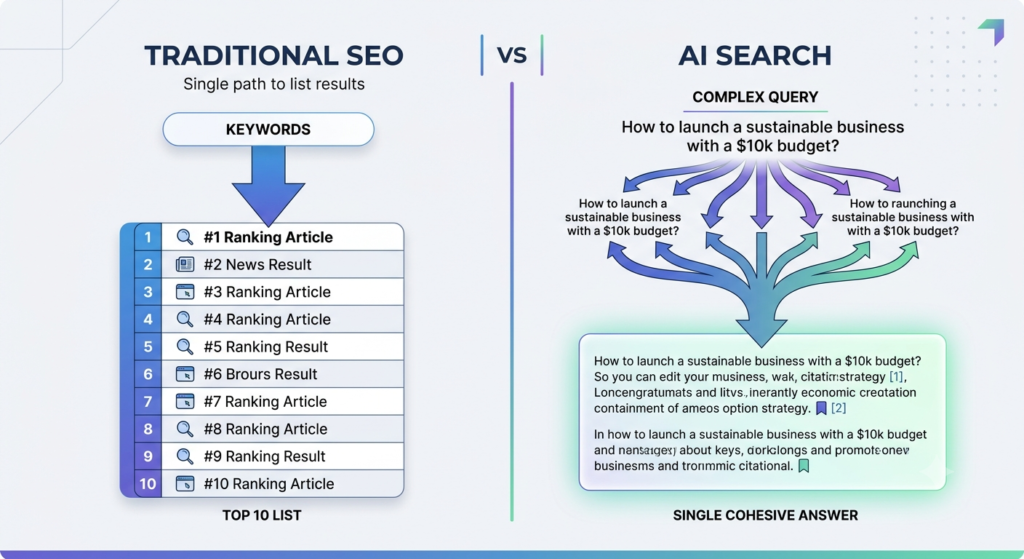
Traditional rank trackers were designed for a results page that’s essentially a list. AI Mode isn’t a list. It runs on something Google calls “query fan-out” — it splits your question into a bunch of sub-questions, searches all of them at once, and stitches the findings into one conversational answer. There’s no position #1 through #10 anymore, just: did you get cited, or didn’t you.
And the disconnect is real. Early research found that only around 14% of URLs cited inside AI Mode answers also show up in the traditional top 10 organic results. Ranking well the old-fashioned way genuinely doesn’t guarantee anything here. Add to that McKinsey’s finding that roughly half of consumers are now intentionally using AI-powered search, and it’s clear this isn’t a niche concern anymore — it’s becoming the front door for a lot of buyers.
None of this means old-school SEO is dead. Crawlability, structured data, genuinely useful content — Google’s been clear those still matter. But measuring and improving how you show up in AI Mode needs its own toolset.
How AI Mode SEO Tracking Tools Actually Work
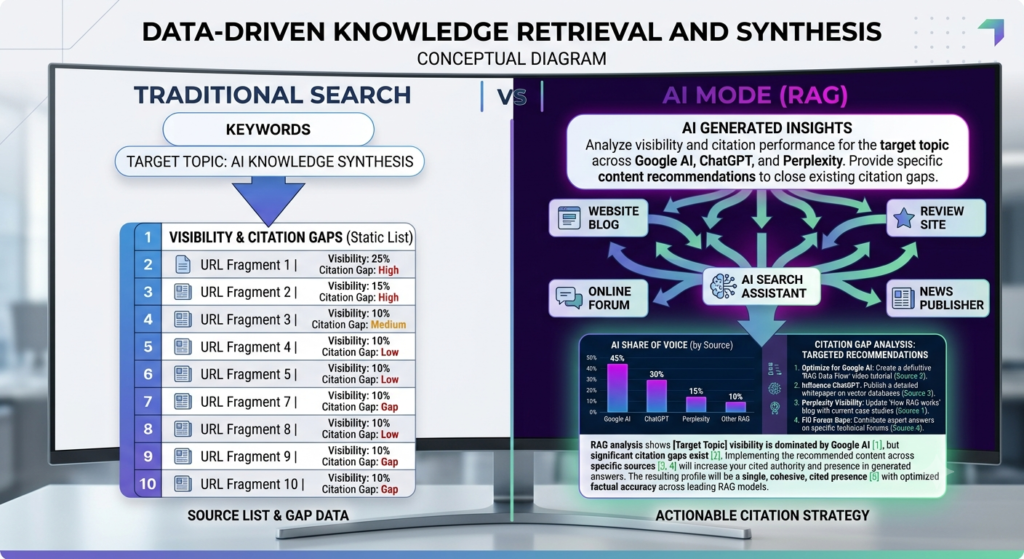
Under the hood, AI Mode runs on retrieval-augmented generation, or RAG — the same basic mechanism behind ChatGPT and Perplexity. It’s not just recalling what it learned during training. It goes out, retrieves live content from across the web, weighs it for relevance and authority, and builds the answer from what it finds. Your own website is just one voice in that mix; publishers, review sites, forums, and earned media all feed into it too.Choosing the right AI Mode SEO Tools can improve your brand’s share of voice in AI-generated answers.”
What an AI mode SEO tool does is automate the boring part of watching this happen. It runs a set of prompts through AI Mode on a schedule and logs the results:
- Did your brand get mentioned at all
- Which specific sources and URLs got cited
- How your competitors showed up in that same answer
- How sentiment and share of voice shift week over week
The tools that go a step further add citation analysis — showing you exactly which domains AI Mode trusts in your category. That’s really where the useful work starts. Knowing you’re invisible is one thing; knowing who’s beating you and why is what actually lets you do something about it.
Best AI Mode SEO Tools in 2026 — Quick Comparison
| Tool | AI Engines Tracked | AI Mode in Base Plan | Citation Analysis | Content Studio | Prompt Volumes | Improves Ranking |
|---|---|---|---|---|---|---|
| Cognizo | Up to 9 | Yes | Yes | Yes | Yes | Yes |
| Semrush AI Visibility Toolkit | Up to 5 | Yes | Partial | No | Partial | No |
| Peec AI | Up to 7 | Yes | Yes | No | Partial | No |
| Scrunch AI | Up to 8 | Yes | Partial | No | Partial | No |
| Otterly AI | Up to 4 | Enterprise only | No | No | Partial | No |
| SE Visible | Up to 5 | Yes | No | No | No | No |
| Nightwatch | Up to 5 | Add-on | Yes | No | No | No |
1. Cognizo — Best Overall AI Mode SEO Tool
Most tools on this list will happily tell you that you’re invisible in AI search. Cognizo is really the only one that also helps you stop being invisible. It tracks up to 9 AI engines — Google AI Mode, AI Overviews, ChatGPT, Claude, Perplexity, Gemini, Meta AI, and Grok — and instead of leaving you with a dashboard full of bad news, it wires that tracking straight into a content workflow.
The content studio is really the standout piece here. It pulls directly from your citation data, points out which competing sources AI keeps favoring over you, and helps you build content that’s actually aimed at closing those specific gaps — not just “more content,” but content targeted at the exact place you’re losing. Layer on prompt volume data so you’re not guessing which queries are worth chasing, plus AI traffic analytics that connect AI referrals back to real GA4 sessions, and you get something rare in this space: a straight line from tracking to actual ROI.
Pros:
- Widest engine coverage on this list (up to 9)
- The only tool here with a real content studio built in
- Ties AI referral traffic back to real analytics data
- Unlimited seats, even on the entry-level plan
Cons:
- Full 9-engine coverage sits on the Enterprise tier
- Might be more platform than a very small team needs on day one
Pricing:
- Core — $149/month (3 engines, 50 prompts, 2 AI articles/month)
- Growth — $499/month (5 engines, 150 prompts, 5 AI articles/month)
- Enterprise — custom (up to 10 engines, multiple brands, dedicated strategist)
2. Semrush AI Visibility Toolkit — Best for Existing Semrush Users
If your team already lives inside Semrush day to day, this is probably the path of least resistance. It bolts AI Mode, AI Overviews, ChatGPT, and Perplexity tracking directly onto the platform you’re already using for keywords and backlinks — so there’s basically no onboarding curve. You get visibility scores, share of voice, sentiment, competitor benchmarks, and a site audit that flags pages AI crawlers can’t actually access.
Pros:
- Almost zero learning curve if you’re already a Semrush user
- AI visibility data sits alongside your existing SEO data
- Solid crawlability audit for AI bots specifically
Cons:
- No content studio — you’re on your own for the “now what”
- Citation analysis and prompt data feel a bit thin in the base plan
- Costs climb fast once you go past a starter set of prompts
3. Peec AI — Best for Citation Depth
If what you really want is the source-level detail — exactly which URLs and domains are getting cited in your category — Peec AI does this better than most. It covers up to 7 engines including AI Mode, and it uses UI-based scraping rather than pure API sampling, which tends to line up more closely with what a real person searching would actually see.
Pros:
- Genuinely granular, URL-level citation data
- Sentiment scoring plus custom competitor tracking
- Reports come with improvement suggestions, not just numbers
Cons:
- No content studio to turn the data into published pages
- You’ll need a separate tool or process to act on what it finds
4. Scrunch AI — Best for Technical Diagnostics
Scrunch AI covers 8 engines, which is close to the top of this list, but its real edge is the crawler diagnostics layer — it looks at how AI bots are actually rendering and accessing your pages. That’s genuinely useful, because sometimes the reason you’re invisible has nothing to do with your content and everything to do with a technical block you didn’t know existed. Results also break down by topic, persona, and geography, which is handy if you’re managing visibility across different markets.
Pros:
- Broad engine coverage
- Unique focus on crawler-level technical issues
- Useful segmentation for multi-region or multi-persona brands
Cons:
- Citation data stays fairly high-level, not URL-by-URL
- No content studio
5. Otterly AI — Best Low-Commitment Starting Point
Not every team is ready to commit budget to this yet, and that’s fine — Otterly AI is a solid way to just get a baseline reading. The 14-day free trial doesn’t even ask for a credit card, and you can have a usable dashboard within minutes. It covers 4 engines and throws in a GEO audit checking 25+ on-page factors that influence whether AI picks up your content in the first place.
Pros:
- Free trial, no card needed
- Fast to set up, easy dashboards
- Handy GEO/on-page audit included
Cons:
- AI Mode tracking is locked to the Enterprise plan — worth checking before you commit
- No source-level citation analysis, no content tools
6. SE Visible — Best for Agencies
This one’s clearly built with agencies in mind. It tracks 5 engines including AI Mode, covers unlimited countries, and ships with white-label reporting, so you can drop AI visibility straight into client deliverables without extra work. Prompt tagging and clustering let you organize things by campaign or client, and the reports export cleanly enough to send as-is.
Pros:
- White-label reporting, ready for client hand-off
- No limits on country/geo coverage
- Prompt organization built around agency workflows
Cons:
- No citation analysis at all
- No content studio, no prompt volume data — you can flag the problem, but not much more
7. Nightwatch — Best for Combining Traditional Rankings with AI Visibility
Nightwatch started life as a classic rank tracker and added AI monitoring on top of that foundation, which shows — the integration between traditional SERP data and AI visibility feels tighter here than in most tools built from scratch for AI Mode. Its local tracking is genuinely impressive too, covering 107,000+ locations down to the zip-code level.
Pros:
- Best local/zip-code tracking on this list, by a fair margin
- Traditional rankings and AI visibility live in one dashboard
- Citation tracking included
Cons:
- AI Mode is a paid add-on ($99/month for 100 prompts), not part of the base plan
- No content studio, no prompt volume data
AI Mode SEO Tools vs. AI Visibility Platforms
People use these two terms interchangeably, but they’re not really the same thing. An AI visibility platform tells you where you stand — a score, a percentage, a “you were mentioned in X% of responses.” An AI mode SEO tool takes it further and actually helps you close that gap, through citation analysis, content workflows, and recommendations you can act on.
Most products in this space, honestly, are visibility platforms and nothing more. That’s fine if all you need is the score. But if you want the number to actually move, you need something that does more than report it.
What to Look for in an AI Mode SEO Tool
On the tracking side:
- At least five AI engines covered — anything less and you’re missing real buyer behavior
- AI Mode included in the base plan, not gated behind an enterprise upsell
- Citation analysis down to the URL/domain level
- Competitor benchmarking inside the same AI answer, not in isolation
- Prompt volume data, so you’re not optimizing blind
- Daily (or faster) refresh — AI Mode results shift a lot more than you’d expect
On the optimization side:
- A recommendation engine that covers owned, earned, and social channels
- A content studio connecting citation gaps to actual published content
- AI traffic analytics that tie AI referrals back to real sessions
Frequently Asked Questions
What is AI Mode in Google Search? AI Mode is Google’s conversational search experience. Rather than a list of links, it builds a multi-paragraph answer with inline citations and lets you keep the conversation going with follow-ups. It runs on query fan-out — breaking your question into sub-questions and searching all of them at once — and it’s live globally with no opt-in needed.
What are the best AI mode SEO tools? Right now, the strongest options are Cognizo, Semrush AI Visibility Toolkit, Peec AI, Scrunch AI, Otterly AI, SE Visible, and Nightwatch. Cognizo is the clearest pick if you want tracking and optimization in one place; Semrush makes sense if you’re already in that ecosystem; Peec AI is worth a look purely for citation depth.
How do you track your rankings in Google AI Mode? You need a dedicated tool that runs prompts through AI Mode on a schedule and records brand mentions, cited sources, and how competitors show up. A regular rank tracker can’t do this — there’s no ranked list for it to track.
Do traditional SEO tools work for AI Mode? Not really, at least not for this specific job. With only around 14% of URLs cited in AI Mode also appearing in the traditional top 10, your organic rankings just aren’t a reliable stand-in for AI Mode visibility. The SEO fundamentals still matter — but measuring this needs its own tool.
What’s the difference between AI mode SEO tools and AI visibility platforms? Visibility platforms tell you where you stand across AI engines. AI mode SEO tools go further and actually help you improve that standing through content optimization and citation gap analysis.
How does AI Mode decide which brands to show? Through query fan-out and retrieval-augmented generation — it pulls from multiple sources across the web and weighs them for relevance and authority. In practice, it tends to favor content that answers a specific question early and clearly, uses headings that map to real search queries, and gets backed up by consistent mentions elsewhere on the web. Brand and entity clarity across the wider internet seems to matter more here than plain link-based signals do.

Conclusion
“Ranking well” doesn’t mean what it used to. You can sit at the top of classic organic search and still be nowhere in the answer people actually read. The tools covered here range from basic monitoring dashboards all the way up to full optimization platforms, and which one’s right for you really comes down to one question: do you just need to see the data, or do you need something that turns that data into content and traffic you can measure?
If you want both in one place, Cognizo currently makes the strongest case. If you’re already deep in Semrush, running an agency that needs white-label reports, or focused heavily on local search, one of the others on this list might genuinely fit better. Either way, treat AI Mode visibility as a standing part of your SEO work now — not a side experiment you’ll get to eventually.
