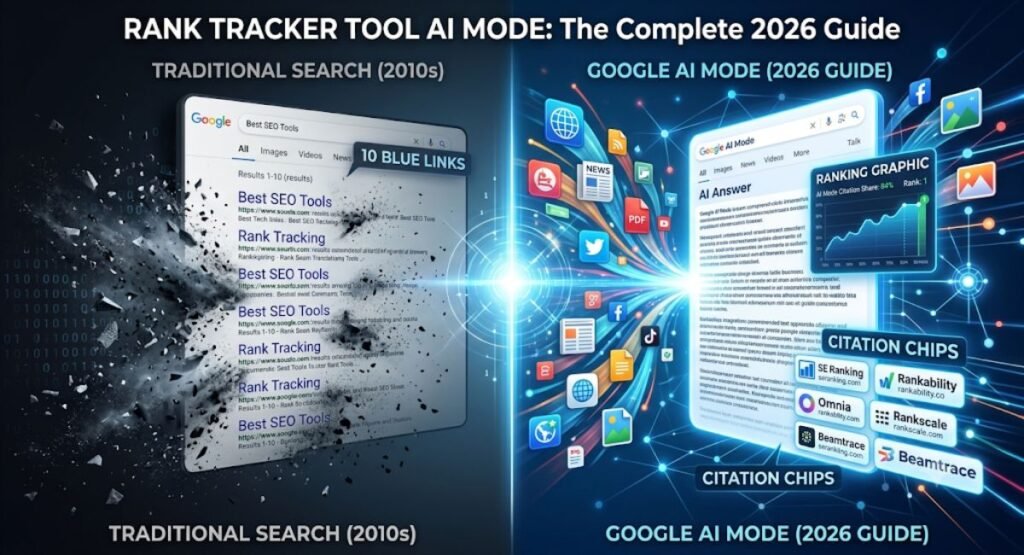
Search visibility used to mean one thing: where you sat on a page of ten blue links. That model has quietly broken down. When a query routes into Google AI Mode, there is no ranked list to check. Instead, Google builds a synthesized answer from dozens of sources pulled through a query fan-out process, and a single response can draw on more than thirty pages, most of which never touched a traditional top-10 spot.
This shift is exactly why a rank tracker tool AI mode solution has become essential for SEO teams, content strategists, and anyone building on generative engine optimization. It tells you whether your domain gets cited, where it shows up, how often it appears, and how you stack up against competitors inside an AI-generated answer that can change from one session to the next.
What Is a Rank Tracker Tool AI Mode Solution?
This kind of AI Mode visibility platform is a monitoring system that runs a library of prompts against Google AI Mode on a repeating schedule, then parses the citation chips that appear in the response to detect brand mentions and linked sources. The real unit of measurement here is not a keyword position but passage-level retrieval — which chunk of your page got pulled into the answer, in what order, and how consistently it reappears across repeated runs.
Google has not published a public API for this surface. Because of that gap, every serious AI Mode citation tracker vendor is effectively operating an automation agent: it simulates a real AI Mode session, extracts structured data from the rendered response, and compares that data against previous runs to spot change.
How Search Behavior Has Changed
Traditional organic ranking still matters, but it no longer tells the whole story. AI Mode retrieves information from a live web index paired with a large language model, then paraphrases and blends content from a huge pool of sources into a single unified answer. That means content can influence what a user sees without ever earning a clickable top-10 position, which is precisely the blind spot a rank tracker tool AI mode setup is designed to close.
How Does a Rank Tracker Tool AI Mode Actually Work?
Most tools in this category follow a loop that will feel familiar to anyone who has built a retrieval-augmented generation pipeline. A typical rank tracker tool AI mode workflow breaks down into four stages:
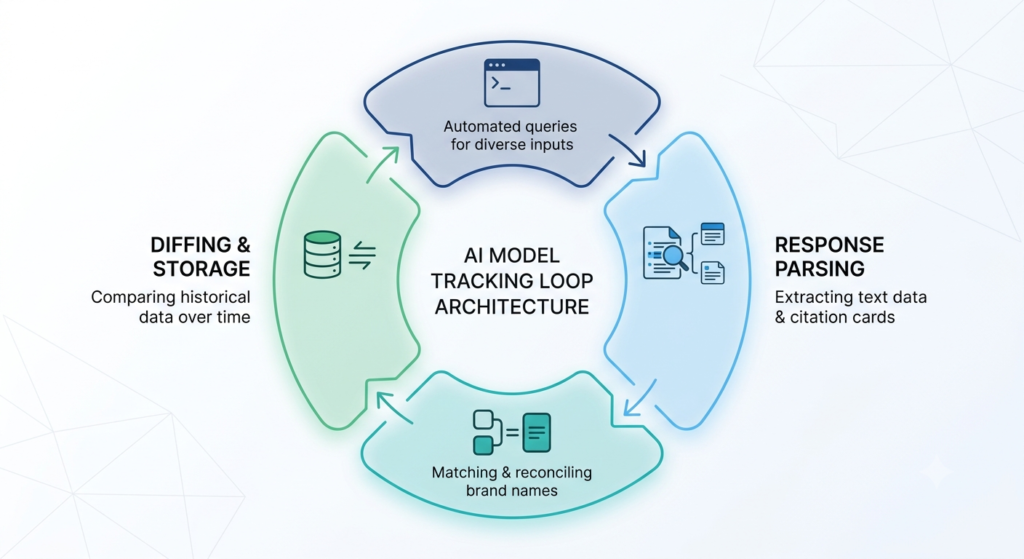
- Prompt execution — the tracker submits a query or a batch of query variants to AI Mode, simulating a signed-out or region-specific session.
- Response parsing — the returned answer, citation chips, and source cards are scraped and structured into a schema covering domain, URL, position within the answer, and surrounding text.
- Entity resolution — brand and competitor names are matched against the parsed text even when no link is present, which separately captures unlinked brand mentions from linked citations.
- Diffing and storage — each run is timestamped and compared against prior runs to surface volatility, since AI Mode answers are not static and can shift between sessions.
This retrieve, parse, and compare loop is structurally similar to what RAG evaluation frameworks already do. If your team is already grading retrieval quality for internal AI products, adapting that same pattern into a rank tracker tool AI mode workflow is a relatively small lift.
Pros and Cons of Using a Rank Tracker Tool AI Mode
Before adopting or building a solution, it helps to weigh what these tools genuinely deliver against their real limitations.
Pros
- Visibility beyond the top 10: This kind of setup surfaces citations that would be invisible to classic keyword-position tools.
- Competitive benchmarking: You can measure how often your brand appears relative to named competitors across a fixed prompt set.
- Content gap discovery: Tracking reveals which adjacent questions your site fails to answer, so you can prioritize new content with evidence instead of guesswork.
- Unified reporting: Many platforms roll AI Mode data into dashboards alongside AI Overviews, ChatGPT, and Perplexity visibility, giving agencies one place to report from.
- Early warning on volatility: Because AI Mode responses shift session to session, a good rank tracker tool AI mode platform flags citation churn before it becomes a bigger visibility problem.
Cons
- No official API: Every AI Mode citation tool relies on simulated sessions and scraping, which means results can break when Google changes its interface.
- Session volatility: A single snapshot tells you very little; unreliable single-run data can mislead teams that don’t run repeated checks.
- Cost for deeper coverage: Free tiers exist, but multi-engine, competitor-level reporting usually requires a paid plan.
- Interpretation complexity: Citation count alone can be misleading, since position, surrounding sentiment, and whether a mention is linked all affect its real value.
- Maintenance overhead for in-house builds: A custom rank tracker tool AI mode script needs regular re-validation against the live UI, since markup and behavior change frequently.
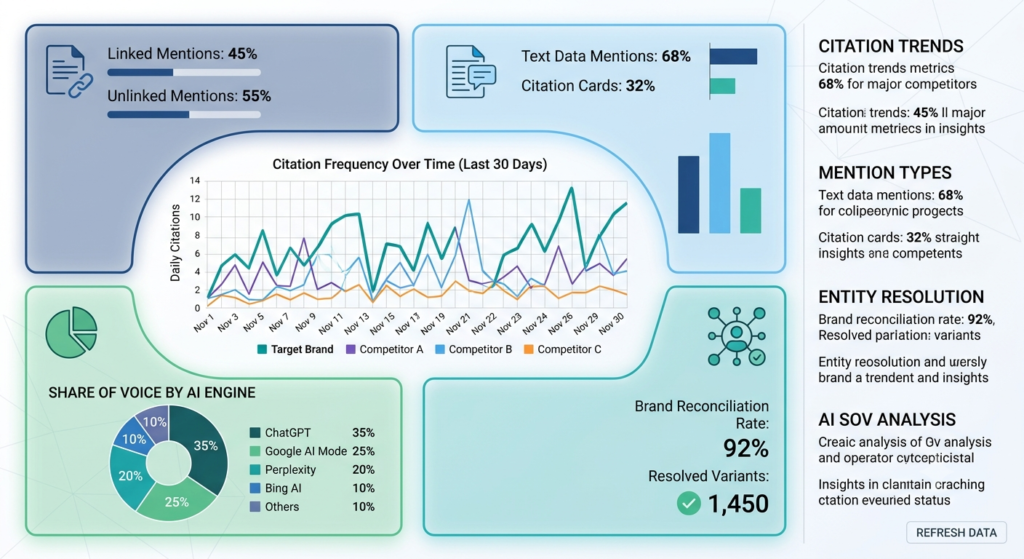
Comparison Table: Best Rank Tracker Tool AI Mode Options
| Tool | Primary Focus | Multi-Engine Coverage | Notable Strength |
|---|---|---|---|
| SE Ranking | AI Mode + AI Overviews tracking | AI Mode, AI Overviews | Bundled with an existing keyword rank tracking suite |
| Rankability | Cross-engine brand citation tracking | AI Mode, AI Overviews, ChatGPT, Perplexity, Gemini | Single dashboard across AI engines and organic search |
| Rankscale | Real-time AI Mode monitoring | AI Mode, AI Overviews | Trailing-average stability scoring for volatile results |
| Omnia | Citation-to-content workflow | AI Mode-focused | Converts citation gaps directly into content briefs |
| Beamtrace | Free-tier entry point | AI Mode, AI Overviews, Claude | No-cost starting plan for smaller sites |
For small businesses on a tight budget, a free tier is usually a reasonable starting point since it needs no upfront commitment. Agencies and larger brands, on the other hand, tend to need a paid, multi-engine rank tracker tool AI mode platform for proper competitor-level reporting.
Step-by-Step: How to Build Your Own Rank Tracker Tool AI Mode
If you would rather build in-house than pay for a subscription, the architecture maps cleanly onto tools your team may already use for retrieval evaluation, such as Ragas or TruLens.
- Define a prompt library. Start with 20–50 queries representing your category, mixing branded, competitor, and generic informational prompts.
- Automate session capture. Use a headless browser, such as Playwright, to trigger AI Mode and capture the rendered response, since there is no public API for this surface.
- Parse citation chips. Extract domain, URL, and surrounding paraphrase text from each citation card into a structured record.
- Score entity coverage. Match your brand and competitor names against both linked citations and unlinked mentions in the paraphrased text.
- Log an evidence trail. Store screenshots or raw HTML alongside parsed data, because AI Mode output is not reproducible and an audit trail matters more here than in classic rank tracking.
- Diff over time. Compare each run against the last to flag new citations, lost citations, and shifts in citation order.
Any scraping-based approach should be re-validated against the live interface regularly, and teams should review Google’s terms of service before automating queries at scale.
Real-World Use Cases for a Rank Tracker Tool AI Mode
- Brand visibility audits: Confirming whether a company is cited in AI Mode answers for its own category terms, even without a top-10 organic position.
- Competitive share of voice: Measuring how often a brand appears relative to named competitors across a fixed prompt library, run on a weekly cadence.
- Content gap detection: Identifying which pages get cited for adjacent questions your site does not currently answer, then prioritizing new content around those gaps.
- Local and vertical monitoring: Tracking citation behavior for location- or industry-specific prompts, since the source pool for these queries can differ sharply from standard organic results.
- Agency reporting: Combining AI Mode citation data with AI Overviews, ChatGPT, and Perplexity visibility for a single client-facing report.
Key Metrics to Monitor
Not every data point coming out of a tracking run carries equal weight. A few metrics tend to matter far more than raw citation counts:
- Citation position: Where your domain lands within the synthesized answer, since sources referenced earlier tend to shape the reader’s takeaway more heavily than sources buried near the bottom.
- Linked vs. unlinked mentions: A clickable citation drives referral traffic, while an unlinked brand mention still shapes perception and trust even without a visit.
- Citation frequency over time: A single strong run means little; what matters is whether your domain keeps reappearing across repeated sessions for the same prompt.
- Competitor overlap: Tracking which competitors show up alongside you for the same query tells you who you’re actually up against inside the answer, which may differ sharply from your usual organic competitor set.
- Surrounding sentiment: The tone of the paraphrased text around your citation matters almost as much as the citation itself, since a neutral or negative framing can undercut an otherwise strong mention.
- Source diversity: Watching how many unique domains get cited across a prompt library helps gauge how contested a topic is and how much room exists for a new page to break in.
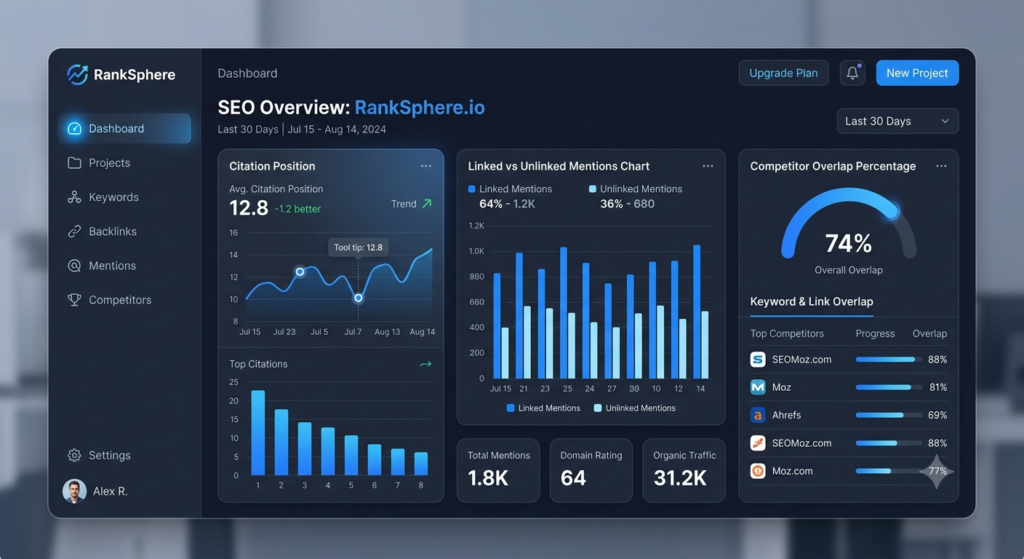
Combining these signals into a single weighted score, rather than reporting raw citation counts, gives stakeholders a clearer picture of whether visibility is actually improving.
Why This Matters for Generative Engine Optimization
Generative engine optimization treats AI-generated answers as a distinct surface with its own rules, separate from classic search engine optimization. Because AI Mode blends dozens of sources into one paraphrased response, the old playbook of chasing a single ranking position doesn’t translate cleanly. Instead, teams need ongoing measurement of citation share, source diversity, and mention sentiment to understand how their content actually performs inside these AI-generated summaries. Treating this measurement as a core part of a content strategy, rather than an occasional check, is what separates brands that adapt quickly from those that keep optimizing for a search experience that fewer users actually see.
Common Mistakes to Avoid
- Treating citation count like a keyword rank. A single citation carries different weight depending on its position, the surrounding sentiment, and whether it is linked or just a text mention.
- Ignoring unlinked brand mentions. AI Mode performs passage-level retrieval across multiple sources rather than ranking whole pages, so your brand can be described without ever being linked.
- Running prompts once and calling it done. Because output is session- and time-sensitive, a single snapshot tells you almost nothing about real volatility.
- Assuming organic rank predicts AI Mode citation. There is meaningful overlap between top-10 organic pages and AI Mode citations, but overlap is not equivalence, so dedicated tracking still matters even for pages that already rank well.
FAQs About Rank Tracker Tool AI Mode
What is a rank tracker tool AI mode? It is a monitoring solution that automatically runs a set of search prompts against Google’s AI Mode, then records whether and how a brand or URL is cited in the synthesized answer, tracking change over time instead of a fixed keyword position.
How is AI Mode different from AI Overviews for tracking purposes? AI Overviews appear above traditional results for select queries and cite a small handful of sources. AI Mode is a separate conversational surface that can appear for almost any query and pull from dozens of sources across a multi-turn session, which makes a single snapshot far less reliable.
Can I track AI Mode citations for free? Yes, in a limited way. Some vendors offer a free entry-level tier for basic citation checks, though teams that need scheduled, multi-engine, or competitor-level tracking will usually need a paid plan or a custom-built AI Mode tracking script.
Does ranking well organically guarantee AI Mode citations? No. There is overlap between top-10 organic pages and AI Mode citations, but the broader source pool and paraphrase-based synthesis mean plenty of citations come from pages well outside the traditional top 10.
How often should I run AI Mode tracking prompts? Weekly runs are a reasonable baseline for most brands given AI Mode’s session-level volatility. Competitive or fast-moving categories often benefit from daily tracking to catch citation churn as it happens.
How do I check if my website shows up in Google AI Mode? You can check manually by running your target queries in AI Mode and scanning the citation chips for your domain, but for consistent, repeatable results, most teams rely on a dedicated tool because manual checks miss session-to-session volatility.
Do I need a separate tool for AI Mode, or can I reuse my existing SEO stack? Some existing keyword rank tracking suites have added AI Mode modules, so it’s worth checking whether your current platform already covers this surface before adopting a separate tool. That said, a dedicated solution often provides deeper entity resolution and sentiment analysis than a bolt-on feature can offer.
Conclusion
Tracking visibility in Google AI Mode is not simply an extension of classic SEO tooling — it is closer to evaluating a retrieval pipeline, which is why the fan-out, parse, and diff loop should feel familiar to anyone building agentic systems. Whether you adopt an established vendor or build a lightweight in-house rank tracker tool AI mode setup on top of a headless browser and a prompt library, the fundamentals stay the same: define your prompts, capture citations consistently, and treat volatility as a signal rather than noise.
