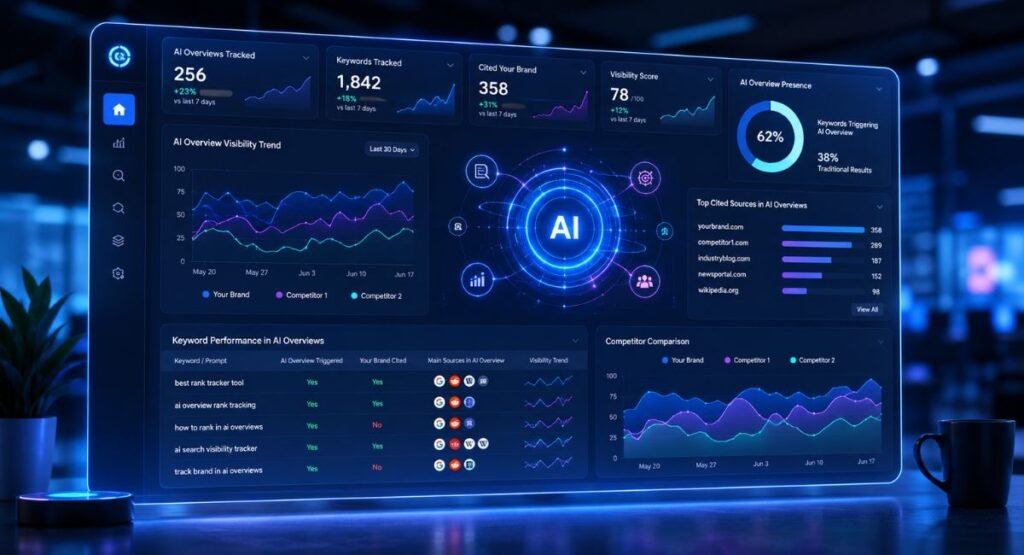
AI Overviews Rank Tracker is one of the most important SEO solutions for businesses and marketers looking to monitor their visibility in Google’s AI-generated search results. Google search is no longer limited to just blue links. AI Overviews have completely changed the way search works, and it has become essential for brands to know whether their website is being cited in these AI-generated answers or not. This is exactly where the AI Overviews Rank Tracker comes in — it tells you where you stand and where your competitors stand too. Choosing the AI Overviews Rank Tracker early on can save you from losing visibility without even realizing it.
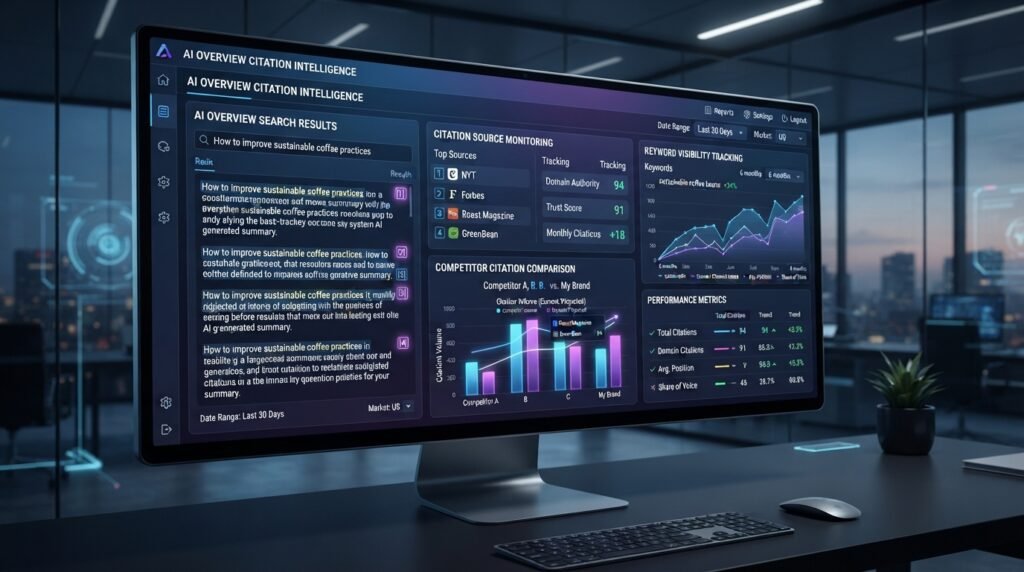
Why the AI overviews rank tracker
AI Overviews are the AI-generated summaries that appear at the very top of Google’s search results. They work in a fundamentally different way compared to traditional organic rankings, because Google assembles them from multiple “sub-queries” (a process known as query fan-out) — which means the same keyword scanned twice can surface completely different cited sources.
This means traditional SEO rank tracking alone is no longer enough. You need to know:
- Which keywords are triggering an AI Overview
- Which sources are being cited in that Overview
- Whether your website is on that list — or has been replaced by a competitor
Together, these three factors determine whether your brand is “visible” or invisible in AI-powered search.
Why Search Behavior Has Completely Changed
People used to search a keyword on Google, then pick a result from among ten blue links. That process has now become much shorter. Users ask AI a question directly, and whatever answer AI gives becomes the basis of their decision.
This is why digital marketing experts and industry analysts agree that the way discovery works is fundamentally shifting. Traditional SEO isn’t disappearing — but AI search visibility has become a separate, essential competitive advantage. Brands that don’t appear in AI-generated answers are becoming invisible to a growing portion of their audience.
Several research studies also show that a large share of consumers now prefer asking AI tools questions instead of using traditional search. If your brand isn’t being recommended there, you’re missing out on a part of discovery that keeps growing every day.
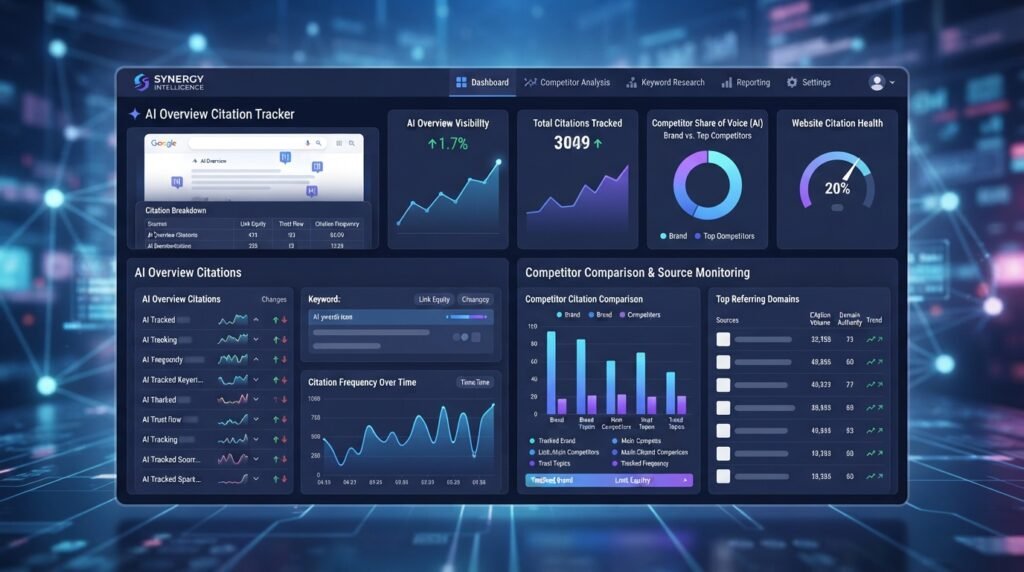
What A Good AI Overview Rank Tracker Should Have
The AI Overviews Rank Tracker should provide accurate citation tracking, competitor analysis, and historical visibility data.
1. Automated Detection Manual checking wastes time and doesn’t guarantee consistency. The tool should automatically detect which keywords trigger an AIO and which ones remain limited to traditional results.
2. Source-Level Citation Data It’s not enough to just know that you’re being cited; you also need to know the exact URL Google is using. This helps you understand which specific page of your content is earning trust.
3. Historical Tracking And Volatility Alerts AI Overview sources keep changing over time, because Google continuously updates its models and re-indexes content. When your URL disappears from the list, you should know immediately — not months later in some pipeline report.
4. Competitor Visibility It’s important to see which competitor pages have suddenly started getting cited in your place. Often a new entrant or a directory site quietly starts getting cited for your “best of” queries — and if you’re not tracking this, you only find out after your traffic has already dropped.
5. Multi-Platform Coverage Tracking your presence isn’t just about Google AI Overviews anymore — platforms like ChatGPT, Perplexity, Gemini, and Claude have become just as important in today’s digital landscape. Seeing everything from a single dashboard saves time and makes decision-making easier.
6. Location-Aware Scanning If your business serves a local market, AI Overviews vary by location. A plumber searched for in one city can get a completely different AI Overview than one searched for in another. That’s why a good tracker appends location to every query, so the results you see are the ones your actual customers see.
7. Side-By-Side SERP Comparison This feature lets you see your AI Overview citations and traditional organic rankings together — so you can understand how AIOs are reshaping your real-world traffic.
How AI overviews rank tracker Works (3 Simple Steps)
The AI overviews rank tracker typically follows a simple three-step process to monitor AI search visibility.

Step 1: Add Your Keywords Or Prompts Every ai overviews rank tracker starts with this step. Enter all the high-intent keywords or questions relevant to your business — whether it’s a short-tail keyword or a conversational question. Most tools support any format.
Step 2: Set Your Scan Schedule Choose daily, weekly, or a custom schedule. After that, scans run automatically in the background — you don’t need to check anything manually. This “set it once, watch it run” approach is the mark of a good tool.
Step 3: Get Visibility Data Each scan tells you:
- Whether an AI Overview was triggered
- Which sources were cited
- Your brand’s mention status
- What the historical trend looks like
Compiling this data over time gives you a clear picture of whether your AI search presence is improving or declining.
Business Benefits Of Using AI Overviews rank tracker
Early warning system — Using the AI overviews rank tracker helps businesses protect traffic and improve AI search visibility. Whenever Google updates its model or re-indexes content, sources can change. If you’re tracking this, you find out about drops immediately — not months later when it shows up in a traffic report.
Content strategy direction — When you see which pages are getting cited and which aren’t, you know exactly what needs improving in your content — whether it’s structure, depth, or freshness.
Competitive intelligence — Seeing the full list of competitor domains tells you exactly who Google’s AI trusts in your industry, and where you’re falling short.
Budget justification — When you can show exact data on how a citation drop impacted traffic, justifying marketing budget becomes much easier.
Multi-channel visibility — Getting data from Google AI Overviews, ChatGPT, Perplexity, and Gemini all from one place makes building strategy far simpler.
Rank Tracker Tool For AI Overviews Vs Traditional SEO Tracking
Traditional SEO tracking mostly shows you a fixed position (like #1, #5, #10) associated with each keyword. But AI Overview tracking is far more dynamic:
- Position isn’t fixed — the source list can reshuffle entirely
- Multiple scans of the same keyword can produce different results (due to query fan-out)
- Being cited doesn’t always mean getting a click, but it does earn brand trust and visibility
- Competitor tracking isn’t just about comparing ranks, it’s about understanding who’s earning trust
This is exactly why traditional rank trackers aren’t enough for AI Overview data — you need the AI overviews rank tracker to handle this dynamic nature.
Which Businesses Need AI Overviews rank tracker
- Local businesses — where location-based visibility is crucial (plumbers, clinics, restaurants)
- E-commerce brands — where “best of” and comparison queries directly influence buying decisions
- SaaS and B2B companies — where high-intent, research-heavy queries have a higher chance of being cited in AI Overviews
- Content publishers and bloggers — for whom citations are a major source of authority and traffic
- Digital marketing agencies — that need to report AI search visibility across multiple clients
No matter which category you fall into, if your customers are asking Google or AI tools questions, AI Overview tracking is relevant for you.
Mistakes To Avoid While Choosing AI Overviews rank tracker
Don’t focus only on the position number — The context of a citation matters too, such as how stable your position is within the source list.
Don’t ignore multi-platform coverage — A tool limited to just Google AI Overviews will give you an incomplete picture, especially as users increasingly turn to platforms like ChatGPT and Gemini.
Don’t underestimate historical data — A single scan isn’t enough. Consistent historical tracking is necessary to see real trends.
Don’t rely on manual checking — It’s time-consuming and doesn’t guarantee consistency. Automation is what makes this process scalable.
How To Calculate ROI From AI Overview rank tracker
Before investing in any tool, it’s important to understand how its return will be measured. ROI from AI Overview tracking isn’t just one number — it’s made up of several small signals that compound over time.
Traffic protection — When you catch a citation drop the same day it happens, you can immediately update or optimize your content before that drop shows up in your organic traffic too. This proactive approach delivers the biggest ROI.
Opportunity discovery — Every scan doesn’t just show drops, it also highlights new opportunities. When a new keyword starts triggering an AI Overview where a competitor isn’t cited yet, you can move first.
Time savings — Manual checking can take hours, especially when you have ten or twenty keywords. Automated tracking turns this entire process into minutes, freeing up your team’s time for strategy and content instead of checking.
Data-backed decisions — When you need to tell a client or management whether AI search visibility is improving or not, backing it up with actual historical data is far more convincing than speaking from assumptions alone.
This is why even a modest monthly investment pays for itself quickly, especially when catching a single citation drop early saves you from a much bigger traffic loss.
How Often Should You Scan Using Your Rank Tracker Tool For AI Overviews?
There’s no single answer that fits every business, but a few general guidelines can help you decide the right cadence for your tracking:
High-competition, high-intent keywords — If a keyword directly drives revenue or leads, scanning it daily makes sense. These are usually the keywords competitors are also fighting hardest to get cited on, so volatility tends to be higher.
Long-tail or niche keywords — For lower-competition terms, a weekly scan is usually enough. These citations tend to be more stable and don’t shift as dramatically.
Seasonal or campaign-specific keywords — During a launch, sale, or seasonal push, it’s worth temporarily increasing your scan frequency so you can react quickly if visibility drops right when it matters most.
New content publication — Whenever you publish or significantly update a page targeting an AI Overview keyword, a scan a few days later helps you see whether the update actually improved your citation chances.
Getting this cadence right means you’re not overwhelmed with data, but you’re also not missing changes that actually affect your bottom line.
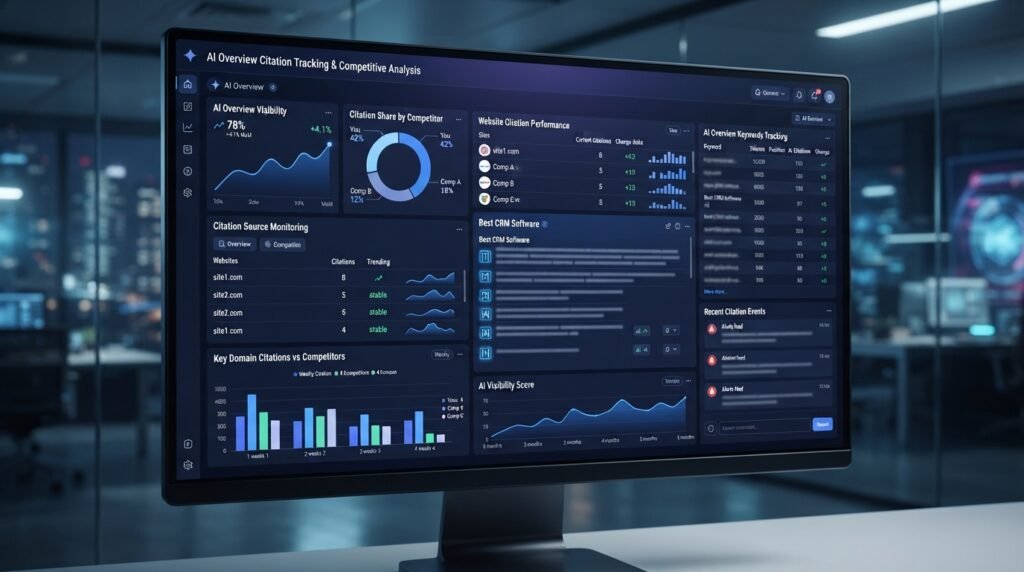
Conclusion
Choosing the AI overviews rank tracker is essential for brands that want to stay visible in AI-powered search results. AI Overviews have become the new “top of the page” in search, and brands that are invisible here are drifting further away from a growing audience. Using the AI overviews rank tracker lets you not only see your current position but also build a path to stay ahead of competitors.
Whether you’re a small local business or an enterprise-level brand, AI search visibility is no longer a luxury — it’s a necessity. The sooner you start tracking, the sooner you can align your content strategy, avoid citation drops, and stay ahead of competitors before they take your place.
FAQs
Q1. What is a AI overviews rank tracker? It’s a tool that automatically checks whether a Google AI Overview is appearing for your target keywords, and if it is, whether your brand is being cited in it.
Q2. Can I track my brand’s position within an AI Overview? Yes. Most modern tools show you the exact citation position, source list, and historical trend so you can gauge your visibility.
Q3. Is AI Overview tracking limited to Google only? No. Better tools offer tracking across Google AI Overviews as well as ChatGPT, Perplexity, Gemini, and Claude, giving you a complete picture of AI search visibility.
Q4. Why is competitor tracking important? Because if a competitor suddenly starts getting cited in your place, it directly impacts your organic traffic and brand visibility. Knowing this on time gives you a chance to react before it shows up as a drop in your traffic report.
Q5. Does location affect AI Overview results? Yes, especially for local businesses. A plumber searched for in one city can get a different AI Overview than one searched for in another city — which is why location-aware scanning is such an important feature.
Q6. What’s the difference between traditional SEO rank tracking and AI Overview tracking? Traditional tracking shows a fixed position, while AI Overview tracking follows dynamic source lists, citation status, and results that shift due to query fan-out.
Q7. How quickly can I find out about an AI Overview visibility drop? If you’re using an automated tracker that scans daily or weekly, you can catch a drop the same day or within that week — not months later in a pipeline report.
Q8. Is AI Overview tracking useful for small businesses too? Absolutely. Small local businesses whose customers search “near me” or location-based queries need AI Overview visibility just as much as large enterprise brands do.
Q9. What is the AI overviews rank tracker? The best tool depends on your needs, but it should offer AI Overview citation tracking, competitor analysis, and historical visibility data eds, but it should offer AI Overview tracking, citation monitoring, competitor analysis, and historical data.
