Online learning has changed fast, and a big part of that shift is the rise of the AI teaching avatar. If you’ve been digging through Reviews of AI Avatar Tools for Educational Content, you already know the market is crowded and every landing page claims to be “the best.” I tested trial versions, dug through user forums, and compared pricing pages so you don’t have to. Here’s what’s actually worth your time, whether you’re a teacher making explainer videos, a course creator scaling a curriculum, or an L&D team building onboarding training.
Reviews of AI Avatar Tools for Educational Content: What Are They?
AI avatar tools for educational content are software platforms — sometimes called AI video generators for teachers or virtual presenter software — that turn a written script into a video featuring a digital instructor. Instead of hiring a videographer, setting up lighting, and recording a human host, you type your lesson script, pick a virtual presenter, and the platform generates a polished text-to-video lesson with natural lip-sync, voice narration, and on-screen visuals. Think of it as a talking-head video generator with the production crew baked in.
Most of these platforms lean on three technologies at once: text-to-speech engines that sound increasingly human, generative video models that animate facial expressions and lip movement, and template-based editors that let non-designers assemble a finished lesson quickly. The result is a fast way to produce lecture videos, e-learning modules, and multilingual course content without a camera crew.
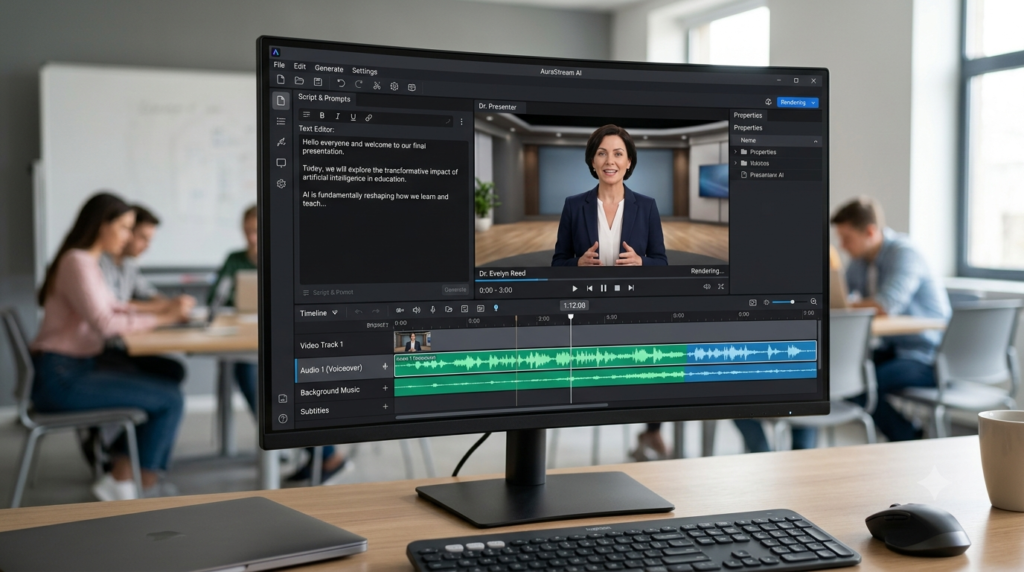
Here’s the honestly interesting part: a script gets broken into segments, matched with a chosen voice and digital presenter, then rendered frame by frame so mouth movements line up with the audio. Some tools churn this out in the cloud within minutes; others crawl for scenes with multiple presenters or heavy on-screen text. That rendering pipeline is why speed, voice quality, and lip-sync accuracy swing so wildly from one synthetic media platform to the next — which is exactly why thorough Reviews of AI Avatar Tools for Educational Content matter so much before you commit to a subscription.
Why Educators Are Switching to AI Avatar Tools for Educational Content
Teachers and instructional designers aren’t adopting AI avatar tools for educational content just because it’s trendy. A few reasons keep coming up again and again in every set of Reviews of AI Avatar Tools for Educational Content we looked at:
Speed of production. A lesson that once took a full day to film can now be produced in under an hour.
Easy updates. When curriculum details change, you edit the text script rather than reshooting an entire video.
Multilingual reach. Many platforms can translate a script and generate a new video in dozens of languages, which is valuable for schools and companies serving international learners.
Consistency. A virtual instructor delivers the same tone and pacing every time, which matters for standardized testing prep or compliance training.
Lower cost per video. Studio rentals, camera operators, and on-screen talent add up quickly; a subscription to an avatar platform is usually far cheaper over time.
Accessibility features. Many platforms generate captions automatically alongside the video, which helps learners with hearing impairments and non-native speakers follow along more easily.
Scalability for large programs. A single instructional design team can produce dozens of lesson videos per week, something that would normally require a much larger production budget and staff.
Of course, no tool is perfect, and part of choosing wisely means understanding where these platforms fall short. We cover that in the pros and cons section further down.
Top Reviews of AI Avatar Tools for Educational Content in 2026
Here is our hands-on breakdown of the platforms that consistently show up at the top of every serious comparison in this space, based on real-world Reviews of AI Avatar Tools for Educational Content.
Synthesia
Synthesia is usually the first name that comes up in any AI avatar review, and honestly, it earns the spot. It offers a large library of realistic presenters, clean templates built for structured lessons, and support for well over one hundred languages. As an e-learning avatar platform, its interface is simple enough for a teacher who’s never touched video editing, yet flexible enough for instructional design teams building a full course catalog. Synthesia also tends to lead on compliance paperwork, which matters if your school district needs a formal data agreement before anyone signs up. Reviewers keep praising its screen-recording integration, which lets you layer a presenter alongside slides or software walkthroughs — a nice fit if you’re teaching something like spreadsheets or coding.
HeyGen
HeyGen is the strong alternative if you want a highly realistic custom avatar modeled on a real instructor’s face and voice — this is where the “digital twin” style of AI teaching avatar really shines. Its lip-sync quality has improved sharply, and blind tests often rate it ahead of competitors for naturalism. HeyGen also supports live translation with re-synced mouth movement, handy for global training programs. It tends to appeal to teams that want a recognizable subject-matter expert fronting every video, not just a generic stock face. One thing worth knowing: its credit-based pricing scales with actual usage rather than a flat cap, which works in your favor for occasional videos but can add up fast once your program grows.
Colossyan
Colossyan leans hard into interactivity and localization, and it’s become something of a go-to for learning-and-development teams. Its drag-and-drop editor makes it easy to test multiple script variations quickly, and its avatar library covers a wide range of dialects. For corporate training and structured e-learning modules, Colossyan strikes a good balance between polish and speed. Its built-in scenario branching also makes it a genuine option for role-play-style compliance training rather than just a slideshow with narration.
D-ID
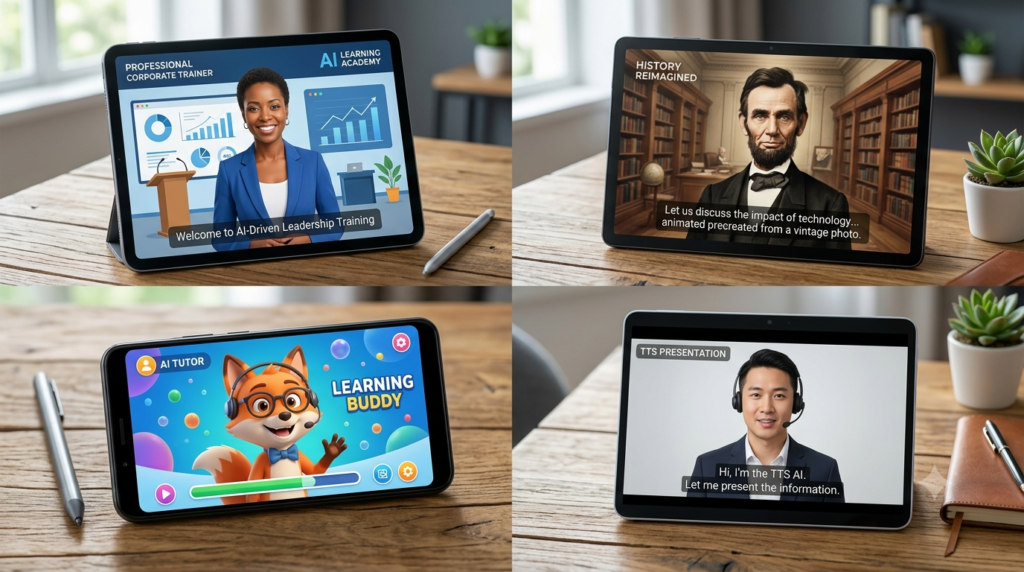
D-ID takes a different approach: it animates still photographs instead of relying on stock avatars. That makes it a budget-friendly pick if you want to bring a custom character, an illustration, or even a historical photo to life for a lesson — a fun trick for a history or literature class. Rendering can take longer for complex scenes, and gestures are more limited than full-body platforms, but the price makes it accessible for individual teachers. Its voice-cloning feature (from just a short audio clip) also means a teacher’s own voice can narrate lessons even on days they can’t record on camera.
Elai.io
Elai stands out for one particular trick: turning a URL or existing document straight into a video lesson, which is a genuine time-saver if you already have blog posts, PDFs, or lecture notes lying around. It also supports interactive quizzes baked right into the video, which helps keep learners engaged instead of just watching passively.
Vidnoz
Vidnoz is the more affordable entry point into full-body avatars with gesture and lip-sync support. Templates are built for common formats like tutorials and course modules, and a free tier lets you kick the tires before paying anything. Advanced editing controls are more limited than premium platforms, but for educators on a tight budget, it’s a reasonable middle ground.
Voki
Voki takes a lighter, more playful approach and was genuinely built with classrooms in mind. Teachers and students can create talking characters for projects, presentations, and interactive assignments. It’s not going to give you polished, professional-grade course production, but it’s still a classroom favorite for K-12 activities where engagement beats photorealism every time.
Reviews of AI Avatar Tools for Educational Content: Comparison Table
| Tool | Best For | Starting Price | Languages Supported | Standout Feature |
|---|---|---|---|---|
| Synthesia | Structured courses, compliance training | ~$30/month | 120+ | Polished stock avatars, strong compliance posture |
| HeyGen | Custom-avatar realism, SME-led training | Free tier; Creator $29/mo | 40+ | Best-in-class lip-sync naturalism |
| Colossyan | Corporate L&D, localized training | Custom/tiered plans | Dozens of dialects | Fast script-variation testing |
| D-ID | Budget custom characters, interactive modules | From ~$2.99/month | 65+ | Animates any photo into a talking avatar |
| Elai.io | Turning documents into video lessons | Tiered plans | Multiple | Generate video directly from a URL or document |
| Vidnoz | Budget full-body avatars | ~$13.50–30/month | Multiple | Free tier with daily minutes |
| Voki | K-12 classroom projects | Free/paid tiers | Multiple | Simple, student-friendly character builder |
This table should make it easier to shortlist which platforms are worth a free trial before you commit to an annual plan, based on the Reviews of AI Avatar Tools for Educational Content above.
Pros and Cons: Reviews of AI Avatar Tools for Educational Content
Pros:
Dramatically faster production compared to traditional filming
Lower long-term cost than hiring video crews or studio space
Simple text-edit workflow makes updating outdated lessons painless
Strong multilingual support opens content to global learners
Consistent delivery quality across an entire course catalog
Cons:
Avatars can still feel slightly robotic or uncanny if scripts are poorly written
Lacks the genuine warmth, spontaneity, and motivational connection of a real teacher
Enterprise-grade plans with custom avatars can be a significant upfront cost
Some platforms limit editing flexibility once a video is rendered
Learners with strong preferences for human instructors may disengage over time
Weighing these trade-offs honestly is really the whole game when reviewing any AI teaching avatar, since the “best” tool depends on your budget, audience, and comfort level with a virtual instructor doing the talking instead of you. That’s the honest takeaway from these Reviews of AI Avatar Tools for Educational Content.
How to Choose the Right Tool: Reviews of AI Avatar Tools for Educational Content Checklist
Before subscribing to any platform, run through this checklist:
Define your use case. A K-12 classroom project has very different needs than corporate compliance training, and the right platform for one may be the wrong choice for the other.
Test the free tier first. Almost every serious platform offers a limited free trial, so compare rendering quality, voice naturalness, and turnaround time before paying anything.
Check language coverage. If your learners are international, confirm the platform actually supports the specific dialects and accents you need, not just a generic language count on the pricing page.
Review compliance requirements. Schools and districts should confirm data-handling agreements, student privacy protections, and hosting locations are in place before uploading any real student data.
Budget for the full stack. Many educators pair an avatar platform with a script-writing assistant and a voice tool, so factor in the combined monthly cost rather than judging a single subscription in isolation.
Ask about export flexibility. Confirm you can download finished videos in a standard format so you are not locked into one hosting platform if you decide to switch providers later.
Following this process will help you avoid subscribing to the wrong tool — and it’s the same process we used to compile these Reviews of AI Avatar Tools for Educational Content.
FAQs: Reviews of AI Avatar Tools for Educational Content
Are AI avatar tools for educational content actually effective for student learning? Early classroom data suggests they can be effective when paired with well-written scripts and interactive elements like quizzes. They work best as a supplement to human instruction rather than a full replacement.
Which is the best free option among AI avatar tools for educational content? D-ID and Vidnoz both offer accessible free or low-cost tiers, making them good starting points for teachers who want to experiment before investing in a paid plan.
Do these platforms support multiple languages? Yes. Most leading platforms, including Synthesia and HeyGen, support well over one hundred languages, which is one of the biggest reasons schools and companies adopt them for global audiences.
Can I use my own face as the avatar? Several platforms, including HeyGen and D-ID, let you upload a photo or record a short clip to create a custom avatar modeled on a real person.
Are AI avatar videos suitable for young children? Some platforms, such as Voki, are designed specifically with classroom-friendly, less realistic characters that work well for younger learners, while more photorealistic tools may be better suited to older students and adult training.
How much do these tools typically cost? Pricing ranges widely, from free tiers and sub-$5 monthly plans to enterprise packages running several hundred dollars a month, depending on video volume and customization needs.
Will these tools keep improving, or is the quality already at its peak? Voice cloning, lip-sync accuracy, and gesture realism have all improved noticeably over the past two years, and most vendors are actively investing in faster rendering and more natural-sounding narration, so quality is likely to keep climbing rather than plateau — a trend every new round of Reviews of AI Avatar Tools for Educational Content will need to track.

Final Thoughts: Reviews of AI Avatar Tools for Educational Content
Choosing among the many AI avatar tools for educational content out there really comes down to matching the platform to your actual teaching context — there’s no single “winner” that works for everyone. Synthesia and HeyGen remain the strongest all-around picks for polished, professional lessons; Colossyan and Elai.io shine for interactive corporate training; and D-ID, Vidnoz, and Voki offer accessible entry points if you’re working with a tighter budget. No digital instructor can fully replace a caring human teacher, but used thoughtfully, these tools can save real time, extend your course content to a global audience, and keep lessons fresh without constant reshoots. Run a few free trials, compare the output against your own teaching style, and pick the one that lets you spend less time on production and more time on what actually matters — helping students learn. We hope these Reviews of AI Avatar Tools for Educational Content made that decision easier.
