
AI tools for business workflow analysis process mapping 2026 are changing how companies figure out where their processes actually break down. Instead of weeks of interviews and hand-drawn flowcharts, AI now pulls data straight from your systems and shows you exactly how work really flows — bottlenecks, redundant approvals, and all.
Most businesses don’t actually know how their own processes work in practice. Ask five people in the same department how a task gets handled and you’ll often get five slightly different answers. That gap between what leadership assumes is happening and what’s actually happening is exactly what this new generation of AI-driven tools is built to close.
This guide covers what these tools do, the top categories to know, a comparison table, a pros and cons breakdown, key features to look for, real-world use cases, common mistakes, future trends, and the FAQs people keep asking in 2026.
Organizations investing in AI tools for business workflow analysis process mapping 2026 are gaining better visibility into operations, reducing inefficiencies, and making data-driven decisions faster than ever before.
What Are AI Tools for Business Workflow Analysis and Process Mapping?
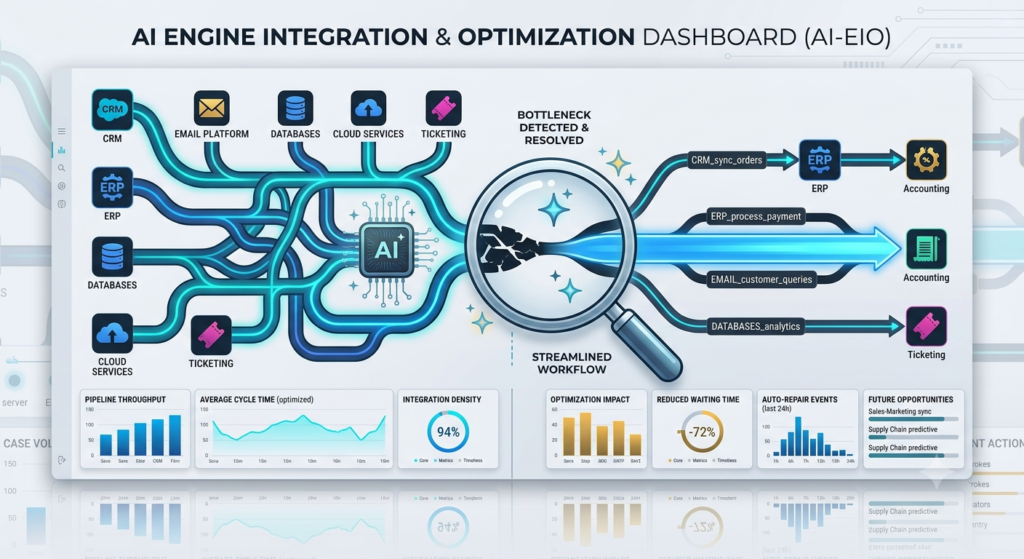
These tools combine process mining, task mining, and generative AI to detect how work actually moves through a company — not how it’s supposed to move on paper, but how it really happens day to day. The AI pulls data from system logs, emails, ticketing platforms, and collaboration tools to build a live, accurate picture of operations.
This matters because it surfaces things humans usually miss — duplicate approvals, manual steps someone’s kept “just in case” for years, and bottlenecks everyone complains about but nobody’s actually measured. With business process automation moving fast this year, workflow visualization software has gone from nice-to-have to near-essential. Before choosing among different AI tools for business workflow analysis process mapping 2026, businesses should evaluate workflow complexity, integration requirements, and long-term automation goals. Gartner defines process mining as a technique for discovering, monitoring, and improving real processes by extracting knowledge directly from system event logs — which is essentially the engine behind most tools in this category.
Traditional process mapping relied on interviews, whiteboards, and a fair amount of guesswork, which meant documentation was often outdated the moment it was finished. AI-driven mapping instead stays current automatically, updating as systems and behaviors change, which is a big part of why adoption has picked up so quickly this year.
Why Businesses Are Investing in Process Mapping AI in 2026
The growing demand for AI tools for business workflow analysis process mapping 2026 is largely driven by the need for automation readiness, compliance tracking, and operational efficiency.
- Remote and hybrid work has made processes harder to see, so leaders need automated documentation instead of tribal knowledge.
- AI-driven automation projects need clean, mapped processes before RPA or agentic AI can be deployed safely.
- Compliance and audit pressure, especially in finance and healthcare, demands accurate, timestamped process records.
- Cost-cutting pressure is pushing teams to find inefficiencies fast instead of waiting on a traditional audit.
- Operational excellence programs increasingly want data behind decisions instead of gut feeling.
Each of these pressures alone would be enough to justify looking into workflow analysis software, but together they’re pushing adoption forward faster than most vendors expected even a year ago. Business leaders who once treated process documentation as a once-a-year compliance exercise are now expecting it to be continuous, automatic, and always up to date.
Best AI Tools for Business Workflow Analysis Process Mapping 2026 by Category
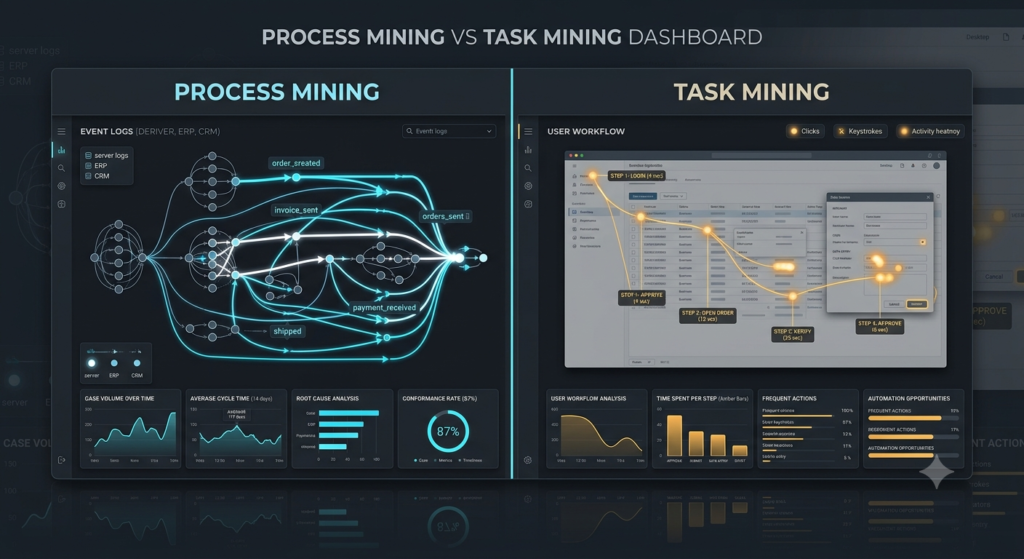
Process Mining Platforms connect to your ERP, CRM, or ticketing system and reconstruct the real sequence of events — great for exposing bottlenecks in finance, procurement, and support. Because the data comes straight from system logs, the resulting maps are hard to argue with, which is exactly why compliance teams favor this category.
Task Mining Software observes desktop-level activity (clicks, keystrokes, app-switching) to reveal which repetitive manual tasks are eating up employee time. This is the category to look at if you suspect your team is doing a lot of copy-paste, manual data entry, or switching between systems that don’t talk to each other.
AI Diagramming Tools turn natural language input into flowcharts, swimlanes, or BPMN diagrams automatically — faster to set up, though less precise than raw data mining. These work well for teams that just need clear, shareable documentation without a heavy technical integration project.
Workflow Automation Suites combine analysis with execution, so once a process is mapped, the same tool can trigger approvals or automated actions. This closes the loop between spotting a problem and actually fixing it, rather than leaving insights sitting in a report nobody acts on.
Agentic AI Process Assistants go further still — simulating “what if” scenarios and predicting the impact of a change before you actually make it. This is the newest and most experimental category, but it’s the one generating the most interest from larger organizations this year.
Comparison Table: Tool Categories at a Glance
| Tool Category | Best For | Data Source | Setup Effort | Cost Range |
|---|---|---|---|---|
| Process Mining | Compliance & bottleneck detection | ERP/CRM logs | Moderate–High | Mid–Enterprise |
| Task Mining | Manual, repetitive work | Desktop activity | Moderate | Mid-range |
| AI Diagramming | Fast documentation | Natural language input | Low | Low–Mid |
| Automation Suites | Analysis + execution | Integrated systems | High | Mid–Enterprise |
| Agentic Assistants | Predictive decision-making | Combined data + AI modeling | High | Enterprise |
When comparing AI tools for business workflow analysis process mapping 2026, businesses should focus not only on features and pricing but also on scalability, integration capabilities, and long-term process improvement potential.
There’s no single “best” tool here — it depends on whether you prioritize accuracy, speed of setup, or built-in automation.
Pros and Cons of Each Category
Process Mining Platforms
- Pros: Highly accurate, real system data, strong for audits.
- Cons: Needs clean data integration; can get pricey for smaller teams.
Task Mining Software
- Pros: Reveals manual work worth automating.
- Cons: Raises privacy concerns; needs clear employee communication.
AI Diagramming Tools
- Pros: Fast, intuitive, low setup effort.
- Cons: Only as accurate as the input; not a substitute for real data.
Workflow Automation Suites
- Pros: Insights turn directly into action.
- Cons: Complex to configure; steep learning curve.
Agentic AI Process Assistants
- Pros: Predicts outcomes before you commit to a change.
- Cons: Still maturing — treat suggestions as a starting point, not gospel.
Key Features to Look For
Leading AI tools for business workflow analysis process mapping 2026 offer advanced analytics, real-time monitoring, and AI-powered recommendations for process improvement.
- Integration depth with your existing ERP, CRM, or helpdesk systems
- Real-time visualization, not static diagrams that go stale
- Machine-learning-driven bottleneck and root-cause detection
- Compliance and audit-ready reporting
- Scalability across departments, not just a single pilot team
- Strong data security and privacy controls
- Easy collaboration for both technical and non-technical teams
These same criteria overlap with what people search for under business process management (BPM) and digital process automation — worth keeping in mind as related terms when researching vendors.
How to Choose the Right Tool
If compliance is your priority, go with process mining. If manual, repetitive work is the real pain point, task mining gives better insight. Just starting out with documentation? A simple AI diagramming tool is a reasonable first step. Either way, pilot on one department first to validate accuracy, measure actual time savings, and build internal buy-in before scaling company-wide. When evaluating AI tools for business workflow analysis process mapping 2026, focus on integration, scalability, and reporting features.Investing in the right AI tools for business workflow analysis process mapping 2026 can significantly improve process visibility, reduce operational costs, and accelerate digital transformation initiatives.
Industry Use Cases
Many enterprises are adopting AI tools for business workflow analysis process mapping 2026 to improve customer service, supply chain operations, finance workflows, and employee onboarding.
Finance and banking: Tracking loan approval timelines and catching compliance deviations before month-end close.
Healthcare and insurance: Mapping claims processing and prior-authorization workflows to cut delays and admin overhead, since so much of that work still runs through manual data entry across disconnected systems.
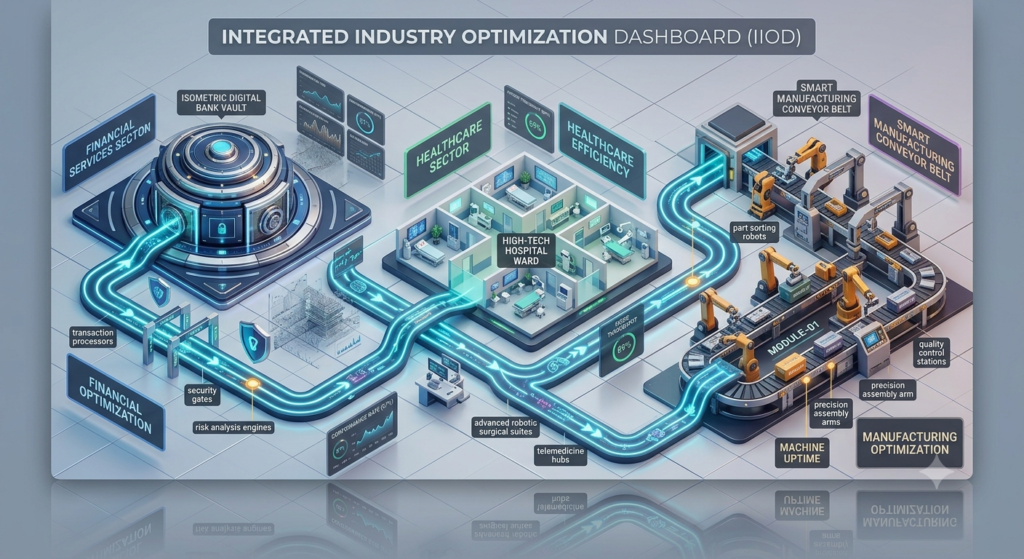
Manufacturing and supply chain: Spotting supplier delays and quality-control handoffs slowing down production.
Customer service: Analyzing ticket routing and escalation paths to shorten resolution times and reduce repeat contacts.
Human resources: Mapping onboarding and approval chains to reduce admin load and improve the new-hire experience.
Benefits of Adopting AI-Powered Process Mapping
One of the biggest advantages of AI tools for business workflow analysis process mapping 2026 is their ability to uncover hidden inefficiencies that traditional process reviews often miss.
- Faster bottleneck detection — days instead of weeks
- Lower operational costs from cutting redundant steps
- Better compliance posture with logged, reviewable processes
- Smarter automation investments based on real time-usage data
- More cross-department transparency, which cuts down on finger-pointing when something goes wrong
- Stronger, data-backed change management
The Role of Generative and Agentic AI
Generative AI can now summarize a complex process map in plain language, making it accessible to non-technical stakeholders. Agentic AI systems go further, simulating scenarios like “what if we removed this approval step” before anyone touches the real process — lowering risk and improving decision quality, especially in larger organizations where one change can ripple across departments.
This predictive layer matters more than it might sound at first. In a large organization, a single process change — removing a sign-off step, reassigning a task, or automating a handoff — can affect several departments at once in ways that aren’t always obvious upfront. Being able to model that impact before rolling it out, rather than finding out the hard way, is a meaningful shift from how process improvement projects used to work.
Common Mistakes to Avoid
- Skipping data cleanup before integration, which leads to inaccurate maps and bad conclusions
- Ignoring change management, leading to employee resistance toward new documentation or automation
- Choosing tools based on hype instead of actual workflow complexity
- Treating mapping as the finish line instead of pairing it with real action
- Overlooking privacy policies before rolling out task mining across teams
Avoiding these mistakes is often what separates a rollout that actually sticks from one that quietly gets abandoned a few months in.
Future Trends to Watch
The future of AI tools for business workflow analysis process mapping 2026 will include deeper agentic AI integration, predictive simulations, and automated process optimization.

- Deeper agentic AI integration with human oversight
- Cross-company process benchmarking using anonymized data
- Natural language process queries (“where are we losing time in onboarding?”)
- Tighter ties to sustainability and resource-waste reporting
- Greater explainability for auditors and regulators
As these tools mature, the businesses that already have solid process mapping habits in place will be the ones best positioned to take advantage of the more advanced, predictive capabilities coming next. Waiting until the technology is “perfect” often just means starting from further behind. The next generation of AI tools for business workflow analysis process mapping 2026 will rely heavily on agentic AI and predictive analytics.
Frequently Asked Questions
1. What’s the difference between process mining and process mapping? Process mining reconstructs how a process actually happens using real system data; process mapping is the visual diagram of it, built manually or generated automatically. The two are closely related, but mining is about the data and mapping is about the picture it produces.
2. Are these tools suitable for small businesses? Yes — lighter AI diagramming and automation tools are priced and scaled for small and mid-sized teams, not just enterprises. Many smaller businesses start with a simple diagramming tool before ever considering full process mining. Many AI tools for business workflow analysis process mapping 2026 are now affordable for small businesses.
3. Do these tools replace human process analysts? No. They cut down manual documentation work significantly, but humans still need to interpret findings, weigh trade-offs, and decide what to actually change.
4. How soon do results show up? Most businesses see initial bottleneck insights within a few weeks of integration; full-scale optimization and measurable ROI usually take a few months to fully play out.
5. Is employee data safe with task mining software? Reputable vendors anonymize or aggregate data and offer configurable privacy settings — it’s still worth reviewing each vendor’s data handling policy carefully before deploying anything company-wide.
6. Can these tools integrate with existing RPA systems? Most modern platforms are built to integrate with popular RPA ecosystems, so a mapped process can be handed off directly for automation without starting from scratch.
Conclusion
As adoption accelerates, AI tools for business workflow analysis process mapping 2026 are becoming a strategic necessity rather than an optional technology investment.
The growing interest in AI tools for business workflow analysis process mapping 2026 comes down to one thing: businesses are tired of guessing how their own operations actually work. Whether through process mining, task mining, AI diagramming, or agentic assistants, companies now have practical ways to see what’s really happening and fix it. The right tool depends on your priorities — compliance, automation-readiness, or simple documentation — but process intelligence is quickly becoming a core part of how businesses operate, not an optional side project.
Getting started doesn’t have to mean a massive, company-wide overhaul on day one. Picking one process, one department, or one recurring bottleneck to map first is usually enough to prove the value and build momentum for the next stage. The companies that treat this as an ongoing habit rather than a one-time project are the ones most likely to see real, lasting gains from it. Businesses that start using AI tools for business workflow analysis process mapping 2026 today will be better prepared for the next wave of intelligent automation and digital transformation.
