Staring at a blank page while a melody loops in your head is one of the oldest frustrations in music. You know how the chorus should feel, but the words won’t come. This is exactly the gap that modern AI lyric generators are built to fill. Over the past two years, a new generation of tools has moved far beyond gimmicky rhyme bots — they now understand mood, genre, syllable stress, and song structure well enough to act as genuine co-writers.
If you’ve been searching for the top AI platforms for song lyrics, you’ve probably noticed the market is crowded and confusing. Some tools are music-native apps that sing your lyrics back to you. Others are general-purpose writing assistants that happen to be excellent at rhyme and meter. A few are lightweight novelty generators built for a quick laugh on social media. This guide breaks all of that down in plain language, so you can pick the right tool for your actual workflow instead of just the loudest marketing page.
Why Songwriters Are Turning to AI Lyric Generators
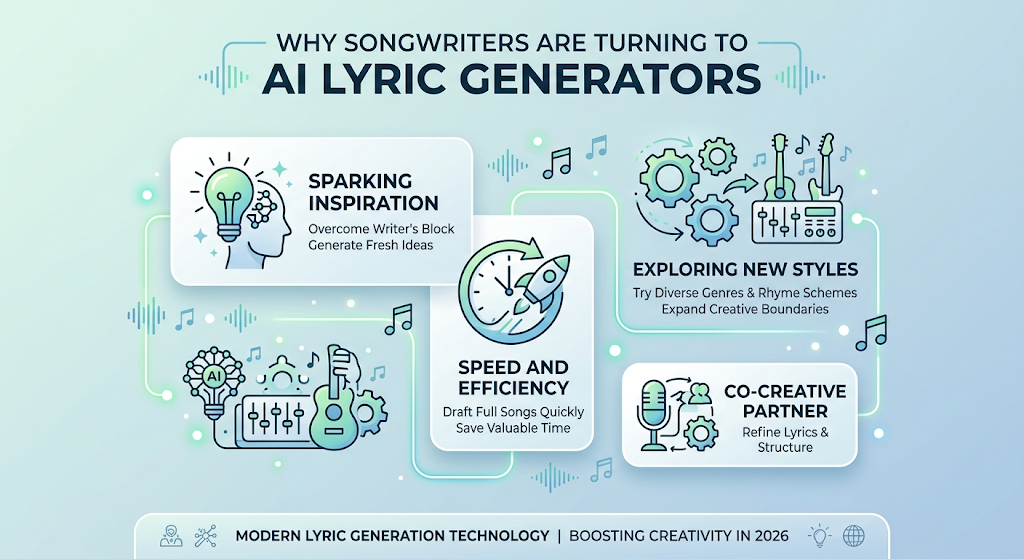
Songwriting has always blended inspiration, craft, and stubborn persistence. Writer’s block doesn’t care how talented you are — it hits beginners and Grammy winners alike. An AI lyric generator doesn’t replace your voice or your lived experience, but it does something valuable: it compresses the blank-page phase. Instead of staring at an empty document, you get a draft verse, a handful of rhyme options, or a fresh angle on your theme in seconds, and then you edit like a songwriter rather than starting from nothing.
This is also why the category has grown so fast. Independent artists without a co-writer, content creators who need a jingle by Friday, and even professional songwriters looking to break a creative rut are all using these platforms daily. Whether you call it an AI songwriting assistant, a lyric writing AI, or simply a rhyme generator, the underlying appeal is the same: speed without giving up creative control.
What Makes a Platform Genuinely Useful for Lyrics
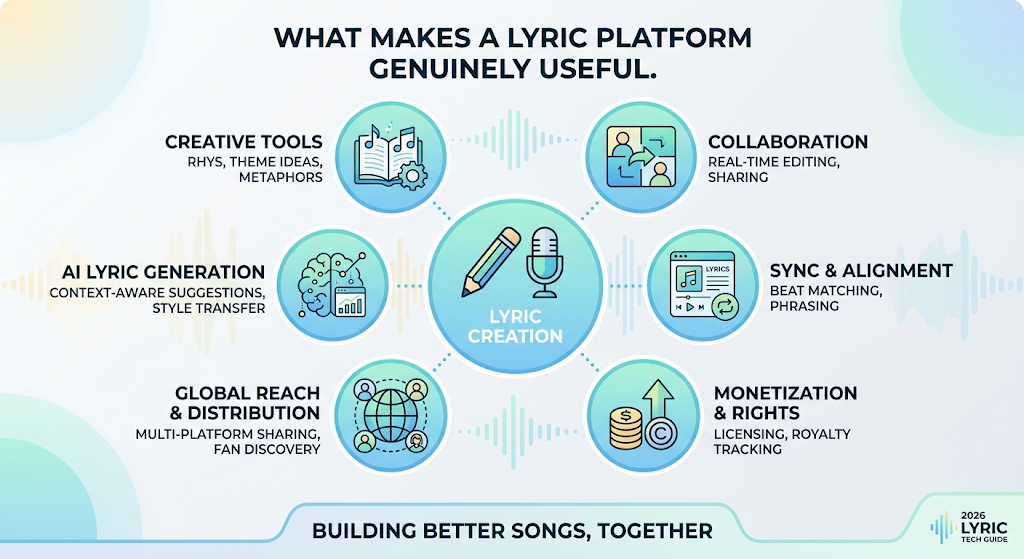
Before ranking anything, it helps to know what separates a serious songwriting tool from a shallow one. Look for:
- Structural awareness — does it understand verse, pre-chorus, chorus, and bridge, or does it just spit out generic rhyming lines?
- Rhyme scheme and syllable control — can you lock a rhyme pattern (ABAB, AABB) and a syllable count that fits your melody?
- Genre and tone flexibility — does it adapt to pop, hip-hop, country, or cinematic ballads, or does everything sound the same?
- Editability — can you rewrite line by line and ask for alternatives, or is it a one-shot generator with no conversation?
- Audio feedback — some platforms let you hear the lyrics sung immediately, which reveals rhythm and stress in a way plain text never can.
- Rights and licensing clarity — always check the terms before monetizing anything an AI helped you write.
With those criteria in mind, here’s how the leading names in the space actually stack up.
The Leading Top AI Platforms for Song Lyrics, Compared
1. Suno
Suno has become one of the best-known names in AI music because it doesn’t stop at lyrics — it merges lyric drafting with full arrangement and vocal synthesis. Its lyric tooling pays attention to singability, counting syllables and shaping phrasing the way a musician would, which is something pure text models tend to ignore. You give it a prompt or a rough lyric idea, and it hands back a complete demo track with vocals.
Pros:
- Produces a finished, listenable song from a single prompt
- Strong attention to syllable stress and melodic phrasing
- Great for quickly testing how a lyric idea actually sounds sung
- Frequent model updates improving vocal naturalness
Cons:
- Best treated as a demo singer, not final publisher-ready copy
- You’ll still need to export and rewrite lines after the first render
- Less useful if you only want text, not audio
2. Udio
Udio is Suno’s closest rival and takes a similarly generation-first approach, pairing lyrics with instrumentation and vocals in one workflow. Many teams prefer its feel on certain genres, so it’s worth A/B testing both platforms before committing to one for a release.
Pros:
- Fast, flexible text-to-track generation
- Good for creative exploration and rapid concept testing
- Useful for building quick demos to pitch collaborators
Cons:
- Precise line-level edits and melody adjustments are limited
- Output quality can vary noticeably between similar prompts
- Not ideal for polished, performance-ready final masters
3. ChatGPT (as a Lyric Co-Writer)
A general AI assistant like ChatGPT remains one of the most versatile and controllable options in this whole category. Because it’s conversational, you can specify theme, rhyme scheme, syllable feel, tone, and even words to avoid, then iterate line by line or ask for ten alternate versions of a single hook.
Pros:
- Extremely steerable — you direct every detail of the prompt
- Can critique and refine your own original draft, not just generate from scratch
- No music-specific subscription required
- Works well for any genre or language
Cons:
- No native audio playback or melody awareness
- Requires more detailed prompting to get music-ready output
- Won’t automatically lock syllables to a BPM unless you specify counts
4. LyricStudio
LyricStudio is a dedicated songwriting assistant built specifically for musicians, not general content writers. Rather than generating a full song in one step, it works more like an interactive co-writer — as you type each line, it offers several ways to continue that respect your existing rhyme, tone, and structure.
Pros:
- Purpose-built for songwriting, not generic copywriting
- Line-by-line collaboration feels closer to working with a human co-writer
- Strong rhyme-scheme and structure controls
Cons:
- Narrower feature set outside of lyric writing
- Less useful if you also want an instrumental or vocal demo
- Learning curve for songwriters used to freeform prompting
5. LyricLab
LyricLab positions itself as a musician-first suite rather than a text shuffler, combining lyrics, chord suggestions, and instant audio so you can hear your song idea almost immediately. It’s aimed squarely at the “blank page paralysis” moment every songwriter knows.
Pros:
- Combines lyrics with chords and quick audio playback
- Genuinely built with musicians’ workflow in mind
- Helpful for turning a vague melody idea into a structured draft
Cons:
- Smaller user base and fewer third-party integrations than Suno or Udio
- Audio quality is a guide, not a finished production
6. Freshbots
Freshbots has carved out a niche as a free, structured, genre-aware lyric generator. It’s a solid entry point if you want decent structural output without committing to a paid plan right away.
Pros:
- Free tier with genuinely usable structure and genre coverage
- Good starting point for beginners
- Low barrier to entry
Cons:
- Less depth and customization than premium, dedicated tools
- Fewer advanced controls for rhyme scheme and syllable precision
7. Rytr
Rytr is a broader AI writing platform with a lyric-focused template. Its main strength for songwriters is multilingual output, making it a reasonable pick if you’re writing in a language other than English.
Pros:
- Strong multilingual support
- Affordable pricing tiers
- Simple, beginner-friendly interface
Cons:
- Lyric writing is one feature among many, not the core focus
- Limited song-structure awareness compared to dedicated songwriting tools
8. AISEO
AISEO is primarily an SEO content platform that happens to include a song-lyrics template built around a keyword or theme. It’s genuinely useful in a very specific scenario: turning a keyword into lyric-style text fast, inside a broader content pipeline.
Pros:
- Extremely fast keyword-to-lyrics workflow
- Fits neatly into an existing content or marketing pipeline
Cons:
- No real song-structure awareness or rhyme-scheme control
- No way to hear the result
- Not built for serious songwriters chasing a polished, singable lyric
9. These Lyrics Do Not Exist
This is the original one-click novelty generator. Pick a topic, hit generate, and share whatever comes out. It’s fun, fast, and almost instant.
Pros:
- Near-zero latency
- Genuinely entertaining for quick, throwaway content
Cons:
- Quality is uneven and unpredictable
- Not suited for anything beyond casual, low-stakes use
10. MuseGen
MuseGen pairs a free built-in lyric generator with full song production, making it a reasonable all-in-one pick if you want to write and produce in the same place. Stem and MIDI export are on the roadmap rather than fully available yet.
Pros:
- One platform for both lyric writing and song production
- Free tier for the core lyric generator
Cons:
- Some advanced export features are still coming, not yet live
- Newer platform with a smaller track record than Suno or Udio
Comparison Table: Top AI Platforms for Song Lyrics
| Platform | Best For | Audio Output | Rhyme/Structure Control | Free Tier | Price (Paid Plans) |
| Suno | Full song demos with vocals | Yes | Moderate | Yes (limited) | From ~$10/month |
| Udio | Rapid concept testing | Yes | Moderate | Yes (limited) | From ~$10/month |
| ChatGPT | Controllable, conversational co-writing | No | High (with prompting) | Yes (limited) | From ~$20/month |
| LyricStudio | Dedicated interactive songwriting | No | High | Limited | Paid plans available |
| LyricLab | Musicians wanting lyrics + chords | Yes (basic) | High | Limited | Paid plans available |
| Freshbots | Free structured drafts | No | Moderate | Yes | Free / low-cost |
| Rytr | Multilingual lyric drafts | No | Low-Moderate | Yes (limited) | Affordable tiers |
| AISEO | Keyword-to-lyric content workflows | No | Low | Limited | Subscription-based |
| These Lyrics Do Not Exist | Instant novelty songs | No | Low | Yes | Free |
| MuseGen | All-in-one writing and production | Yes | Moderate | Yes | Paid upgrades available |
Pricing and features change frequently across this fast-moving category, so always confirm current plans directly on each platform before subscribing.
How to Choose the Right Tool for Your Workflow
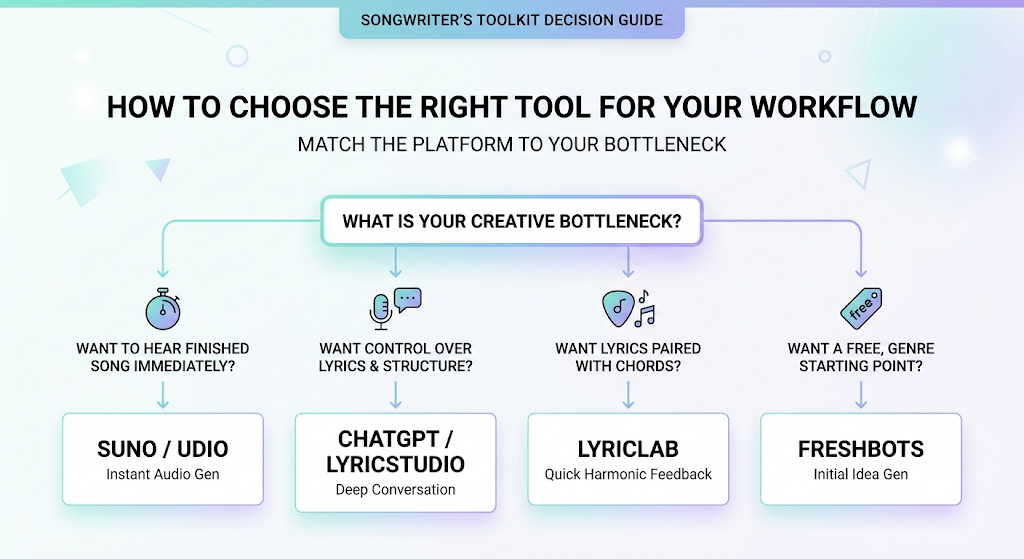
Not every songwriter needs the same thing, so match the platform to your actual bottleneck rather than chasing whichever tool is trending:
- Want to hear a finished song immediately? Choose Suno or Udio.
- Want fine-grained control over rhyme, tone, and structure through conversation? Choose ChatGPT or LyricStudio.
- Want lyrics paired with chords and quick audio feedback? Choose LyricLab.
- Want a free, genre-aware starting point? Choose Freshbots.
- Writing in multiple languages? Choose Rytr.
- Want lyric writing and production in one place? Choose MuseGen.
A practical hybrid approach works well for most people: start broad with brainstorming to nail down theme, mood, and genre, then move your favorite ideas into a dedicated songwriting assistant to shape rhyme scheme, syllable count, and prosody, and finally, if you want to hear it sung, run the polished draft through a music-native platform like Suno or Udio.
Prompting Tips to Get Better Results From Any AI Lyrics Tool
The gap between a mediocre AI-generated verse and a genuinely usable one almost always comes down to the prompt, not the platform. Whether you’re using a general AI writing assistant or a dedicated AI music lyrics generator, a few habits consistently produce sharper output.
Be specific about structure, not just theme. Instead of asking for “a sad song,” specify a full verse-chorus-bridge structure, a target line count per section, and where you want the emotional turn to land. Vague prompts produce vague lyrics; detailed prompts produce something you can actually build on.
Lock your rhyme scheme up front. Tell the tool exactly which pattern you want — ABAB, AABB, or a looser near-rhyme scheme — rather than letting it default to whatever feels natural. Most modern songwriting assistants will follow an explicit rhyme scheme far more reliably than an implied one.
Give it a syllable target tied to your melody. If you already have a melody in your head, count the syllables per line yourself and hand that number to the AI. This single step is what separates lyrics that actually fit a tune from lyrics that merely read well on the page.
Ask for options, not a final answer. Treat any AI lyric generator as a brainstorming partner rather than an oracle. Request five or ten variations of a single hook line and pick the strongest elements from each, the same way you might work with a human co-writer.
Feed it real details, not generic imagery. Generic prompts return generic lyrics — clichés about broken hearts and city lights. Specific, personal details (a place, an object, a real memory) push even a general-purpose AI writing tool toward lines that feel lived-in rather than templated.
Always run a final human editing pass. No matter how strong the raw output is, the difference between an AI draft and a finished lyric is almost always the editing pass where you inject your own phrasing, timing, and emotional truth. This is also the step that protects your claim to originality if ownership or copyright ever becomes a question.
Used this way, these platforms stop feeling like a shortcut around songwriting and start feeling like what they actually are: a fast, flexible collaborator that clears the blank page so your own creative instincts can take over.
A Note on Copyright and Originality
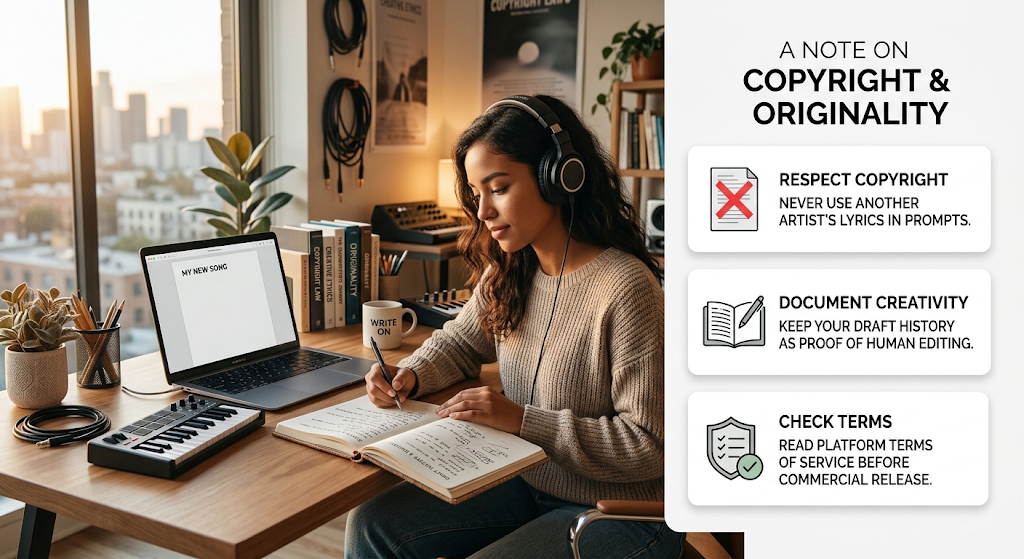
Whichever tool you use, a few ground rules protect you legally and creatively. Never paste another artist’s copyrighted lyrics into a prompt hoping for a “similar” result. Keep your draft history so you can show meaningful human editing if ownership is ever questioned. And always read each platform’s terms of service before releasing or monetizing AI-assisted lyrics commercially, since licensing language differs significantly between platforms and can change without much notice.
Frequently Asked Questions
Are AI-generated lyrics good enough to release commercially? They can be a strong starting point, but most professionals treat AI output as a first draft. The best results come from using these tools to break writer’s block and generate options, then rewriting and personalizing the lines so the final lyric carries your own voice and lived experience.
Which platform is best for a complete beginner? Freshbots or ChatGPT are the easiest entry points. Freshbots offers a genuinely usable free tier with structure built in, while ChatGPT lets you simply describe what you want in plain language and refine it through conversation.
Do I own the copyright to lyrics an AI helps me write? This depends heavily on the specific platform’s terms of service and on how much original human creativity you add during editing. Always check each tool’s current licensing terms, since policies in this space are still evolving and vary by provider.
Can AI lyric generators match a specific melody or BPM? Text-only models like ChatGPT need explicit syllable-count instructions to match a melody closely. Music-native platforms such as Suno and Udio are generally better at this because they generate lyrics and melody together rather than as separate steps.
Is it worth paying for a premium AI lyrics platform? If you write regularly or work on commercial projects, a paid plan usually unlocks more generation credits, better output consistency, and more advanced rhyme or structure controls. Casual or occasional users can often get solid results from free tiers alone.
What’s the difference between an AI lyric generator and a general AI writing assistant? A dedicated AI lyric generator, such as LyricStudio or LyricLab, is built around song structure, rhyme scheme, and syllable stress from the ground up. A general assistant like ChatGPT can do all of this too, but it requires you to specify those musical details yourself rather than applying them automatically.
Conclusion
There is no single “best” answer when it comes to the top AI platforms for song lyrics — the right choice depends entirely on what you’re trying to create. If you want a full, listenable demo in minutes, Suno and Udio lead the pack. If you want a controllable, conversational co-writer that respects your rhyme scheme and tone, ChatGPT and LyricStudio are hard to beat. And if you’re chasing a musician-first workflow that blends chords, lyrics, and quick audio feedback, LyricLab deserves a serious look.
What all of these platforms share is a simple promise: they get you past the blank page faster. They won’t hand you a finished hit, and they can’t replace genuine emotional specificity or your personal story — that part is still, and always will be, on you. Used well, though, these tools turn a frustrating creative block into a fast, flexible starting point, letting you spend more time refining a great lyric and less time staring at an empty screen.
