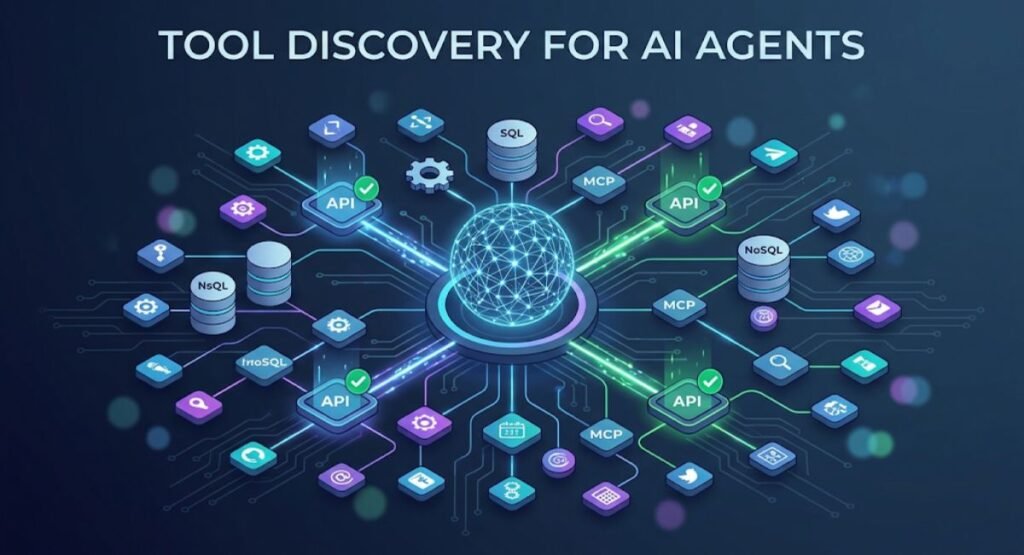
Ask any engineer who has built an agent with more than a handful of integrations, and you will hear the same story. The demo works beautifully with five tools. Then the team connects a CRM, a ticketing system, a calendar, two databases and a dozen internal APIs, and suddenly the agent starts picking the wrong function, inventing arguments, or slowing to a crawl. The model did not get dumber overnight. The real culprit is usually weak tool discovery for AI agents.
This guide explains tool discovery for AI agents in plain language. You will learn what it actually means, how it works under the hood, which approaches teams use in 2026, where each one breaks, and how to make your own tools easier to find and select. Whether you build agents, publish an API, or run an AI platform team, the goal is the same: help the right tool reach the right agent at the right moment.If you want to explore practical AI solutions for improving your workflow, read our guide to AI Tools for Content Refinement to learn more about AI-powered content improvement tools.
What Is Tool Discovery for AI Agents?
Tool discovery for AI agents is the process by which an autonomous system finds out which tools exist, understands what each one does, and decides which one fits the task in front of it. A “tool” can be a function exposed through function calling, an API endpoint, a plugin, a skill, or a server that follows the Model Context Protocol (MCP).
Think of the difference between a toolbox and a hardware store. In a toolbox, you see every tool at a glance. In a hardware store with thousands of aisles, you need signs, a directory, and maybe a helpful assistant. Early agents lived in toolboxes. Modern agents live in hardware stores.
Discovery has three parts that work together:
- Awareness: the agent learns that a tool exists, either because it was preloaded or because it was found through a registry or search.
- Understanding: the agent reads the name, description and input schema and builds a picture of what the tool does and when to use it.
- Selection: the agent compares candidates, picks one and fills in the parameters.
If any of these steps fails, the tool is effectively invisible, no matter how good the underlying service is. That is why tool discovery for AI agents has become a real product and engineering discipline rather than a footnote in the documentation.

Why Tool Discovery for AI Agents Matters More in 2026
A couple of years ago, most agents received a short, hand-picked list of functions. That approach does not scale, and a few shifts explain why discovery is now a central concern.
The number of available tools exploded. The official MCP Registry is reported to list close to two thousand servers in 2026, and community directories such as Smithery and Glama add more, with extra search and review layers on top. Enterprises are building private catalogs too. Kong, for example, introduced an MCP Registry inside its Konnect platform in early 2026, positioned as a central system of record where agents can find approved internal and external tools without hardcoded configuration.
Context windows are not free. Every tool definition consumes tokens. Load hundreds of them and you leave less room for the user’s actual request, slow down responses, and make reasoning harder. Some model providers also cap how many functions you can pass in a single call, with a figure around 128 commonly cited in developer discussions.
Agents now act, not just answer. When an agent only chats, picking the wrong source is an annoyance. When it sends emails, updates records or moves money, picking the wrong tool is a real incident. Discovery and governance have to go together.
Visibility became a growth channel. If you publish an API or an MCP server, agents are your new users. A tool that agents cannot find or confidently choose never gets called, which makes discovery the top of the funnel for agent-facing products, much like search rankings are for websites.
How Tool Discovery Works Under the Hood
There is no single standard recipe. Teams combine four building blocks, and most serious systems use more than one.
1. Static tool lists
The simplest method is a fixed list of tools sent with every request. It is easy to build and easy to debug. It is also the first approach to fail as your tool count grows, because every definition is paid for in tokens on every turn.
2. Registries and catalogs
A registry is a directory where providers publish metadata: names, descriptions, schemas, authentication requirements and endpoints. Writers covering the MCP ecosystem often compare it to npm for agent tools. A public registry helps developers find servers worth installing. A private enterprise registry helps agents and engineers find only the tools security has already approved. The registry becomes a yellow-pages layer between many agents and many tool providers.
3. Search-based (just-in-time) discovery
In this style of tool discovery for AI agents, nothing is preloaded by default. Instead, the agent gets a small search capability. It describes what it needs in natural language, the system searches an index of tool names and descriptions, and only the best matches enter the context. Search can be keyword-based (BM25 is popular), regex-based, or embedding-based using vector retrieval. Some platforms expose this as a pair of meta tools: one to search and one to execute what was found.
Anthropic’s Tool Search follows this just-in-time idea, and other agent frameworks offer similar progressive disclosure modes that switch on once tool definitions take up a set share of the context window.
4. File-based dynamic context discovery
Coding agents added another pattern. Cursor has described what it calls dynamic context discovery: instead of stuffing everything into the prompt, it keeps tool descriptions and long outputs in files and lets the agent pull in what it needs with search utilities, the way a developer explores a codebase.
None of these is universally better. They trade off simplicity, speed, accuracy and cost, which is exactly what the next section compares.
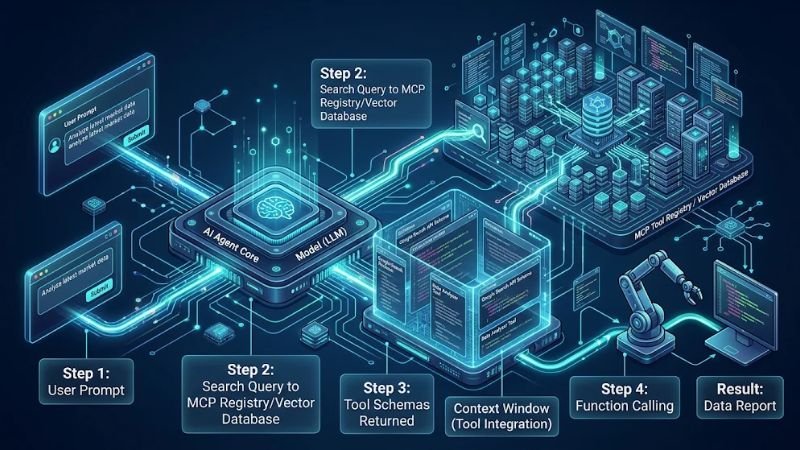
Tool Discovery for AI Agents: Approaches Compared
The table summarizes how the main methods stack up. Treat it as a decision aid rather than a ranking, because the right choice depends on how many tools you have and how critical accuracy is.
| Approach | Best for | Context cost | Scalability | Accuracy risk | Setup effort |
|---|---|---|---|---|---|
| Static tool list | Prototypes, under about 10 tools | High, paid every turn | Poor | Low at small scale, rises fast | Very low |
| Public MCP registry | Finding servers to install | None at runtime | Good for human discovery | Depends on server quality | Low |
| Private enterprise registry | Governed company-wide catalogs | Low | Very good | Lower, because tools are vetted | Medium to high |
| Keyword search (BM25 or regex) | Large catalogs with clear naming | Low | Good | Misses when names are vague | Medium |
| Semantic or vector search | Large catalogs with varied wording | Low | Very good | Can surface near-duplicates | Medium to high |
| File-based dynamic discovery | Coding and developer agents | Low | Good | Needs a capable agent | Medium |
| Hybrid (registry, search, core set) | Production enterprise agents | Low to medium | Excellent | Lowest when tuned | High |
A pattern that keeps showing up: preload a small core of frequently used tools and push the long tail behind search. Common tasks stay fast, and rare tasks stay possible.
Pros and Cons of Dynamic Tool Discovery for AI Agents
Dynamic discovery is not magic. It solves some problems and creates others, so look at both sides honestly.
Pros
- Smaller prompts. Only relevant definitions enter the context window. Vendors who ship tool-search features report large context savings for tool-heavy agents, though numbers vary by setup, so measure your own.
- Faster, cheaper responses. Fewer tokens mean lower cost and less latency from processing big schemas.
- Scales past hard limits. You can expose thousands of capabilities without hitting provider caps on function counts.
- No hardcoding. New tools become available without redeploying the agent, which helps multi-tenant products where each customer has different integrations.
- Governance friendly. A central registry can enforce ownership, approval status and policy, so agents only discover what they are allowed to use.
Cons
- Extra round trips. A “cold” tool often needs a search step, a describe step and then the call, which adds latency.
- Retrieval becomes the bottleneck. If search fails to surface the right tool, the model never gets to choose it. A widely discussed community test of Tool Search against a very large catalog found that some common actions, such as sending an email or posting a message, were often missed in the top results while other categories were found reliably. Retrieval quality, not model reasoning, can limit large-scale agents.
- Dependence on description quality. Search only matches the words you provide. Vague descriptions lose.
- Smaller models may struggle. Weaker models tend to write poorer search queries, which hurts recall.
- Overkill for tiny setups. With fewer than about ten constantly used tools, a static list is simpler.
Why Agents Pick the Wrong Tool
Before you can fix tool discovery for AI agents, you need to know how it fails. These patterns come up most often.
Overlapping descriptions. Two tools like search_customer_records and query_user_database with near-identical descriptions leave the agent no reliable way to choose. It guesses, and guesses are inconsistent.
Names that say nothing. A tool called process or handle_request gives people and search indexes almost nothing to work with. The name is usually the strongest signal in any index.
Descriptions written for engineers, not models. Internal jargon and implementation details do not help a model decide whether a tool matches a goal. Describe the outcome, not the plumbing.
Missing boundaries. The best descriptions say what a tool does and what it does not do. Without that, agents stretch tools beyond their purpose.
Messy schemas. Unclear parameter names, missing defaults and vague validation rules cause repeated failed calls, and orchestrators learn to avoid tools that keep erroring.
Trust gaps. Humans decide which tools an agent may use. If a tool asks for broader permissions than its job justifies, reviewers will block it before the agent ever sees it.
How to Improve Tool Discovery for AI Agents (For Tool Builders)
If you publish an API, an MCP server or a plugin, these habits make it easier for agents to find and use. Think of it as SEO for agents: be clear, specific and honest.
Write names like a search query
Use verb-plus-object naming that mirrors how a user phrases the task: create_invoice, list_open_tickets, send_email_message. Avoid vague verbs and internal codenames.
Lead with the outcome
Put the most important information in the first sentence: what the tool accomplishes, when to use it, and when not to. If a description gets truncated, the beginning is what survives.
Use the phrases people actually say
Users say “email my team,” not “dispatch SMTP payload.” Including a few natural phrases gives both keyword and semantic search something to match, the agent-world equivalent of related terms in web content.
Keep schemas tight
Give every parameter a clear name, type, short description and, where it helps, an example. Use enums for fixed choices. Return structured errors that tell the agent how to correct its next attempt.
Split big tools, merge near-duplicates
One tool that does ten unrelated things is hard to describe. Ten tools that do slightly different versions of the same thing are hard to choose between. Aim for one understandable job per tool.
Test discovery before you ship
Write realistic user requests and check whether your tool shows up in the top results and gets chosen over alternatives. Re-run the set after every description change, like a regression suite. The goal is to measure selection rate, not just whether the API works.

Best Practices for Teams Building Agents
If you design the agent or platform that consumes tools, here is what tends to work for tool discovery for AI agents.
- Start small, then add search. Begin with a static list and add dynamic discovery once tool count or token cost justifies it.
- Keep a curated core. Always load the handful of tools used in most conversations and defer the rest.
- Combine retrieval methods. Keyword and semantic search catch different cases. Consider rerankers for very large catalogs.
- Decompose tasks first. Some teams report better results when the model splits a goal into subtasks and searches per subtask, instead of searching once for the whole goal.
- Use a private registry. Track who owns each tool, what data it touches, which scopes it needs and whether it is approved.
- Log discovery events. Record what the agent searched for, what came back, what it chose and whether the call worked. These logs are your best source of improvements.
- Test with your actual model. Stronger models usually write better tool-search queries, so check recall if you use a smaller one.
Security and Governance in Tool Discovery for AI Agents
Discovery is also an attack surface. When an agent can find and load tools dynamically, make sure it only discovers what it should.
- Approve before you expose. Public directories are great for humans exploring, but production agents should see vetted tools only.
- Treat tool descriptions as untrusted input. A malicious or compromised tool can hide instructions in its description to steer the model.
- Apply least privilege. A calendar tool should not need access to your whole drive.
- Keep humans in the loop for risky actions. Require confirmation for destructive or financial operations, however confident the agent seems.
A Four-Week Roadmap to Better Tool Discovery for AI Agents
Week 1, audit. List every tool your agent can access and note duplicates, vague names and missing descriptions.
Week 2, rewrite. Improve names, rewrite the first sentence of each description around the outcome, add “use this when” and “do not use this for” notes, and clean up schemas.
Week 3, measure. Build a test set of at least fifty realistic requests with known correct tools. Measure how often the right tool is retrieved and selected.
Week 4, add retrieval. If definitions are eating your context, introduce search-based loading with a small core preloaded, then compare accuracy and latency with your baseline. Keep monitoring failed calls and wrong selections afterward.
Frequently Asked Questions About Tool Discovery for AI Agents
What is tool discovery for AI agents in simple words?
It is how an AI agent finds out which tools are available, understands what they do and picks the right one for a task. Instead of being told about every tool in advance, the agent can look things up in a registry or search index when it needs them.
How is tool discovery different from tool calling?
Tool calling, often called function calling, is invoking a function with specific arguments. Discovery happens earlier: it is how the agent learns which function exists and whether it fits. You can have flawless tool calling and still fail because the right tool was never found.
What is an MCP registry?
It is a directory where Model Context Protocol servers publish metadata so developers and agents can find them. Public versions help people discover servers to install, and private enterprise versions give organizations a governed catalog of approved tools.
Do I need dynamic discovery if I only have a few tools?
Usually not. With fewer than about ten tools that you use regularly, a static list is simpler and avoids extra latency. Dynamic tool discovery for AI agents pays off when the catalog is large, definitions consume too much context, or customers need different integrations.
Why does my agent keep choosing the wrong tool?
The usual causes are overlapping descriptions, vague names, unclear schemas and truncated documentation. State what each tool does and does not do, make names specific, tighten schemas and test selection with realistic prompts.
Is BM25 or vector search better for finding tools?
Neither wins everywhere. BM25 is fast and predictable when tool names and descriptions use the same words as users. Vector search handles paraphrases better but can return near-duplicates. Many production systems combine both and add reranking.
How do I measure tool discovery for AI agents?
Build a list of realistic requests and check whether your tool appears in the retrieved results and whether the agent chooses it over alternatives. Track both rates and re-run the test whenever names, descriptions or schemas change.
Is dynamic tool discovery for AI agents secure?
It can be, if you control what gets indexed. Limit agents to approved tools, treat third-party descriptions as untrusted, use least-privilege credentials, log activity and require human approval for high-risk actions.
Conclusion: Make Tool Discovery for AI Agents a Priority
Agents are only as capable as the tools they can find and trust. As catalogs grow from a handful of functions to thousands, discovery stops being an implementation detail and becomes one of the main factors that decide whether an agent feels reliable or flaky.
The fundamentals of tool discovery for AI agents are not mysterious. Use clear, outcome-focused names and descriptions. Keep schemas tidy. Preload a small core set and keep the long tail behind search. Govern what agents are allowed to see. Measure selection and recall the way you would measure website rankings, and iterate.
To learn more about the protocol behind many AI tool integrations, explore the official Model Context Protocol documentation, which explains how MCP connects AI applications with external tools and data sources.
The direction of travel is clear too. Registries are becoming more interoperable, search layers are getting smarter about intent, and governance is moving into the discovery layer itself. As more providers publish servers for the same job, the ones with clearer descriptions, better schemas and steadier behavior will be chosen more often.
If you build agents, invest in a discovery layer that matches the size of your catalog. If you build tools, write for the model as carefully as you write for the developer. Either way, getting tool discovery for AI agents right is one of the most practical ways to make autonomous workflows faster, safer and more dependable in 2026 and beyond.