The way software talks, listens, and reacts has changed. Instead of waiting for a page to reload or a response to load in a chat box, modern applications respond instantly — mid-sentence, mid-call, mid-action. This shift is powered by realtime AI tools frameworks 2025, a new generation of infrastructure built specifically for low-latency, streaming, and conversational AI experiences.
If you are a developer, product manager, or founder trying to build voice assistants, live customer support bots, multimodal agents, or streaming AI applications, understanding the current landscape of realtime AI tools frameworks 2025 is no longer optional. It is the foundation on which almost every modern AI product is being built. In this guide, we will break down what these frameworks are, why they matter, the best options available right now, their pros and cons, a detailed comparison table, and answers to the most common questions developers are asking today.
Throughout this article, we will use the term realtime AI tools frameworks 2025 to describe the entire category of technology that powers low-latency, streaming, conversational, and multimodal AI systems. Whether you call it a real-time AI framework, a live conversational AI stack, or a streaming voice AI toolkit, the underlying goal is the same: making machines respond as fast and naturally as a human would in a live conversation.
What Are Realtime AI Tools and Frameworks?
Realtime AI tools frameworks 2025 refer to the software infrastructure that allows artificial intelligence systems to process and respond to data — audio, video, or text — as it happens, rather than in batches. Traditional AI pipelines often work in a request-response pattern: you send data, wait, and get a result. Realtime frameworks eliminate that waiting period by streaming data continuously between the user, the AI models, and the application logic.
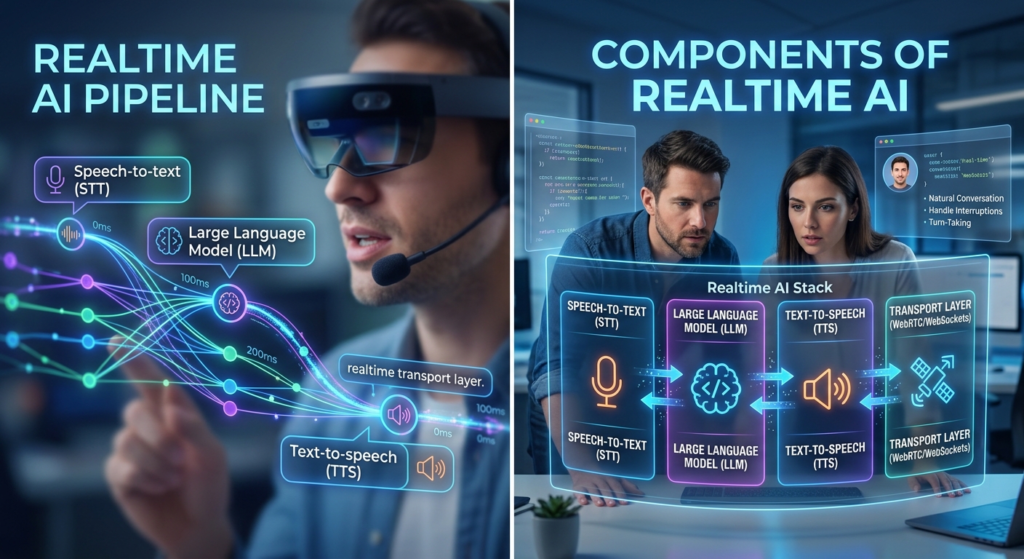
A typical realtime AI stack usually combines a few core pieces working together:
- Speech-to-text (STT) to convert spoken words into text instantly
- A large language model (LLM) to understand context and decide what to say or do
- Text-to-speech (TTS) to generate natural-sounding audio responses
- A realtime transport layer, often built on WebRTC or WebSockets, to carry audio, video, and data with minimal delay
Together, these components allow an AI agent to hold a natural conversation, handle interruptions, manage turn-taking, and respond within a few hundred milliseconds — close to how a human would react in a real conversation.
Why Realtime AI Frameworks Matter in 2025
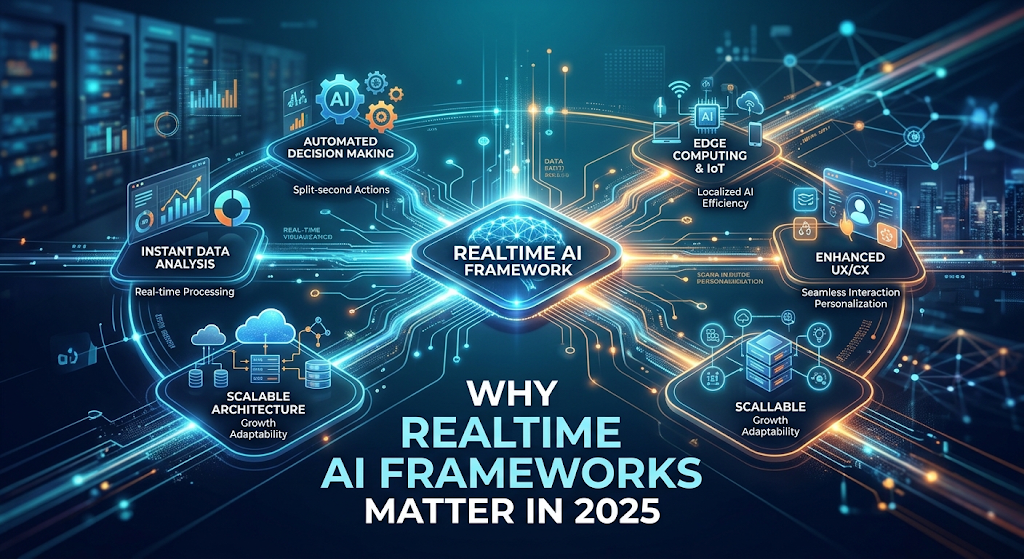
The demand for instant, human-like interaction has exploded. Businesses no longer want chatbots that feel robotic or delayed; they want voice AI agents that sound natural, respond quickly, and integrate directly into phone systems, apps, and websites. Industry research shows the voice AI market is growing at a rapid pace, with healthcare, customer support, and sales automation leading the adoption curve because of the operational efficiency these systems provide.
There are several reasons realtime AI tools frameworks 2025 have become essential:
- User expectations have shifted. People are used to fast, conversational interfaces after years of using voice assistants and messaging apps.
- Multimodal AI is mainstream. Modern agents need to process voice, video, and text together, not just one channel at a time.
- Latency directly affects trust. A delay of even one or two seconds in a voice conversation feels unnatural and reduces user confidence in the system.
- Open-source ecosystems have matured. Frameworks that were experimental a couple of years ago are now production-ready with strong developer communities.
- Telephony and web integration is easier than ever. Many frameworks now offer native support for phone calls, browsers, and mobile apps out of the box.
This is why choosing the right realtime AI framework in 2025 has become a strategic decision, not just a technical one.
Top Realtime AI Tools and Frameworks in 2025
Here is an overview of the most widely used realtime AI tools frameworks 2025, based on how developers and companies are actually using them today.
LiveKit Agents is one of the most popular open-source frameworks for building realtime voice and multimodal AI agents. Built on top of WebRTC, it treats audio, video, and data as first-class citizens, making it a strong choice for voice assistants, phone call bots, and multimodal AI agents. It supports plugins for popular providers like OpenAI, Deepgram, and ElevenLabs, and has a large, active developer community.
Pipecat is an open-source, Python-first framework created by the team at Daily. It was built because existing orchestration tools weren’t flexible enough for real production needs. Pipecat simplifies building STT → LLM → TTS pipelines and is vendor-neutral, meaning developers can mix and match components based on cost, performance, and requirements. It is especially popular for fast prototyping and MVPs.
Vapi is a platform-level solution rather than a pure framework. It offers a lightweight plugin model and fast setup, making it attractive for individual developers, startups, and small teams who want to launch a voice AI agent quickly without managing deep infrastructure themselves.
Retell AI focuses on vertical integration for customer service use cases, combining call simulation, routing, and memory logic into one platform. It is well-suited to businesses that want a more managed, end-to-end solution rather than building everything from scratch.
Vocode Core is a lower-level, modular toolkit that gives developers granular control over how voice AI agents are constructed. It appeals to teams that want flexibility similar to a framework but still need some pre-built components.
TEN (Transformative Extensions Network) is a modular, real-time conversational AI framework designed to handle voice, vision, and multimodal agents together, reflecting the industry’s move toward combining multiple data types in a single pipeline.
Vision Agents by Stream takes a video-first approach instead of adding video as an afterthought to a voice-first stack. It runs on a low-latency WebRTC edge network and supports pluggable computer-vision processors, making it useful for coaching apps, accessibility tools, and multimodal support agents.
Alongside these frameworks, major AI labs have also released their own realtime APIs — such as streaming and live conversational APIs from leading LLM providers — which developers often combine with the frameworks above rather than using in isolation.
Realtime AI Tools Frameworks 2025 vs Traditional AI Pipelines
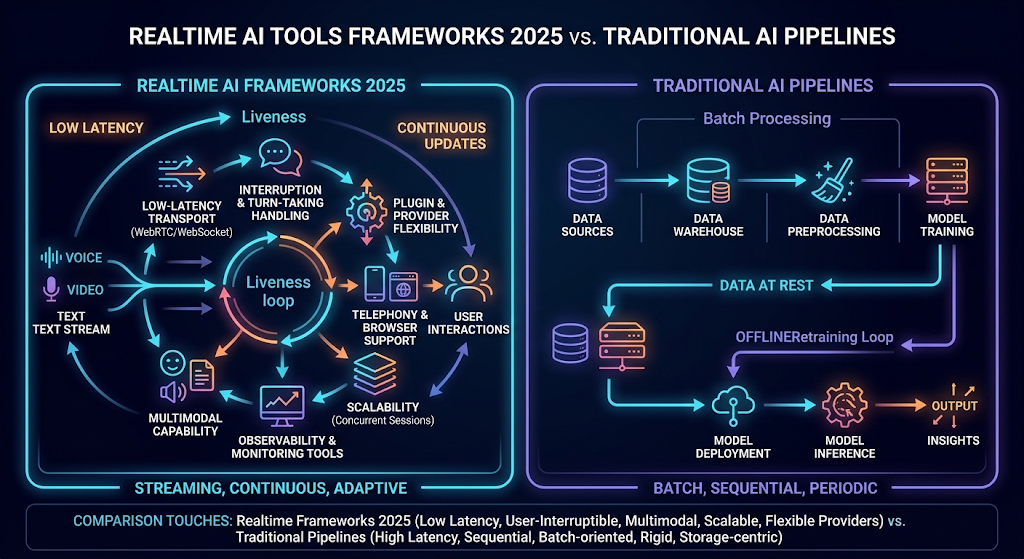
To really understand why realtime AI tools frameworks 2025 are getting so much attention, it helps to compare them with traditional, request-response AI pipelines that most people are still familiar with.
A traditional AI pipeline usually works like this: a user sends a message or uploads a file, the system processes it in the background, and then a complete response is returned once everything is finished. This works fine for tasks like document summarization, image generation, or batch data analysis, where a short delay does not hurt the user experience.
Realtime AI tools frameworks 2025, on the other hand, are built around continuous, streaming interaction. Instead of waiting for a complete response, the system processes small chunks of audio, video, or text as they arrive and starts responding almost immediately. This is essential for use cases like:
- Live voice conversations with an AI agent over the phone
- Real-time translation during a video call
- Interactive customer support bots that need to interrupt, clarify, or redirect mid-sentence
- Live coaching or monitoring tools that analyze video and audio as an event happens
The core difference is not just speed — it is architecture. Realtime AI tools frameworks 2025 are designed from the ground up around streaming data, persistent connections, and event-driven processing, while traditional pipelines are optimized for accuracy over completed, static inputs.
Key Features to Look for in Realtime AI Tools Frameworks 2025
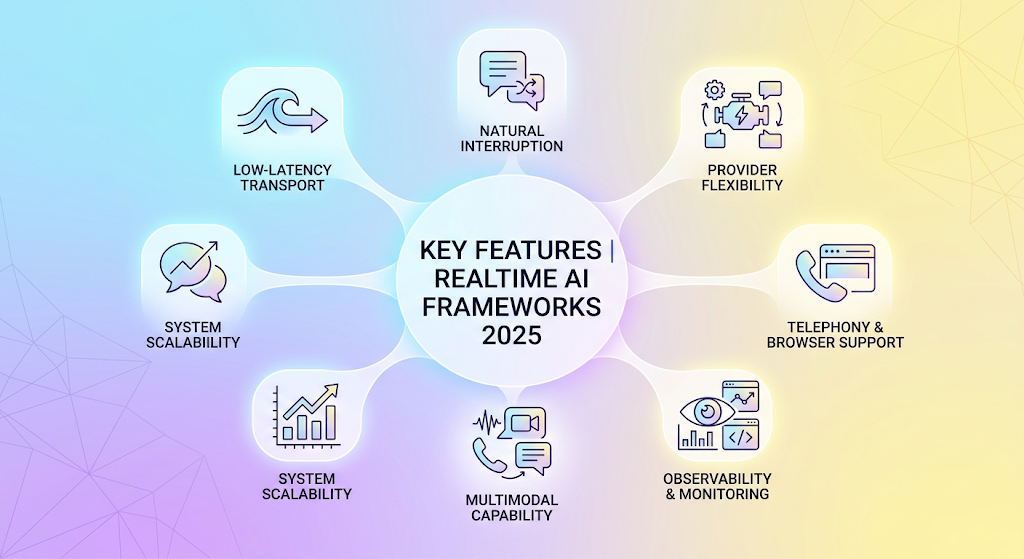
Not all realtime AI tools frameworks 2025 are built the same way, and choosing one without understanding its core features can lead to costly rework later. Here are the features that genuinely matter when evaluating a framework or platform:
- Low-latency transport layer — Look for native WebRTC or optimized WebSocket support, since this directly affects how natural a conversation feels.
- Interruption and turn-taking handling — A good realtime AI framework should let users interrupt the AI mid-response, just like a real conversation.
- Plugin or provider flexibility — The ability to swap speech-to-text, text-to-speech, and language model providers without rewriting your entire application is extremely valuable.
- Telephony and browser support — Native integration with phone systems and web browsers reduces the need for extra middleware.
- Multimodal capability — As voice, video, and text increasingly merge into single agents, frameworks that support multiple modalities out of the box offer better long-term flexibility.
- Observability and monitoring tools — Since realtime systems fail differently than batch systems, built-in logging, call analytics, and debugging tools are essential for production use.
- Scalability — The framework should be able to handle a growing number of concurrent sessions without a major architecture rewrite.
Evaluating any tool against this checklist will make it much easier to shortlist the right realtime AI tools frameworks 2025 for your specific product.
Pros and Cons of Realtime AI Frameworks
Every realtime AI framework comes with trade-offs. Here is an honest breakdown to help you evaluate them properly.
Pros
- Instant, natural interaction — Users get human-like response times instead of noticeable delays.
- Multimodal support — Many frameworks now combine voice, video, and text in a single pipeline.
- Open-source flexibility — Tools like LiveKit and Pipecat let developers customize every layer of the stack.
- Strong plugin ecosystems — Easy integration with popular STT, TTS, and LLM providers.
- Production-ready infrastructure — Native telephony, WebRTC support, and scaling tools reduce engineering overhead.
- Faster time-to-market — Platforms like Vapi and Retell AI let smaller teams launch voice agents without building infrastructure from zero.
Cons
- Steep learning curve — Frameworks like LiveKit and TEN require solid knowledge of real-time systems and networking concepts.
- Infrastructure complexity — Setting up low-latency pipelines, handling interruptions, and managing state can be technically demanding.
- Vendor lock-in risk — Some managed platforms limit flexibility once you scale, making migration harder later.
- Cost at scale — Streaming AI models and realtime transport can become expensive as usage grows.
- Language and ecosystem limits — Some frameworks, like Pipecat, are Python-centric, which may not suit every engineering team.
- Latency is never zero — Even the best frameworks have physical and network limits, so ultra-low latency still requires careful architecture decisions.
Comparison Table: Popular Realtime AI Frameworks 2025
| Framework | Type | Best For | Key Strength | Main Limitation |
| LiveKit Agents | Open-source framework | Production voice & video agents | WebRTC-based, industry-grade performance | Requires real-time systems knowledge |
| Pipecat | Open-source framework | Fast prototyping, MVPs | Vendor-neutral, developer-friendly | Python-centric, not ultra-low latency |
| Vapi | Managed platform | Startups, indie developers | Quick setup, lightweight plugins | Less control at scale |
| Retell AI | Managed platform | Customer service automation | End-to-end call handling | Less flexible for custom builds |
| Vocode Core | Modular toolkit | Developers needing granular control | Highly customizable | More setup effort required |
| TEN | Modular framework | Voice + vision + multimodal agents | Handles multiple modalities together | Newer, smaller community |
| Vision Agents | Open-source framework | Video-first AI applications | Native WebRTC + computer vision | Narrower use case focus |
How to Choose the Right Realtime AI Framework
Picking from the many realtime AI tools frameworks 2025 available depends heavily on your goals, team size, and technical comfort level. A few practical questions can guide the decision:
- Do you need full control, or speed to launch? If you want to own your infrastructure and customize every detail, open-source frameworks like LiveKit or Pipecat make more sense. If you want to launch quickly, managed platforms like Vapi or Retell AI are better suited.
- What modalities do you need? If your product only needs voice, most frameworks will work. If you need video or computer vision alongside audio, TEN or Vision Agents are worth serious consideration.
- What is your team’s technical depth? Real-time networking, WebRTC, and streaming pipelines require specialized skills. Teams without this expertise often benefit more from managed platforms.
- What is your growth plan? If you expect to scale significantly, evaluate long-term costs and flexibility carefully before locking into a single vendor.
- Do you need telephony integration? Some frameworks offer native phone call support, which can save significant engineering time for customer support or sales use cases.
The Future of Realtime AI Tools and Frameworks
The trajectory is clear: realtime AI is moving from a niche capability to a default expectation. Multimodal agents that combine voice, video, and contextual memory are becoming standard rather than experimental. Open-source frameworks are maturing quickly, closing the gap between hobby projects and enterprise-grade deployments. At the same time, managed platforms are simplifying access for teams that don’t want to manage infrastructure directly.
Going forward, expect tighter integration between realtime frameworks and enterprise systems like CRMs, helpdesks, and analytics platforms, along with continued improvements in latency, natural turn-taking, and voice quality. Businesses that adopt the right realtime AI tools frameworks 2025 early are likely to have a meaningful edge in customer experience and operational efficiency.
Frequently Asked Questions (FAQs)
1. What is the difference between a realtime AI framework and a realtime AI platform? A framework, like LiveKit or Pipecat, gives developers code-level control to build and customize their own agent. A platform, like Vapi or Retell AI, offers a more managed, ready-to-use solution with less customization but faster setup.
2. Which realtime AI framework is best for beginners? Pipecat is generally considered beginner-friendly because of its simple Python-based structure and strong documentation, making it a good starting point for prototypes.
3. Are realtime AI frameworks only used for voice assistants? No. While voice agents are the most common use case, many frameworks now support video, computer vision, and multimodal interactions as well.
4. Is WebRTC necessary for building realtime AI applications? WebRTC is widely used because it offers low-latency, peer-to-peer style communication, but some frameworks also support WebSockets or other transport layers depending on the use case.
5. Can small businesses use realtime AI tools without a large engineering team? Yes. Managed platforms like Vapi and Retell AI are specifically designed to let smaller teams launch voice AI agents without deep infrastructure expertise.
6. What industries benefit most from realtime AI frameworks in 2025? Customer support, healthcare, sales, and e-commerce are among the fastest-growing adopters, since real-time voice interaction directly improves response times and customer satisfaction.
7. Do I need to build everything from scratch to use realtime AI tools frameworks 2025? No. Most modern frameworks and platforms come with pre-built components for speech-to-text, text-to-speech, and language model integration, so you can focus on your application logic instead of building infrastructure from zero.
8. How much does it cost to build with realtime AI tools frameworks 2025? Costs vary widely depending on whether you choose an open-source framework (where you pay mainly for hosting and API usage) or a managed platform (where you pay a subscription or usage-based fee on top of the underlying model costs). It is worth calculating expected call or session volume before committing to one option.
9. Can realtime AI frameworks be used outside of voice applications? Yes. Many realtime AI tools frameworks 2025 now support video and multimodal use cases as well, including live translation, real-time coaching, accessibility tools, and interactive video agents.
Conclusion
Realtime AI tools frameworks 2025 have fundamentally changed how developers build conversational and multimodal applications. Whether you choose an open-source framework like LiveKit or Pipecat for full control, or a managed platform like Vapi or Retell AI for speed, the right choice depends on your team’s technical depth, product goals, and long-term scaling needs.
As multimodal, low-latency AI becomes the industry standard rather than the exception, investing time in understanding realtime AI tools frameworks 2025 now will pay off significantly as your product grows. Companies that adopt the right realtime AI framework early are positioning themselves ahead of competitors who are still relying on slower, request-response style AI systems.
At the end of the day, there is no single “best” answer — the right realtime AI tools frameworks 2025 for your project depend on your specific goals, budget, and technical resources. Start small, test with real users, measure latency and conversation quality carefully, and scale the framework that performs best for your exact use case. The realtime AI space is moving fast, and with the right foundation in place, your application can move just as fast alongside it.
