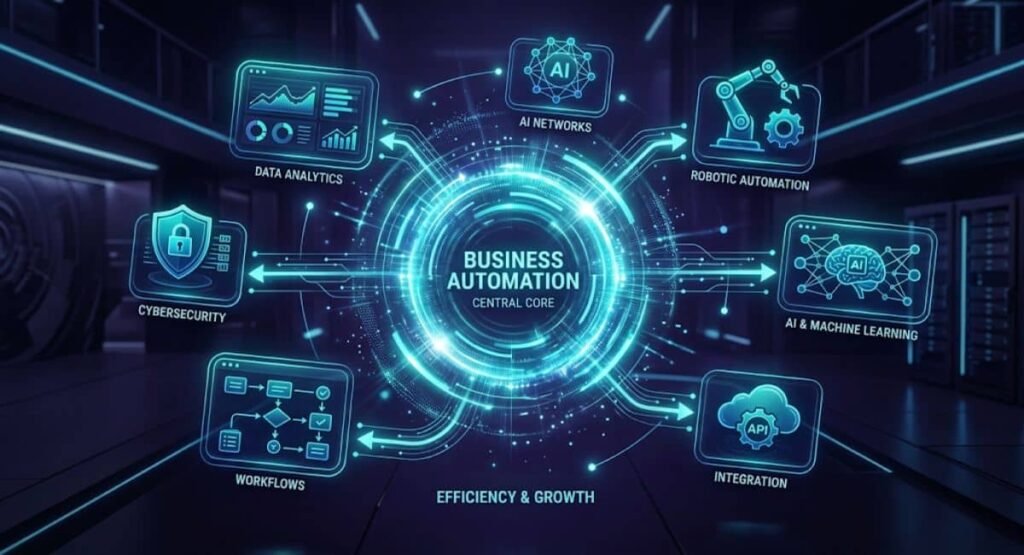
If you’ve ever spent three hours copying numbers from one system into another, you already know why so many businesses are talking about automation right now. It’s not hype — it’s a genuine response to a genuine problem. Teams are tired of doing work that a computer could do faster and without mistakes. That’s the conversation Droven.io RPA and business automation content sits right in the middle of.
Rather than pushing a specific tool on you, Droven.io has carved out a niche as an educational resource — a place where business owners and non-technical decision-makers can actually understand robotic process automation (RPA), workflow automation, and AI-driven transformation before they open their wallets for any software. And honestly, that’s a smarter place to start than a sales demo. Understanding Droven.io RPA and Business Automation from the ground up makes that shift easier.
This guide walks through what these tools really mean, where Droven.io fits into that picture, the honest pros and cons of adopting them, a side-by-side comparison of the main approaches, and answers to the questions people actually ask before committing to a platform.
What Is RPA (Robotic Process Automation), Really?
Strip away the marketing language and RPA is fairly simple: it’s software that mimics what a person does on a screen. Instead of an employee logging into a portal, pulling data, and pasting it somewhere else, a “bot” does the same steps — just faster, around the clock, and without the typos that creep in after hour six of data entry. This baseline is central to any discussion of Droven.io RPA and Business Automation.
A typical RPA bot can:
- Log into applications and web portals
- Pull data from one system and move it into another
- Fill out forms and generate routine documents
- Send notifications and follow-up emails automatically
- Check information against a set of business rules
- Handle high-volume, repetitive transactions without getting tired
This is the foundation layer of what people mean when they search for Droven.io RPA and Business Automation. Where RPA earns its keep is in structured, rules-based work — the kind of task that doesn’t change much from one day to the next. Think of a finance team pulling invoices out of an inbox every morning, an HR team processing new-hire paperwork, or a logistics team reconciling shipment records across three different platforms before they can go home.
Business Automation Is the Bigger Picture
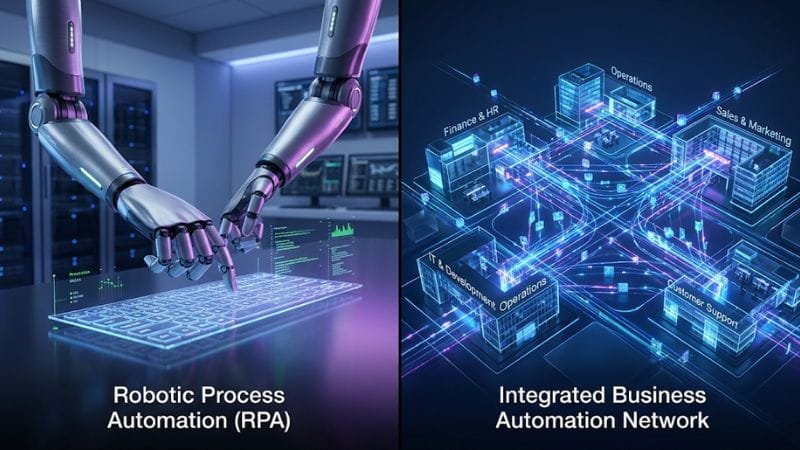
RPA handles one task at a time. Business automation zooms out and connects the whole workflow — across systems, across departments — so information doesn’t get stuck waiting on someone to notice an email. Understanding this distinction is really the whole point of learning about this space before you commit to any single tool. That’s the core lesson behind Droven.io RPA and Business Automation.
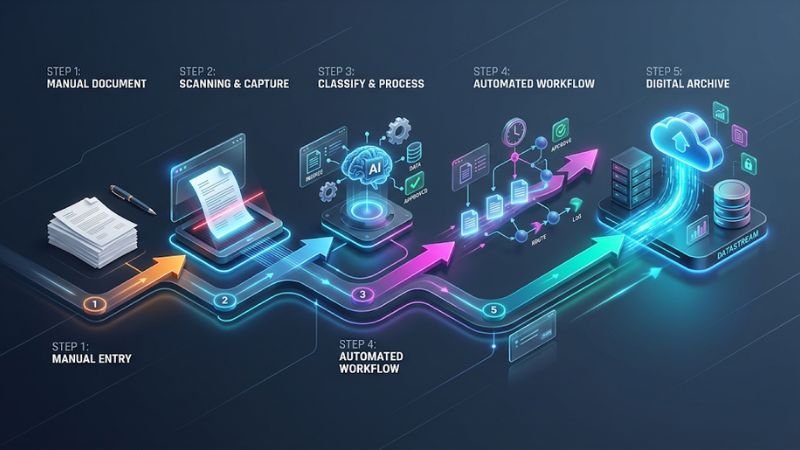
A good example is employee onboarding. Done manually, it usually means one person creating a profile, someone else sending the welcome email, IT provisioning system access a day or two later, and HR updating records whenever they get around to it. Automated properly, all of that happens in sequence, automatically, the moment a new hire is approved — no one has to remember a single step. It’s a simple but useful illustration of Droven.io RPA and Business Automation in practice.
Business automation usually layers a few technologies together:
- Workflow automation, which handles approvals, notifications, and handoffs between teams
- Artificial intelligence, which lets systems interpret messy, unstructured data and make judgment calls
- Hyperautomation, a broader strategy that combines RPA, AI, and analytics into something closer to a self-improving system
Together, these layers are what people usually mean by Droven.io RPA and Business Automation.
Where Droven.io Actually Fits
Here’s something worth being upfront about: search results for Droven.io aren’t entirely consistent with each other. Some pages describe it as a software platform. Most describe it as an information and education site rather than a vendor. Based on what’s publicly verifiable, the safer read is the latter — Droven.io functions as a knowledge resource, not a piece of software you install or subscribe to. In short, it treats Droven.io RPA and Business Automation as a subject to learn, not a product to buy.
What it does cover, fairly consistently across sources, includes:
- The practical difference between RPA, workflow automation, and AI automation
- How to map a process properly before you even think about automating it
- The basics of bot training, monitoring, and governance
- Where trends like hyperautomation and intelligent document processing are headed
- How to size up an automation vendor without falling for the sales pitch
Given how crowded and noisy the automation software market has gotten, having a neutral starting point for learning about the topic isn’t a bad idea. Just treat it the way you’d treat any educational resource — a place to build understanding, not a substitute for checking the specifics directly on a vendor’s own site before you sign a contract. Approaching Droven.io RPA and Business Automation this way keeps expectations realistic.
Why 2026 Is the Year Everyone’s Talking About Droven.io RPA and Business Automation
A few forces are pushing this shift from “nice to have” to “obviously worth doing” for companies of every size:
- Tight budgets and hiring freezes — automating repetitive tasks reduces reliance on headcount for low-value work.
- Error costs add up — bots don’t get distracted, and they run the same rule the same way every single time.
- Speed matters more than ever — a reconciliation that used to eat an afternoon can now finish in minutes.
- Growth without the growing pains — automated workflows can absorb more volume without a matching increase in staff.
- Auditability — every action a bot takes leaves a digital trail, which regulated industries genuinely appreciate.
Each of these forces is accelerating interest in Droven.io RPA and Business Automation across industries.
The Honest Pros and Cons
No automation strategy is perfect, and anyone who tells you otherwise is probably selling something. That’s true for Droven.io RPA and Business Automation just as much as any other technology. Here’s a fair look at both sides.

Pros
- Fewer mistakes — bots don’t mistype, skip a field, or forget a step the way a tired employee might at 4pm.
- Real time savings — tasks that once took hours can genuinely shrink down to minutes.
- Lower long-term cost — the setup isn’t free, but the ongoing overhead usually drops once things are running.
- Happier employees — nobody enjoys copy-pasting spreadsheets all day; automation frees people up for work that’s actually interesting.
- Easier scaling — volume can grow without needing to hire proportionally more staff.
- Cleaner compliance trail — every bot action gets logged, which makes audits far less painful.
- Works while you sleep — bots don’t need business hours to get things done.
These advantages are a big part of why Droven.io RPA and Business Automation keeps gaining traction.
Cons
- Upfront cost and effort — mapping workflows and integrating systems takes real time before you see any payoff.
- Not every task qualifies — anything that requires genuine judgment or handles constant exceptions is a poor automation candidate.
- Bots break — if a connected app changes its interface or an API updates, the bot can stop working without warning.
- People get nervous — automation conversations often trigger job-security worries, which can slow adoption if not handled well.
- Governance matters — a poorly controlled bot with too much system access is a real security risk, not a theoretical one.
- Rigidity — classic RPA follows fixed rules and struggles the moment inputs become unpredictable, unless it’s paired with AI.
These trade-offs are worth weighing honestly before adopting Droven.io RPA and Business Automation.
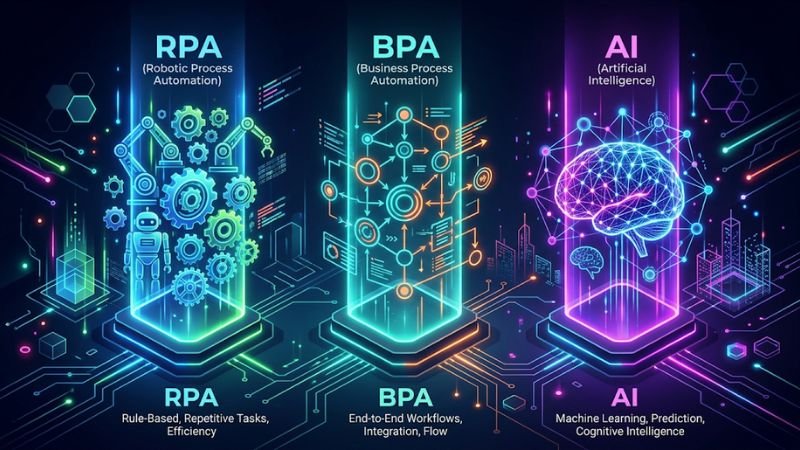
RPA vs. Business Automation vs. AI Automation
Since these terms often get lumped together with AI automation, a side-by-side breakdown makes the differences much easier to see — something anyone researching Droven.io RPA and Business Automation should understand clearly:
| Feature | RPA (Robotic Process Automation) | Business Process Automation | AI-Powered Automation |
|---|---|---|---|
| Primary focus | Automates single, repetitive digital tasks | Connects entire workflows across departments | Handles unstructured data and decision-making |
| Best suited for | High-volume, rules-based work (data entry, invoicing) | End-to-end processes (onboarding, order fulfillment) | Tasks requiring judgment, prediction, or pattern recognition |
| Technical complexity | Low to moderate | Moderate to high | High |
| Handles exceptions well? | Not really — fixed rules only | Somewhat — can route exceptions to a human | Yes — adapts based on data |
| Typical setup time | Days to weeks | Weeks to months | Months, depending on data readiness |
| Ongoing human involvement | Minimal once configured | Moderate — approvals and exceptions | Ongoing — training and oversight |
| Common examples | Data entry, invoice processing, report generation | Employee onboarding, order-to-cash cycles | Fraud detection, sentiment analysis, demand forecasting |
| Cost profile | Lower upfront cost | Moderate, scales with number of integrations | Higher, given data and model requirements |
This comparison is a useful reference point whenever Droven.io RPA and Business Automation comes up in vendor conversations.
Where Droven.io RPA and Business Automation Actually Get Used
- Finance and accounting — invoice processing, expense reconciliation, accounts payable automation
- Human resources — onboarding, payroll runs, benefits administration
- Customer service — ticket routing, automated responses, quick data lookups during calls
- Logistics — shipment tracking, inventory reconciliation, order status updates
- Healthcare admin — claims processing, appointment scheduling, records updates
- Sales and marketing — lead enrichment, CRM updates, recurring report generation
These use cases show just how broad the reach of Droven.io RPA and Business Automation really is.
How to Actually Evaluate a Platform
Whether you’re looking into Droven.io’s take on this topic or comparing established names like UiPath, Automation Anywhere, or Blue Prism, don’t just go by the marketing copy. Either way, comparing options against the fundamentals of Droven.io RPA and Business Automation helps you ask better questions. A more reliable approach:
- Map the process first. Know exactly what you’re automating before you shop for a tool.
- Check what it actually integrates with. Confirm compatibility with your CRM, ERP, email, and databases — don’t assume.
- Ask how pricing really works. Per-bot, per-task, subscription — and what happens to the price as volume grows?
- Look for real governance features. Audit logs, access controls, and exception handling aren’t optional extras.
- Verify claims at the source. Third-party articles (including this one) can be inconsistent — always double-check specifics on the official site before deciding anything.
Following this checklist keeps your approach to Droven.io RPA and Business Automation grounded in facts rather than sales pitches.
A Practical Way to Get Started
- Find the repetitive, rules-based tasks eating up the most staff time.
- Map the current process, exceptions included — don’t skip the messy parts.
- Pick a high-impact, low-complexity task for your first project. Don’t start with the hardest one.
- Match the technology to the job — RPA for single tasks, workflow tools for cross-team processes, AI for messy data.
- Pilot it on one process before rolling it out everywhere.
- Keep watching it. Automation isn’t “set it and forget it” — bots need upkeep as the systems around them change.
This step-by-step path is a practical way to actually get started with Droven.io RPA and Business Automation.
A Few Myths About Droven.io RPA and Business Automation Worth Clearing Up
“Automation is going to replace most jobs.” In practice, RPA is best at repetitive, rules-based work — not judgment calls or relationship-driven roles. Most automation projects end up freeing people for better work rather than eliminating their jobs outright.
“RPA and AI are basically the same thing.” They’re not. RPA follows fixed rules; AI learns from data and handles things that don’t fit a script. Plenty of modern platforms use both, but they solve different problems.
“Once you build a bot, it runs forever without touching it.” Bots depend on the stability of whatever systems they connect to. Change the interface or update an API, and the bot can quietly break. Someone needs to keep an eye on it.
“This is only for big companies with big budgets.” Not anymore. Cloud-based, no-code tools have made automation genuinely accessible to small and mid-sized businesses too.
“Every process can be automated.” Not really. Anything that changes constantly or relies heavily on subjective judgment is a bad candidate — unless it’s paired with more advanced AI.
What’s Changing in 2026
The world of workflow and process technology doesn’t sit still. A few things worth keeping an eye on:
- Hyperautomation — stitching RPA, AI, machine learning, and process mining into one strategy that keeps finding new things to optimize.
- Intelligent document processing — using AI to read messy, unstructured documents like invoices and contracts, which pushes RPA well beyond simple data entry.
- No-code adoption — more platforms are shifting toward drag-and-drop builders so the people who actually know the process can build the automation themselves, no developer required.
- Process mining — tools that scan system logs and map out existing workflows automatically, which takes a lot of the guesswork out of picking what to automate first.
- Human-in-the-loop design — rather than removing people entirely, a lot of workflows now route the tricky exceptions to a human while automating everything else.
- Composable automation — businesses are increasingly stitching together several specialized tools instead of betting everything on one all-in-one platform.
Keeping up with shifts like these — through resources like Droven.io or similar sites — is a decent way to avoid investing in an approach that’s outdated within a year or two.
Frequently Asked Questions About Droven.io RPA and Business Automation
Is Droven.io a piece of Droven.io RPA and Business Automation software? Based on what’s publicly available, no — it reads more like an educational resource covering these topics than something you’d install or subscribe to. Worth confirming directly on the site, since platforms do change over time.
What’s the actual difference between the two? This comes up constantly when people research this area for the first time. RPA handles one repetitive task at a time — like data entry. Business automation connects the whole workflow across systems and departments, usually combining RPA with other tools along the way.
Do I need to know how to code to use RPA tools? Not necessarily. Plenty of modern platforms offer no-code, drag-and-drop builders that business users can pick up without a development background. Older enterprise RPA tools tend to be more technical.
How much does implementing Droven.io RPA and Business Automation usually cost? It depends heavily on scope. A single automated task can be fairly affordable; a multi-system workflow with several integrations costs considerably more. Get a real quote based on your specific situation rather than trusting a general number.
Can Droven.io RPA and Business Automation handle tasks that need judgment? Not on its own — traditional RPA sticks to fixed rules. For anything requiring pattern recognition or adaptive decisions, businesses typically pair it with AI-powered automation instead.
Is this only useful for large enterprises? Not anymore. RPA started in big enterprise environments, but cloud-based and no-code tools have made it realistic for small and mid-sized businesses too.
Which industries get the most out of it? Finance, healthcare, logistics, HR, and customer service tend to see the biggest gains, though honestly, any industry with repetitive digital work stands to benefit.
Wrapping Up
RPA and business automation aren’t a passing trend — by 2026 they’ve become a fairly standard way for businesses to cut down manual work, tighten up accuracy, and free their teams for work that actually needs a human brain. That’s really what Droven.io’s content on this subject is trying to help you get to. Resources like Droven.io are useful precisely because they help you build that understanding before you’re sitting across from a sales rep.
The real key to getting this right with Droven.io RPA and Business Automation isn’t picking whichever platform has the flashiest homepage. It’s understanding your own processes first, matching the right type of automation — RPA, workflow automation, or AI — to the actual problem you’re solving, and checking any platform’s claims against what your business genuinely needs. Whether you’re just starting to look into automation or you’re about to build your first bot, taking the time to get this foundation right will save you money and headaches later.
If Droven.io’s content on this subject is where you’re starting your research, use it to build that base — then take the specifics straight to the vendors themselves before you decide anything.
