
Search is changing fast, and Google’s AI Overviews are at the center of that shift. As more searches now return AI-generated summaries instead of a traditional list of blue links, website owners, SEOs, and content marketers need a reliable way to know where they stand. That’s exactly why an AI Overviews Rank Checker has become one of the most talked-about tools in the SEO community this year.
In this article, we’ll break down what this tool actually does, why it matters, its pros and cons, how it compares to traditional rank trackers, and answer the most common questions people are asking about it.
The Rise of AI Overviews: A Quick Background
Google introduced AI Overviews as an evolution of the earlier Search Generative Experience (SGE) experiment, rolling it out to a growing share of search results starting in 2024 and expanding significantly through 2025 and into 2026. Instead of showing ten blue links, Google now generates a synthesized answer at the top of many search results pages, pulling information from multiple sources and citing a handful of them directly.
For years, SEOs measured success purely through position tracking — position 1, position 3, page 2, and so on. That model still matters, but it no longer tells the full story. A page can rank #1 in the traditional results and still receive zero clicks if an AI Overview above it fully answers the searcher’s question using a competitor’s content instead. This is precisely the gap an AI Overviews Rank Checker was built to close.
What Is an AI Overviews Rank Checker?
An AI Overviews Rank Checker is a specialized SEO tool designed to monitor whether your website or content appears inside Google’s AI Overviews (formerly known as Search Generative Experience, or SGE). Unlike a standard rank tracker that only shows your position in the classic organic listings, this AI visibility tool tells you:
- Whether your page is being cited or summarized inside an AI Overview
- Which keywords trigger an AI Overview result
- Your visibility share compared to competitors inside that AI-generated box
- How your citation position changes over time
Because AI Overviews often appear above the fold and push traditional organic results further down the page, getting tracked and cited inside them is becoming just as important — if not more important — than ranking #1 in the old-style results.
Why You Need an AI Overviews Rank Checker in 2026
Google’s AI Overviews now appear for a large percentage of informational queries. If your competitor’s content is being cited inside the AI Overview and yours isn’t, you’re losing visibility, clicks, and authority — even if your traditional ranking looks fine. This is where an AI-powered rank tracking tool becomes essential:
- Visibility tracking – See exactly which of your pages get pulled into AI Overviews.
- Competitor benchmarking – Understand which competitors dominate AI-generated summaries for your target keywords.
- Content optimization signals – Identify patterns (structure, schema, answer format) that increase your chances of being cited.
- ROI justification – Prove to clients or stakeholders that your SEO strategy is adapting to Google’s AI-first search era.
How This AI Search Tracking Tool Works
Most tools in this category work in a similar way:
- You enter your target keywords.
- The tool simulates a real search query and captures the AI Overview result (if one appears).
- It scans the citation links inside that AI Overview.
- It matches those citations against your domain and your competitors’ domains.
- The data is presented in a dashboard showing your citation frequency, position within the overview, and historical trend.
Some advanced platforms combine this with traditional rank tracking, so you get one unified dashboard showing both classic SERP rankings and AI Overview citations side by side.
Key Metrics an AI Overviews Rank Checker Reports
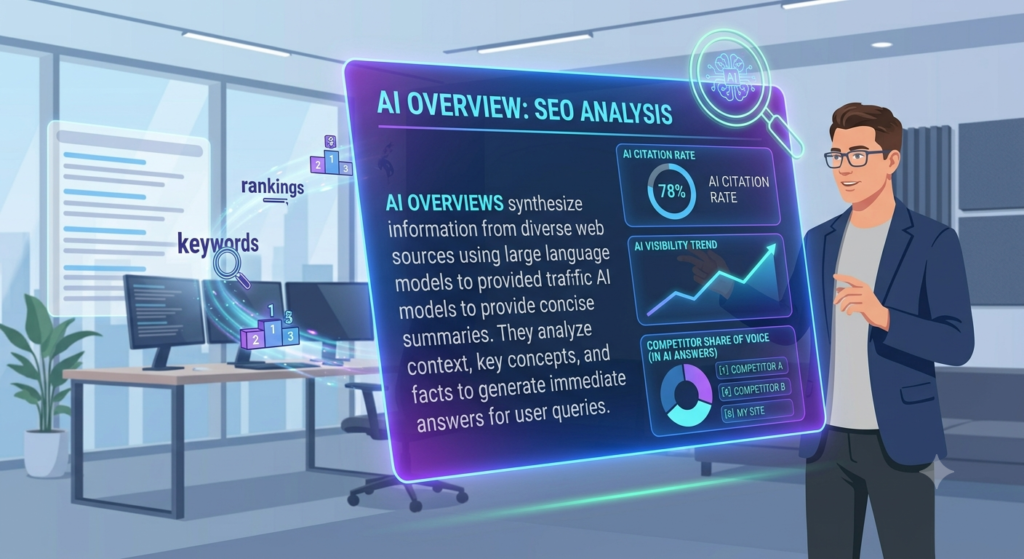
To get real value from this kind of tool, it helps to understand exactly what data it’s showing you:
- Citation frequency – How often your domain appears inside AI Overviews for your tracked keywords, expressed as a percentage over time.
- Citation position – Whether your link appears first, second, or further down the list of sources cited inside the overview.
- Overview trigger rate – The percentage of your tracked keywords that actually generate an AI Overview at all, since not every query does.
- Share of voice – Your citation count compared to the total number of citations across all competitors for the same keyword set.
- Content type correlation – Which formats (lists, tables, definitions, step-by-step guides) are most commonly pulled into the overview.
Tracking these metrics consistently through a dedicated AI Overviews Rank Checker over weeks and months gives you a much clearer picture than a single snapshot ever could.
Pros and Cons of Using This AI Overview Tracking Tool
Pros
- Early insight into AI search trends – You see how AI Overviews are reshaping your niche before competitors catch on.
- Better content strategy – Data-driven decisions on formatting, structure, and answer-style content.
- Competitive intelligence – Know exactly who is winning citations and why.
- Improved reporting – Agencies can show clients real evidence of AI-search performance, not just classic rankings.
- Time-saving automation – No need to manually search hundreds of keywords to check AI Overview appearances.
Cons
- Data volatility – AI Overviews change frequently, so results can fluctuate day to day.
- Limited historical data – Since AI Overviews are relatively new, long-term trend data is still developing.
- Tool accuracy varies – Not every AI visibility platform uses the same detection method, leading to inconsistent results across tools.
- Cost – Many advanced tools charge premium pricing for AI Overview tracking features.
- No guaranteed control – Even with perfect tracking, there’s no direct way to force Google to cite your page.
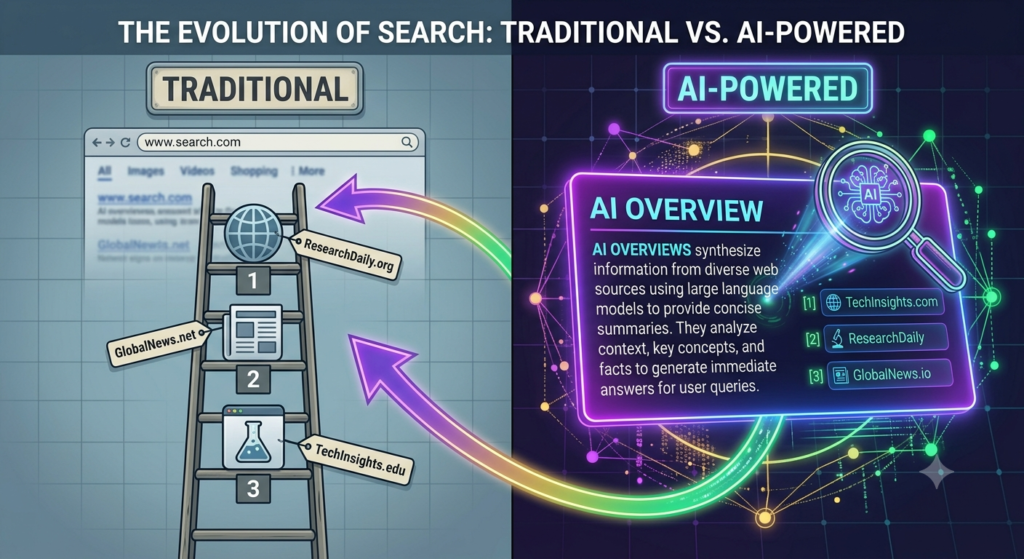
Comparison Table: AI Overview Tracking vs Traditional Rank Tracker
| Feature | AI Overviews Rank Checker | Traditional Rank Tracker |
|---|---|---|
| Tracks classic SERP position | Sometimes (as add-on) | Yes, primary function |
| Tracks AI Overview citations | Yes, core function | No |
| Competitor citation analysis | Yes | Limited |
| Historical trend data | Growing, still limited | Extensive |
| Content optimization insights | AI-specific formatting tips | General keyword-based tips |
| Best suited for | Modern AI-search strategy | Classic organic ranking strategy |
| Pricing | Often premium | Wide range, including free tools |
As the table shows, the two tools serve different but complementary purposes. Most SEOs today use both together to get a complete visibility picture.
Key Factors That Improve Your Chances of Being Cited
If you’re using this kind of tool and want to actually improve your results, focus on these areas:

- Clear, direct answers near the top of your content
- Structured headings (H1, H2, H3) that match natural search intent
- Schema markup (FAQ, HowTo, Article) to help Google parse your content
- Authoritative sourcing and up-to-date statistics
- Concise summaries that AI models can easily extract and rephrase
- Original data or first-hand insights that make your content harder to replace with a generic summary
- Fast page load times, since Google’s AI systems tend to favor technically healthy pages when selecting citation sources
- Consistent internal linking so search engines understand the topical authority of your site as a whole
Common Mistakes to Avoid
Even with a solid AI Overviews Rank Checker in place, many site owners undermine their own results through avoidable mistakes:
- Ignoring the data – Collecting reports but never acting on the insights defeats the purpose of tracking in the first place.
- Over-optimizing for AI at the expense of readers – Content written purely to be “extractable” can feel robotic and hurt engagement.
- Tracking too few keywords – A narrow keyword set gives an incomplete picture of your true AI visibility.
- Forgetting mobile behavior – AI Overviews often render differently on mobile, and citation patterns can vary by device.
- Comparing short-term snapshots – Because AI Overviews are volatile, judging performance from a single day’s data can be misleading; trends matter more than isolated readings.
Choosing the Right AI Overviews Rank Checker
When evaluating tools, look for:
- Accurate, real-time detection of AI Overview appearances
- A clean dashboard that separates AI citations from classic rankings
- Competitor comparison features
- Reliable customer support and regular updates (since Google frequently changes its AI Overview algorithm)
- Reasonable pricing relative to the size of your website or agency
Frequently Asked Questions (FAQs)
1. What is an AI Overviews Rank Checker used for? It’s used to track whether your website appears or gets cited inside Google’s AI Overview results, separate from traditional organic rankings.
2. Is an AI Overviews Rank Checker the same as a normal rank tracker? No. A normal rank tracker only monitors your position in classic search results, while this tool specifically monitors citations inside AI-generated summaries.
3. Can I improve my AI Overview visibility using this tool? The tool itself only tracks performance, but the insights it provides can guide content changes that improve your chances of being cited.
4. Are AI Overviews Rank Checker results 100% accurate? Accuracy can vary between tools, since AI Overviews are dynamic and Google frequently updates how they are generated.
5. Do I need both a traditional rank tracker and an AI Overviews Rank Checker? Yes, most SEO professionals recommend using both to get a full picture of visibility across classic and AI-driven search results.
6. How often should I check my AI Overview citations? Weekly monitoring is usually enough for most sites, though highly competitive niches may benefit from daily tracking given how quickly AI Overviews can change.
7. Does being cited in an AI Overview replace the need for good SEO? No. Strong technical SEO, quality backlinks, and well-structured content remain the foundation; AI Overview visibility is an additional layer built on top of that foundation, not a replacement for it.
Who Should Use an AI Overviews Rank Checker
This type of tool isn’t only for large enterprise SEO teams. It’s genuinely useful across a wide range of situations:
- Bloggers and content creators who rely on organic search traffic and need to know if AI Overviews are eating into their click-through rates.
- E-commerce brands competing for product-related informational queries, where AI Overviews increasingly summarize comparisons and buying guides.
- Local businesses that want to understand whether their location pages or service pages are being referenced in AI-generated local answers.
- SEO agencies managing multiple client accounts, who need a scalable way to report on AI visibility across dozens or hundreds of keywords at once.
- In-house marketing teams trying to justify continued investment in organic content in a search landscape that keeps shifting toward AI summarization.
Regardless of your niche, if your business depends even partly on organic search visibility, using an AI Overviews Rank Checker to understand your AI Overview presence is quickly becoming as important as tracking your classic keyword rankings.
The Future of AI Overview Tracking
As Google continues refining its AI systems, the tools built around tracking them are evolving just as quickly. A few trends are already emerging:
- Deeper integration with content editors – Expect future versions of an AI Overviews Rank Checker to suggest real-time content edits designed to increase citation likelihood, rather than just reporting after the fact.
- Cross-platform tracking – As AI-generated answers spread beyond Google into other search engines and AI assistants, rank checking tools are expanding to monitor citations across multiple AI-driven platforms, not just one.
- Predictive scoring – Some platforms are beginning to introduce a “citation probability score” that estimates how likely a given page is to be pulled into an AI Overview before you even publish it.
- Tighter connection to traditional analytics – Expect tighter integrations between AI visibility dashboards and tools like Google Search Console and Google Analytics, so marketers can see the full funnel from AI citation to actual website visit.
None of this replaces solid fundamentals. Good writing, genuine expertise, accurate information, and a well-structured website will always matter. But layering an AI Overviews Rank Checker on top of your existing SEO workflow gives you a clearer, faster way to see how well those fundamentals are translating into visibility in this new AI-driven era of search.

Conclusion
As Google continues to expand AI Overviews across more search queries, having a reliable AI Overviews Rank Checker is no longer optional for serious SEOs, content creators, and digital marketers. It gives you visibility into a part of search that traditional rank trackers simply can’t measure. By combining strong on-page optimization, structured content, and consistent monitoring through this AI visibility tool, you can stay ahead of competitors and secure your place in the next generation of search results.
If you want your content to survive — and thrive — in the AI search era, start treating your AI Overviews Rank Checker data with the same seriousness you once gave to your Google Search Console rankings. The websites that adapt early to this new layer of search visibility will be the ones that continue attracting traffic, authority, and trust, long after the shift to AI-driven results becomes the new normal rather than the exception.
