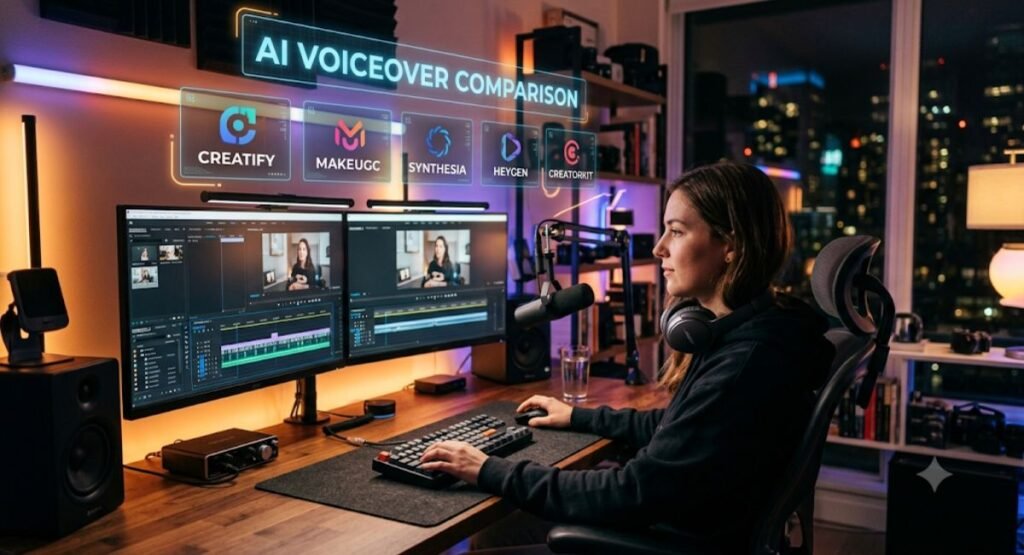
When you compare AI voiceover options in UGC video tools, not every platform sounds the same or works for the same content type. This guide breaks down the five biggest AI UGC platforms of 2026 — Creatify, MakeUGC, Synthesia, HeyGen, and Creator Kit — so you can compare AI voiceover options in UGC video tools and pick the right AI voiceover generator fast.
What Is an AI Voiceover in a UGC Video Tool?
An AI voiceover is a computer-generated, synthetic voice or text-to-speech (TTS) narration that reads your script without a real human recording anything. Before you can meaningfully compare AI voiceover options in UGC video tools, it helps to understand what this feature actually does.
In UGC video tools, this feature lets brands produce ads, demos, explainers, and faceless video content at scale — without hiring voice actors for every variation.
Modern AI narration tools now produce voices that sound natural and platform-ready. But the gap between the best and worst options is still wide enough to affect your results, which is exactly why you need to compare AI voiceover options in UGC video tools before committing budget to one platform.
Why AI Voiceover Quality Matters in UGC Content
Most brands focus on visuals when building UGC content. But the voiceover is what holds attention past the first three seconds.
A flat, robotic voice drops watch time immediately. A natural, confident voice keeps viewers engaged long enough to reach your call to action.
That difference shows up directly in your CTR and conversion rate. That’s why you should compare AI voiceover options in UGC video tools by language support, accent range, voice cloning ability, and voice output style before you commit to any tool.
Quick Comparison Table: AI Voiceover Platforms in 2026
Here’s a side-by-side snapshot before we go platform by platform — useful if you just want the short version of how these tools compare on AI voiceover options in UGC video tools.
| Platform | Languages | Starting Price | Best For |
|---|---|---|---|
| Creatify | 4-6 | $29/mo | Social Ads |
| MakeUGC | 10+ | $199/mo | Professional UGC |
| Synthesia | 40+ | $18/mo | Multilingual Content |
| HeyGen | 15+ | $99/mo | Custom Avatars |
| CreatorKit | 20+ | $99/mo | Tutorials |
Creatify: Fastest Voiceover Generation for Social Ads
Creatify is built for speed. If you need large volumes of short-form content for TikTok, Instagram Reels, or Facebook ads, this UGC ad creation tool gets there faster than any competitor — a key reason it always comes up when brands compare AI voiceover options in UGC video tools.
The voiceover setup is simple. You paste a product URL and Creatify generates a complete video with an AI voiceover already built in. No scripting required on your end.
Voiceover language support covers four to six languages. That’s narrower than competitors, so multilingual campaigns and video localization at scale will hit a ceiling here.
Voice quality is solid for the price. It’s not the most natural-sounding synthetic voice, but it performs well for short-form ads where quick hooks matter more than warmth.
At twenty-nine dollars per month for five videos and ninety-nine dollars for unlimited, it’s the most affordable entry point in the category.
MakeUGC: Professional Voiceover Quality Across Multiple Languages
MakeUGC positions itself as a more complete solution. The platform supports over ten languages with noticeably better voice quality than Creatify across most of them, which is why it earns a spot whenever brands compare AI voiceover options in UGC video tools for longer-form content.
The voices sound polished and professional, making it a better fit for YouTube channels, product pages, or longer-form campaigns where quality perception matters.
MakeUGC also combines AI voiceover with a real human creator marketplace on the same platform. If your AI content isn’t converting, you can hire a real UGC creator directly from the same dashboard.
The voiceover editing tools are more advanced too. You can adjust pacing, tone emphasis, and pronunciation more precisely than most template-based competitors allow — a key AI dubbing feature for brands going international.
The trade-off is price. Plans start at one hundred ninety-nine dollars per month, which makes it a harder sell for small brands still testing AI UGC for the first time.
Synthesia: Best AI Voiceover Range for B2B and Multilingual Content
When you compare AI voiceover options across all five platforms, Synthesia offers the widest language library by a significant margin. It supports over forty languages with voices that sound natural and professional across all of them — making it the top pick when you compare AI voiceover options in UGC video tools for multilingual voiceover and video localization needs.
This makes Synthesia the strongest choice for international campaigns or global training content. Voice quality stays consistent whether you’re generating English, Spanish, Arabic, or Japanese narration.
Synthesia works differently from template tools. You write a script, select an avatar and voice, and the platform generates a video of the avatar speaking your words.
The platform is particularly strong for B2B explainer videos, pitch content, legal or financial education, and HR training materials.
At eighteen dollars per month, it’s the lowest-priced avatar platform available. That makes the forty-plus language voiceover library even more impressive for the cost.
The main limitation is that you need to write the script yourself. There’s no automatic content generation. Avatar-format videos also perform roughly forty percent worse than faceless demo formats on TikTok and Instagram.

HeyGen: Premium Voiceover Control With Custom Avatar Support
HeyGen combines a strong AI voiceover engine with the most advanced avatar customization available. The platform supports over fifteen languages and offers higher voice realism than most competitors, which is exactly the kind of detail that matters when you compare AI voiceover options in UGC video tools for founder-led content.
What makes HeyGen stand out is the ability to upload your own face and create a photorealistic avatar that speaks in any AI voice you select, including voice cloning technology for founder-led brands — a genuinely powerful feature.
The lip-sync accuracy is the best available in 2026. When a viewer sees an avatar speaking and the mouth movement matches the voice perfectly, the content feels more trustworthy.
The platform also supports background customization. You can place your avatar in different settings without reshooting anything — great for repurposing content across multiple campaigns.
The downside is cost and speed. Plans start at ninety-nine dollars per month and video generation takes thirty to sixty minutes, noticeably slower than template-based tools.
CreatorKit: AI Voiceover Built for Screen Recording and Tutorial Content
CreatorKit takes a different approach. Instead of generating videos from scratch, it’s designed to work alongside footage you already have — particularly screen recordings. Tutorial creators researching how to compare AI voiceover options in UGC video tools often land on CreatorKit first for this exact reason.
The AI voiceover feature covers over twenty languages and accents, putting it ahead of Creatify on language range while keeping the interface simple for non-technical users.
What makes CreatorKit unique is the automatic editing layer. After you add an AI voiceover, the platform removes dead air, speeds up slow sections, adds captions, and packages the video for export — all in one workflow.
This makes it ideal for SaaS companies, software reviewers, and tutorial creators who produce large volumes of instructional content — and another strong reason it shows up whenever teams compare AI voiceover options in UGC video tools for tutorial workflows.
The limitation is that CreatorKit needs source material. It doesn’t generate content from scratch, so it’s not the right tool if you want a fully AI-produced ad without original footage.
Head-to-Head AI Voiceover Comparison Across All Five Platforms
To properly compare AI voiceover options in UGC video tools, it helps to line the platforms up side by side on the metrics that actually affect results.
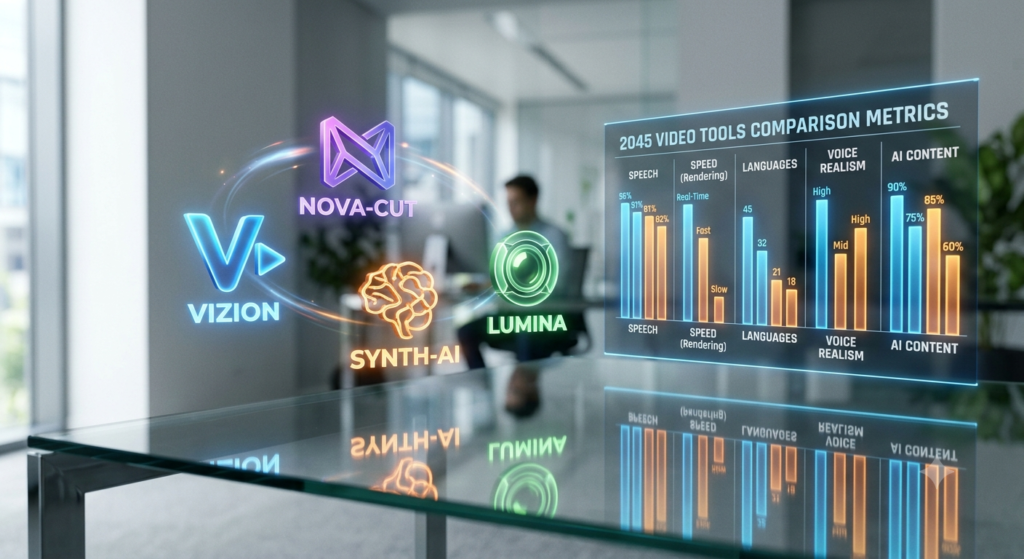
For language range, Synthesia leads with forty-plus languages. CreatorKit follows at twenty-plus, then HeyGen at fifteen-plus, MakeUGC at ten-plus, and Creatify at four to six.
For voice realism, HeyGen and MakeUGC sit at the top. Synthesia is close behind. Creatify prioritizes speed over polish.
For generation speed, Creatify wins at five minutes per video. CreatorKit is next at ten to fifteen minutes. MakeUGC and Synthesia take fifteen to thirty minutes. HeyGen is slowest at thirty to sixty minutes.
For price, Synthesia starts at eighteen dollars per month. Creatify starts at twenty-nine dollars. CreatorKit and HeyGen both start at ninety-nine dollars. MakeUGC starts at one hundred ninety-nine dollars.
Which AI Voiceover Platform Should You Choose?
If you’re still trying to compare AI voiceover options in UGC video tools for your specific use case, the decision usually comes down to budget, language needs, and content format.
If you’re testing faceless UGC ads for the first time on a tight budget, start with Creatify. The voiceover quality is good enough for social ads and the turnaround is the fastest available.
If you’re running international campaigns across multiple languages, Synthesia gives you the widest language coverage at the lowest price for an avatar platform.
If you’re a founder wanting to scale video content using your own face, HeyGen’s custom avatar feature is the most powerful option available.
If your content is primarily explainer videos or product demos for YouTube, MakeUGC delivers the best combination of voice quality and template variety.
If you’re a SaaS brand producing high volumes of screen recording tutorials, CreatorKit handles voiceover, editing, and captioning in one workflow.
The Two-Tool Strategy That High-Volume Brands Are Using
Most serious content teams in 2026 don’t rely on a single platform after they compare AI voiceover options in UGC video tools. The most common approach is using Creatify for rapid social media ad testing and one avatar platform — Synthesia or HeyGen — for YouTube and B2B content.
This two-tool setup costs roughly two hundred dollars per month combined and covers almost every content format a brand needs.
Creatify handles fast volume at low cost. The avatar platform handles polished, trust-building content for warmer audiences. Both tools together cost far less than traditional video production.

Conclusion
When you compare AI voiceover options in UGC video tools, there is no single winner for every brand. Synthesia wins on language range. HeyGen wins on voice realism and avatar customization. Creatify wins on speed and affordability. MakeUGC wins on professional quality. CreatorKit wins for tutorial workflows.
Pick the tool that matches your content format, budget, and volume. Start with one platform, generate ten to twenty videos, and let the data tell you what’s working.
Frequently Asked Questions
Which AI voiceover tool supports the most languages? Synthesia leads with over forty languages, making it the strongest choice for international campaigns, video localization, and global training content. This is usually the first thing brands check when they compare AI voiceover options in UGC video tools.
Is AI voiceover quality good enough for brand YouTube channels? Yes, if you use MakeUGC or HeyGen. Both produce voice quality that holds up well in longer-form YouTube content. Creatify is better for short-form social ads.
Can I use AI voiceover tools for client work as an agency? Yes. All five platforms include commercial licensing on paid plans. Creatify’s unlimited plan at ninety-nine dollars per month is the most cost-effective for agencies managing multiple accounts.
Do these platforms let me adjust voice tone and pacing? MakeUGC and HeyGen offer the most control over tone, pacing, and pronunciation. Creatify and CreatorKit offer less manual customization but make up for it with automation speed.
Which platform is best for TikTok and Instagram Reels? Creatify is purpose-built for short-form social ads. Avatar-based tools like Synthesia and HeyGen perform notably worse on these platforms compared to faceless demo-style content.
Can I switch between platforms without losing my work? Yes. All platforms export standard MP4 files, so you’re never locked in. Many brands test on Creatify first, then move winning creatives to a higher-quality platform for refinement.
What about video copyright and ownership? All AI-generated content on these platforms is yours to use commercially. You own the videos outright — no usage rights negotiations needed.
Key Features to Check Before Choosing an AI Voiceover Platform
Before you commit to any platform, a few specific features are worth checking beyond just language count and price — these are the details that really matter once you compare AI voiceover options in UGC video tools side by side.
Voice cloning is worth asking about. Some platforms, especially HeyGen, let you clone your own voice so the AI narration sounds like you. For personal brands and founders, this is a significant advantage over generic AI voices.
Accent variety within a language matters more than most brands realize. A platform might support English, but only in one neutral American accent. If your audience is British, Australian, or South Asian, a single-accent option creates a disconnect.
Pronunciation controls are the difference between a polished video and an embarrassing one. Product names, brand terms, and industry jargon often get mispronounced by AI systems. Platforms like MakeUGC and HeyGen let you manually correct these, while simpler tools don’t.
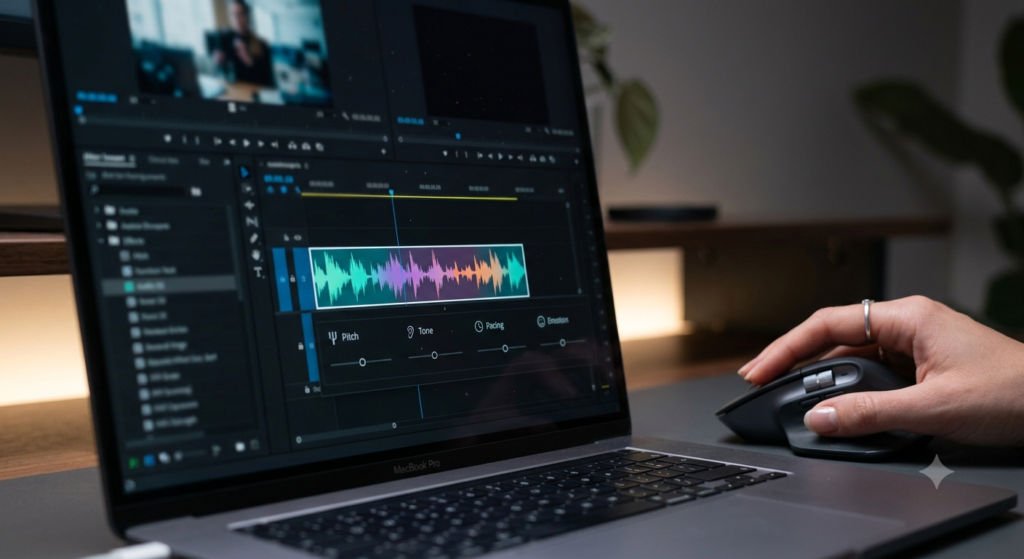
Emotion and tone range is another factor. Some platforms only produce flat, neutral narration. Others let you select confident, conversational, or authoritative tones depending on the content. For ad creatives, tone directly affects how a viewer feels about the brand.
Export format flexibility matters if you’re distributing across multiple platforms. Most tools export MP4, but checking whether captions are embedded, whether the audio track can be exported separately, and what resolution options exist saves headaches later in your workflow.
How AI Voiceover Tools Fit Into a Larger Content Strategy
AI voiceover tools work best when they’re part of a broader UGC video creation system, not a standalone solution.
The most effective brands use AI voiceover for rapid variation testing on social ads, where generating twenty different hook angles in a single afternoon would be impossible with traditional production.
They use higher-quality avatar platforms like HeyGen or Synthesia for content that needs to build trust over time — YouTube explainers, onboarding videos, and brand education content where a viewer spends five to fifteen minutes with your material.
And they keep human UGC creators in the mix for lifestyle content, authentic product moments, and any scenario where a real person’s reaction genuinely can’t be replicated by AI. The goal is using each tool for what it does best rather than trying to replace every content format with one solution — which is really the whole point of learning to compare AI voiceover options in UGC video tools in the first place.
