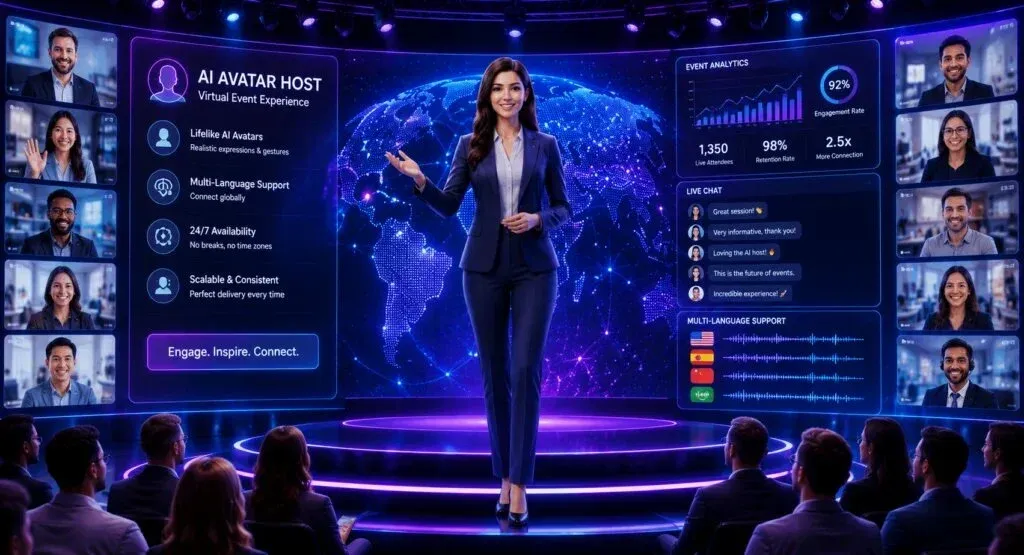
Virtual events have moved far beyond plain video calls, and the top AI avatar tools for virtual event hosting are the biggest reason why. From online conferences and webinars to product launches and training sessions, AI-powered digital hosts now bring the polish, consistency, and audience engagement that used to require a full production team. Event organizers across industries are turning to these tools because they solve real, recurring problems — time zone chaos, speaker no-shows, and inconsistent delivery across multiple sessions.
What Are AI Avatar Tools and How Do They Work
AI avatar tools are platforms that generate realistic video presenters from a simple script. They handle natural voice delivery, lip-sync, and lifelike gestures, turning text into a fully hosted segment in minutes. This is exactly why the top AI avatar tools for virtual event hosting have become a go-to backup and primary solution for so many organizers.
A keynote speaker cancelling four hours before a 300-person conference is the kind of moment these tools are built for. An AI-generated presenter can step in instantly, deliver the content smoothly, and the audience often doesn’t even notice the switch.
Under the hood, most platforms rely on a combination of neural text-to-speech, facial animation models, and pre-trained avatar libraries. The organizer types or pastes a script, picks a voice and avatar, and the system renders a finished video in a matter of minutes rather than the hours or days a traditional video shoot would take. Some platforms also support voice cloning, letting a real host’s voice be reused across dozens of sessions without them ever stepping in front of a camera again. This is part of why the top AI avatar tools for virtual event hosting are being adopted not just by large enterprises but by small teams running weekly webinars on tight budgets.
Why AI Avatars Are Becoming Essential for Virtual Event Hosting
Global audiences spread across Tokyo, Berlin, and São Paulo make scheduling a live human host a losing battle. An AI host performs at the same energy level no matter the timezone, with no jet lag and no dropped lines. This consistency is a major reason the top AI avatar tools for virtual event hosting are now considered standard infrastructure rather than a novelty.
They are also cost-effective. Companies can produce professional event hosting segments without studios, cameras, or a dedicated production crew, which matters most for recurring webinars, training events, and large-scale online education programs.
There’s also a reliability angle that often gets overlooked. Live hosts get sick, deal with internet outages, or simply have an off day where energy dips halfway through a three-hour session. An AI avatar delivers the same tone, pacing, and clarity on take one and take one hundred. For event teams running weekly or monthly programming, this predictability turns hosting from a recurring logistical headache into a solved problem. It also frees up human presenters to focus on the parts of an event that genuinely need a human touch — live audience interaction, improvisation, and relationship building — while the top AI avatar tools for virtual event hosting handle the repetitive, scripted segments in the background.
Key Features to Look for in the Best AI Avatar Tools
When comparing the top AI avatar tools for virtual event hosting, focus on a few core features: customizable avatars, accurate lip synchronization, multilingual support, and script-to-video workflows. Strong analytics to measure audience response is also worth prioritizing.
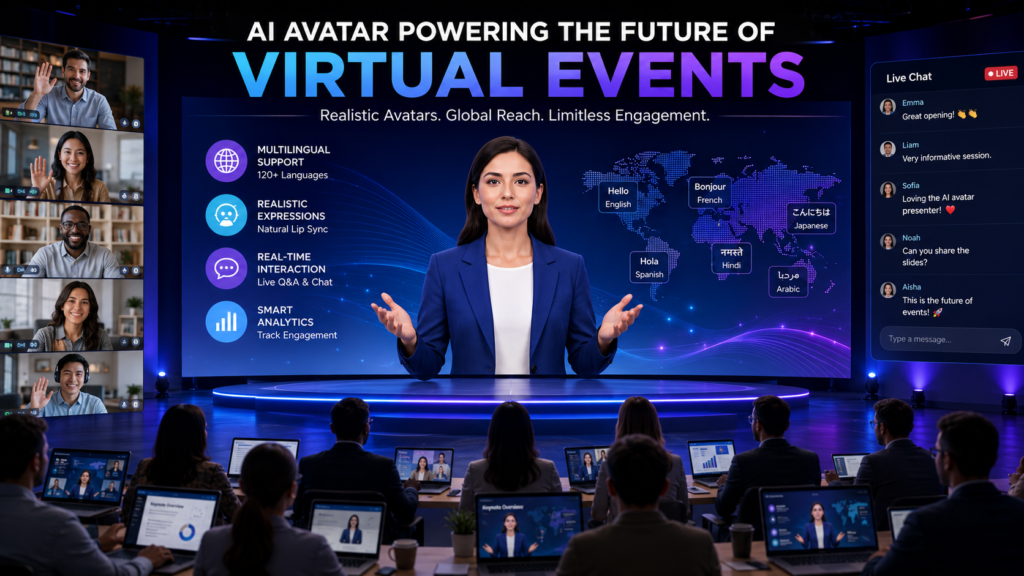
Top 5 Tools Worth Testing in 2026 — Full Comparison
These are consistently ranked among the top AI avatar tools for virtual event hosting based on real event use cases. Use the table below for a quick side-by-side comparison before reading the detailed breakdown.
| Tool | Best For | Avatars | Languages | Standout Feature | Starting Price |
|---|---|---|---|---|---|
| HeyGen | Marketing-led events & product launches | Custom + stock | 175+ | Avatar IV micro-expressions, near-native lip-sync | ~$29/month |
| Synthesia | Enterprise conferences & regulated industries | 230+ | 140+ | SOC 2 Type II compliance | Custom/Enterprise |
| D-ID | Interactive Q&A & virtual booths | Custom | Multiple | Real-time responsive avatars | Usage-based |
| DeepBrain AI | Hyper-realistic, large-scale deployments | Custom | 150 | Gesture control + real-time generation | Custom/Enterprise |
| Colossyan | Multi-speaker, training-heavy events | 200+ | Multiple | Branching scenarios for engagement | Team plans |
HeyGen — best for marketing-led events and product launches. Its Avatar IV technology delivers natural micro-expressions and supports 175+ languages with near-native lip-sync, plus unlimited video generation on paid plans starting around $29/month.
Synthesia — best for enterprise conferences and regulated industries. SOC 2 Type II compliance, 230+ avatars, and 140+ language support make it the safer pick for structured, repeatable formats like onboarding and town halls.
D-ID — best for interactive Q&A and virtual booths. Unlike most pre-rendered tools, D-ID avatars can respond dynamically to audience input, making it useful for live moderation and booth representatives.
DeepBrain AI — best for hyper-realistic, large-scale deployments. With 150 languages, gesture control, and real-time generation, it’s built for organizations running serious event infrastructure.
Colossyan — best for multi-speaker, training-heavy events. With 200+ avatars and branching scenarios, it bridges presentation and audience participation effectively.
How to Choose the Right Tool for Your Event
Picking from the top AI avatar tools for virtual event hosting comes down to matching the platform to the event format, not just the feature list. A few questions help narrow the decision:
- How much live interaction do you need? If your event includes real-time Q&A booths or a virtual receptionist, prioritize D-ID or DeepBrain AI over purely pre-rendered tools.
- What’s the compliance requirement? Regulated industries like finance, healthcare, or government training programs should lean toward Synthesia because of its SOC 2 Type II compliance.
- How many languages does your audience speak? For truly global rollouts, DeepBrain AI’s 150-language support and HeyGen’s 175+ languages are the strongest options.
- Is the content training-heavy or marketing-heavy? Colossyan’s branching scenarios suit corporate training and onboarding, while HeyGen’s Avatar IV is built for punchy, high-energy marketing content.
- What’s the budget? HeyGen offers the most accessible entry point at roughly $29/month, while Synthesia and DeepBrain AI typically require custom enterprise pricing for larger deployments.
Running a short pilot with two or three shortlisted tools on the same script is the most reliable way to compare rendering quality, voice naturalness, and turnaround time before committing to a single platform for an entire event series.
Pricing Breakdown: What to Expect
Budget is often the deciding factor once the feature comparison narrows the list down. Here’s a rough sense of what organizers typically pay across the top AI avatar tools for virtual event hosting:
Keep in mind that most vendors charge per rendered minute of video, per seat, or a hybrid of both, so the real cost depends heavily on how many sessions, languages, and revisions an event actually needs.
Common Use Cases at Virtual Events
Event organizers typically deploy these tools for conference openings and closings, session intros, sponsor messages, and basic Q&A moderation. Each use case benefits from the same core strength of the top AI avatar tools for virtual event hosting: perfect consistency across every session, no matter how many times the content repeats.
Sponsor segments in particular tend to get rushed by live hosts, but a pre-produced AI avatar segment guarantees full, on-brand delivery every single time.
Benefits for Businesses and Educators
Beyond cost savings, these tools reduce presenter performance pressure and allow content to scale across global audiences through multilingual delivery. Educators running upskilling programs use the top AI avatar tools for virtual event hosting to simulate real-world scenarios and maintain consistent instruction across many sessions without needing to be present for each one.
Challenges and Limitations
No avatar tool is perfect. Some platforms still show occasional robotic expressions or limited body movement, and output quality depends heavily on how well the script is written. Cultural sensitivity also needs manual review — avatar diversity doesn’t automatically account for idioms, humor, or references that don’t translate across regions.
The Future of AI Hosting at Virtual Events
Adoption of the top AI avatar tools for virtual event hosting is accelerating alongside improvements in real-time rendering and emotional expressiveness. Expect near-term progress in a few directions: avatars that react to live chat sentiment mid-session, tighter integrations with event platforms like Zoom and Hopin so avatars can be triggered automatically between segments, and better on-the-fly translation that lets one script play out in a dozen languages simultaneously without separate recording passes.
As these tools mature, the line between “backup host” and “primary host” will likely keep blurring, especially for recurring formats like weekly product demos, internal town halls, and evergreen onboarding sessions where consistency matters more than spontaneity.
Practical Tips to Get Started
Start small: test a single session intro before committing to a full event. Write modular scripts broken into segments — opening, intros, Q&A bridge, closing — so individual pieces can be re-rendered without redoing everything. Always keep an offline backup file ready in case of streaming issues.
A few more habits that tend to separate smooth AI-hosted events from awkward ones:
- Write for the ear, not the eye. Short sentences and natural pauses render far more convincingly than dense, formal paragraphs.
- Review every render before the live event. Even the best tools occasionally mispronounce names or technical terms — always do a full playback check.
- Match avatar tone to event tone. A high-energy avatar style that works for a product launch can feel out of place at a formal compliance training session.
- Version-control your scripts. Keep a simple changelog of which script version maps to which rendered video, especially for multi-language events.
- Budget time for revisions. Even fast rendering tools need a review-and-fix cycle before content goes live, so don’t schedule a render for the same hour as the event.
Conclusion
The top AI avatar tools for virtual event hosting aren’t replacing human connection — they’re handling the scaffolding around it: the opens, the transitions, the sponsor reads, and the consistent sign-offs. For any event that crosses timezones, recurs regularly, or has faced no-show chaos before, testing one of these tools on the next session is a low-risk way to see the impact firsthand.
FAQs
What is the best AI avatar tool? It depends on the use case, but HeyGen and Synthesia are widely regarded as leaders among the top AI avatar tools for virtual event hosting.
Can AI avatars interact with live audiences? Yes, tools like D-ID and DeepBrain AI support real-time conversational interaction, while pre-rendered tools like standard Synthesia deliver scripted content only.
Is it worth it for smaller events under 100 people? For one-off small events, a live host may be simpler. For recurring small events, the time saved by batch-producing intros usually justifies the cost.
Can the same avatar be reused across multiple events? Yes, most platforms let you save a custom avatar and reuse it across an entire event series, building consistent brand recognition over time.
