
Picture this: you’ve found the house, the offer’s accepted, and everyone’s already mentally picking paint colors — and then, three days before closing, someone discovers an old lien nobody knew about. It happens more often than people think.
This is the exact problem a real estate title search tool was built to solve. It checks public property records, digs up the ownership history of a home or piece of land, and flags problems like unpaid loans or old legal claims — all using artificial intelligence instead of a person flipping through paper files by hand.
If you’re buying a house, refinancing, or working anywhere in real estate, this one tool can quietly decide how fast — and how safely — your deal actually closes.
Most people never think about a title search until something goes sideways. But a clean title is the foundation every safe property deal sits on, and a good real estate title search tool is changing how that foundation gets built — in minutes now, instead of days.

Why a Real Estate Title Search Tool Matters More Than Ever
At its core, a title search answers two questions: who really owns this property, and is anything attached to it — a lien, a debt, an old claim nobody settled? Most buyers get so focused on the house itself — the kitchen, the backyard, the school district — that they forget this step exists at all, until their agent or lawyer brings it up.
This is exactly where an AI-powered title search platform earns its keep. It traces the full chain of ownership, from the very first recorded owner all the way to whoever’s selling the property today. If there’s a gap anywhere in that chain, or a transfer that never got properly recorded, the buyer could inherit legal trouble they never signed up for.
A solid real estate title search tool also protects buyers from things like:
- Unpaid property taxes left behind by a previous owner
- Old contractor bills that quietly turned into liens on the property
- Court judgments attached to the land itself, not just the person
- Sellers who don’t actually, legally own everything they’re offering to sell
Do the search well, and ownership transfers cleanly. Miss it, or rush it, and buyers can end up in costly legal fights long after the moving trucks have already left.
The Old Way: Why Manual Title Search Was So Painful
Before AI showed up, a property title search meant sending an actual person down to the courthouse to dig through county clerk files and decades-old paper documents, one page at a time. Slow. Expensive. And honestly, easy to get wrong.
A manual search usually dragged on for three to five business days. Cost ranged anywhere from around five hundred dollars to over two thousand, depending on how tangled the property’s history turned out to be. And because a tired human was reading hundreds of pages under a deadline, mistakes crept in — not out of carelessness, just fatigue.
Here’s the thing, though: the real risk was never just the time or the money. A missed lien or an overlooked gap in ownership could unravel an entire deal months after closing, when it’s far harder — and far more expensive — to fix. Every transaction also had to sit and wait on that search, creating a bottleneck that slowed down buyers, sellers, and agents alike.
That bottleneck is precisely the gap a modern real estate title search tool was built to close.
How a Real Estate Title Search Tool Actually Works
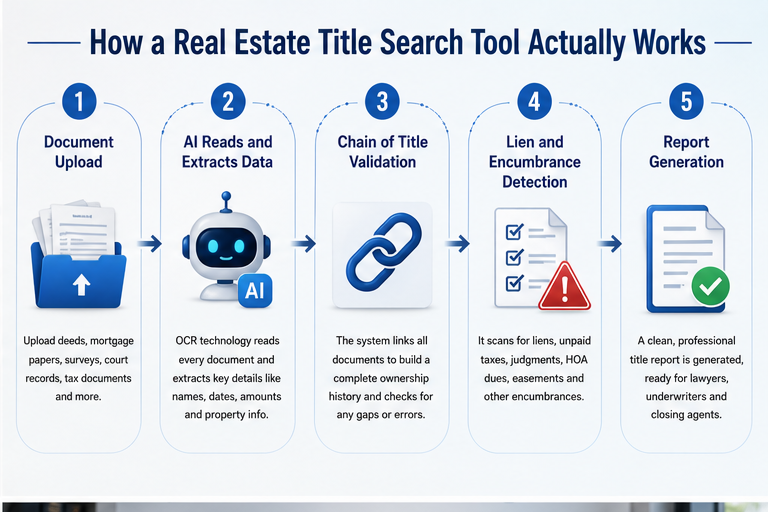
Once you see the steps laid out, the whole process feels a lot less like magic and a lot more like, well, just good engineering.
Step 1: Document Upload
You start by feeding the tool your source documents — deeds, mortgage papers, surveys, court records, tax filings, whatever you’ve got. Most platforms accept scanned PDFs, phone photos, and digital files, and you can dump everything in at once. You don’t even need to label what’s what; the system figures that part out on its own.
Step 2: AI Reads and Extracts the Data
This is where optical character recognition — OCR, for short — takes over. It reads every word on every page, even faded handwriting or low-quality scans that would slow a human reader to a crawl. Once the text is machine-readable, the AI sorts documents by type — a warranty deed gets tagged as a warranty deed, a power of attorney gets flagged separately — and pulls out the details that actually matter: names, dates, dollar amounts, legal property descriptions.
Step 3: Chain of Title Validation
Next, the system stitches everything together into a full ownership timeline. This is where an AI title search tool really earns its reputation, because it can cross-check every document against every other document simultaneously — something no human could realistically do at speed. If a deed from one year lists a different legal description than a later deed for the same property, that mismatch gets flagged instantly.
Step 4: Lien and Encumbrance Detection
Once the ownership chain is built, the tool scans for anything that could hit the buyer’s wallet later: unpaid loans, tax debts, HOA dues, court judgments, easements. This step is arguably the most valuable part of any automated title search tool, because it’s exactly the kind of thing that traditionally surfaced only after closing, when it’s already too late to renegotiate.
Step 5: Report Generation
Finally, everything gets compiled into one clean, professional document — a title abstract that lawyers, underwriters, and closing agents can use right away. What used to take three-plus business days to prepare by hand can now be ready before lunch.
Speed, Accuracy and Cost: The Real Benefits of an AI Title Search Tool
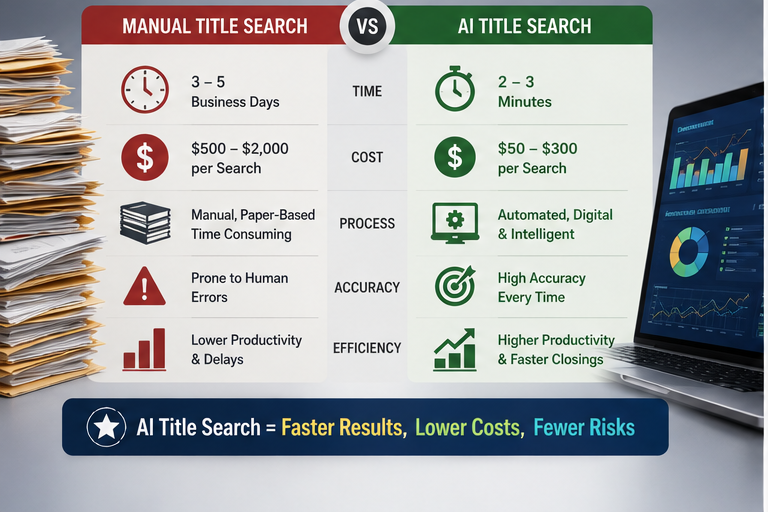
Before getting into the details, here’s the difference in one glance:
| Factor | Manual Title Search | AI Title Search Tool |
|---|---|---|
| Turnaround time | 3–5 business days | 2–3 minutes (processing) |
| Typical cost | $500 – $2,000 | $50 – $300 |
| Consistency | Varies by examiner, fatigue-prone | Same level of scrutiny every time |
| Best for | Complex, contested, or trust-based ownership | Routine searches with clean digital records |
| Error risk | Higher on long, repetitive documents | Low, but depends on source record quality |
| Human review needed? | Yes, throughout | Yes, for final sign-off only |
| Scalability | Limited by examiner headcount | Handles high volume easily |
Honestly, the business case here isn’t subtle. A real estate title search tool that shrinks a multi-day process down to a few minutes — while also cutting cost and improving accuracy — turns the question from “should we try this?” into “why haven’t we switched already?”
From Days to Minutes
Traditional searches take three to five business days. A modern AI-driven title search tool processes the same documents in roughly two to three minutes. That difference changes how closings feel for everyone involved — buyers wait less, sellers move faster, and agents can handle more deals without sacrificing quality.
Lower Costs, Bigger Savings
Manual searches typically run between five hundred and two thousand dollars. AI-powered tools generally charge somewhere between fifty and three hundred dollars per search — a savings of roughly 75 to 87 percent. Scale that across a company running a thousand searches a year, and switching from manual to an automated real estate title search tool can save well over eight hundred thousand dollars annually. That’s not a small efficiency gain; that’s a different cost structure entirely.
Fewer Human Errors
AI gives the same level of attention to every single document, every single time. It doesn’t get tired at 4 p.m. on a Friday, and it doesn’t skip a step just because a file looks familiar. That consistency is a big part of why accuracy improves so noticeably once a firm switches to an automated title search tool.
Catching Problems Earlier
A good title search system flags issues — outstanding litigation, unresolved tax debt, competing ownership claims — right at the start of due diligence, instead of at the closing table, where fixing them is far more expensive and far more stressful for everyone in the room.
Staying Competitive
Recent research shows a large majority of buyers now use AI tools like ChatGPT somewhere in their property search journey. Firms that still lean entirely on manual title examination risk losing deals to competitors who can hand over a clear-to-close status two or three days faster.
The Technology Behind a Real Estate Title Search Tool
What feels like magic on the surface is really just a handful of well-established technologies working together.
Optical Character Recognition (OCR) — Most property records are scanned images, not clean digital text — plenty of them decades old, faded, or handwritten. OCR turns these scanned pages into machine-readable text so the AI can actually work with them, even when the document quality is far from ideal.
Machine Learning — By the time the system sees your documents, it’s already studied thousands of historical deeds and filings. Since most title documents follow recognizable patterns — grantor, grantee, legal description, notary section — the model already knows where to look for each piece of information, even as formatting shifts across decades and counties.
Natural Language Processing (NLP) — This is what makes the tool feel conversational instead of rigid. Instead of typing out exact technical search strings, users can just describe what they need in plain language, and the system picks up on the intent behind the request.
Data Extraction and Structuring — Raw documents are messy by nature — key details scattered across paragraphs, tables, and margin notes. The tool pulls out names, dates, amounts, and legal descriptions, then organizes them into a clean, searchable property records database. It’s also a big reason final reports get generated so quickly.
Integration with Existing Systems — Most modern platforms connect through APIs to loan origination systems and existing title management software. That means a firm can bolt on real estate title search tool capability without ripping out the systems their team already knows how to use.
What an AI Title Search Tool Cannot Do (And When You Still Need a Human)
This part matters just as much as everything above it. No tool is perfect, and any responsible real estate title search tool should never be sold — or treated — as a full replacement for human judgment.
Complex legal situations still need a real person in the loop. Contested ownership between multiple heirs, property tangled up in family trusts, boundary disputes that need survey interpretation, decades-old court orders — all of that requires legal reasoning that current AI simply can’t handle reliably on its own. Think of an AI-generated summary as a fast first draft, not a final legal opinion.
The tool is also only as good as the data it’s fed. If county records are incomplete, poorly digitized, or missing pages outright, the AI is working from a partial picture — and it won’t necessarily know that. Areas with older or less complete public records still need experienced human review to catch what the system might quietly miss.
And AI can’t read people. Real estate deals come loaded with real pressure, real timelines, real personal circumstances. Deciding whether a buyer should wait out a title issue, or whether a seller might budge on price, takes human judgment no algorithm can replace.
The Best Approach: AI and Human Expertise Together

The most effective setup right now isn’t AI alone, and it isn’t humans alone either — it’s both, working within a clear structure. A well-built real estate title search tool handles roughly 80 percent of the routine grind: reading documents, building the chain of title, flagging standard liens, and producing a structured first draft in minutes. A qualified human examiner then reviews that draft, interprets anything flagged as unusual, and signs off on the report with professional authority.
This hybrid approach combines the speed and consistency of automated title examination with the judgment and experience only a trained professional brings to the table. It’s faster than doing everything by hand, and more reliable than trusting automation alone — which is exactly why it’s quickly becoming the standard across the title search industry in 2026.
Choosing the Right Real Estate Title Search Tool
Not every platform is built the same way, so it’s worth being a little picky here. Look for a real estate title search tool that’s transparent about where its data comes from, clear about turnaround times, and upfront about the fact that a human still needs to sign off before anything is final. If a provider claims their AI report is legally binding on its own with zero human review, that’s a red flag, not a selling point.
It also helps to check how well the tool integrates with whatever loan origination or title management software your team already runs. The best real estate title search tool for a small independent agent probably isn’t the same one a large title company needs — so match the tool to the scale of your actual workload, not the flashiest feature list.
Frequently Asked Questions About Real Estate Title Search Tools
Is a real estate title search tool legally valid on its own? Usually not by itself. In most cases, the AI-generated report works as a fast preliminary draft. A licensed title professional or attorney still needs to review and finalize it before it becomes the official document used at closing.
How accurate is a real estate title search tool compared to a human? For routine searches with clean digital records, accuracy is very high, since the system checks every document with the same consistency every single time. Accuracy only drops when the source records themselves are incomplete or poorly scanned — which is exactly why human review still matters.
Do small real estate firms need this technology, or only large title companies? If anything, smaller firms often benefit the most. A real estate title search tool can cut costs by 75 to 87 percent and free up staff time, without demanding a huge upfront investment in new systems or training.
Can a title search tool replace title insurance? No — and it’s not meant to. A title search tool identifies risks before closing, while title insurance protects buyers and lenders against issues that surface later. The two work together; neither one substitutes for the other.
How long does an AI title search actually take, start to finish? The AI processing itself usually wraps up in two to three minutes once documents are uploaded. Add in human review and finalization, and most firms still deliver a complete report the same day — a fraction of the three to five business days a manual search typically needs.
What documents do I need to run a title search? At minimum, you’ll want the current deed, the property’s legal description, and any prior mortgage or lien documents you have. Most tools can also pull additional records — tax filings, court judgments, survey reports — directly from public databases, so you don’t need to track down everything yourself.
Is my data safe when I upload sensitive property documents to an AI tool? Reputable title search platforms use encryption for both storage and transmission, and many follow industry compliance standards similar to those used in banking and mortgage software. It’s still worth checking a provider’s specific security certifications before uploading sensitive financial or legal documents.
Can a real estate title search tool handle commercial properties, not just residential ones? Yes, most modern platforms handle both, though commercial properties often come with more complex ownership structures — multiple entities, easements, zoning overlays — so human review tends to play a bigger role in commercial title searches than in straightforward residential ones.
What happens if the AI tool misses something or gets a detail wrong? This is exactly why the hybrid model exists. A qualified human examiner reviews the AI-generated draft before it’s finalized, catching anything the system misread or missed — which is also why responsible providers never market the AI report alone as a final legal document.
Conclusion
A real estate title search tool isn’t some optional feature for tech-forward firms anymore — it’s quietly become the baseline that buyers and professionals expect. The shift from days-long manual searches to minutes-long automated reports is saving real money, cutting real risk, and giving early adopters a genuine edge over firms still stuck in the old process.
The smartest move for 2026 isn’t choosing between AI and human expertise. It’s combining both — getting the speed of a real estate title search tool without losing the careful judgment a good closing actually depends on.
