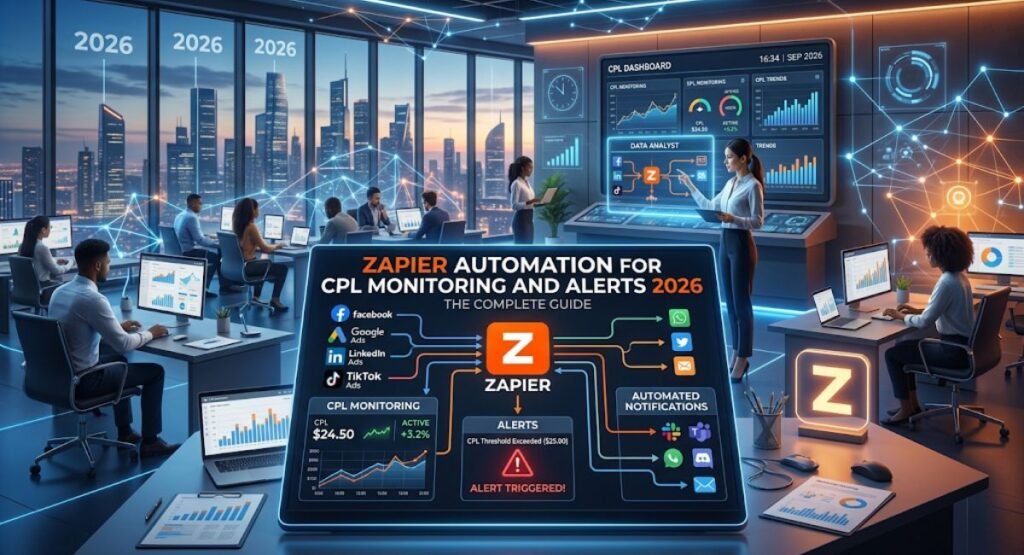
Cost per lead (CPL) is one of the numbers that can make or break a marketing budget, and in 2026, watching it manually is no longer realistic. Campaigns run across Google Ads, Meta, LinkedIn, TikTok, and half a dozen landing pages at once, and CPL can spike within hours if something goes wrong. This is exactly where Zapier automation for CPL monitoring and alerts 2026 becomes a game changer for marketers, agencies, and growth teams who need to catch cost spikes before they burn through the budget.
In this guide, we’ll break down what CPL monitoring actually means, why Zapier is one of the best no-code tools for building automated alert systems, how to set it up step by step, the pros and cons of relying on Zapier for this task, and a detailed comparison with other automation platforms. By the end, you’ll have a clear roadmap to build your own Zapier automation for CPL monitoring and alerts 2026 without writing a single line of code.
What Is CPL Monitoring and Why It Matters in 2026
CPL, or cost per lead, is the amount of money spent to acquire one qualified lead through a marketing campaign. Monitoring CPL means tracking this number continuously so you can react the moment it crosses a threshold you consider unhealthy. This is precisely the gap that a Zapier automation for CPL monitoring and alerts 2026 setup is designed to fill.
In 2026, ad platforms change their algorithms constantly, auction costs fluctuate hour by hour, and audience fatigue can hit a campaign overnight. A CPL that looked great on Monday can double by Wednesday if nobody is watching. Manual checking through dashboards, once or twice a day, simply isn’t fast enough anymore. This is why marketing teams are shifting toward automated, real-time CPL tracking tools connected to instant alert systems.
Without proper monitoring, teams often discover budget problems only after a week or a full billing cycle, by which point thousands of dollars may already be wasted on underperforming ad sets. A Zapier automation for CPL monitoring and alerts 2026 workflow closes that gap almost entirely.
Why Use Zapier for CPL Monitoring and Alerts 2026
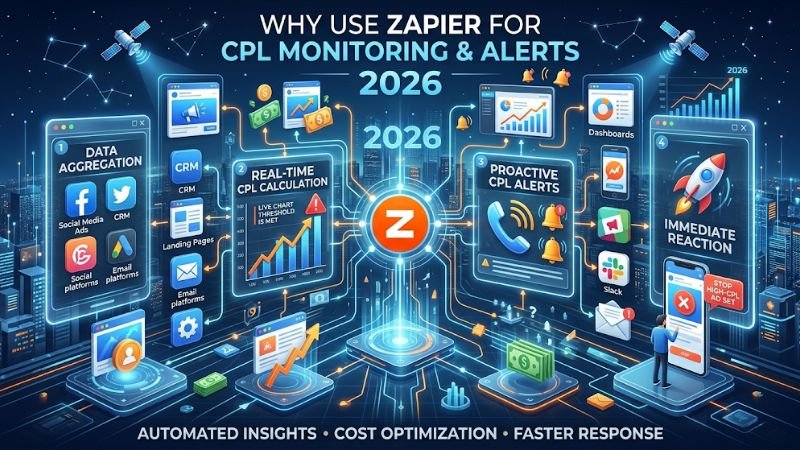
Zapier is a no-code automation platform that connects thousands of apps — Google Ads, Facebook Ads Manager, Google Sheets, Slack, CRM tools, and email platforms — without needing a developer. This makes it one of the most practical choices for building a Zapier automation for CPL monitoring and alerts 2026 workflow, especially for small and mid-sized marketing teams that don’t have an in-house engineering resource.
Here’s why Zapier fits so well into CPL monitoring and alerts:
- No coding required – Marketers can build their own automation without depending on a developer.
- Wide app ecosystem – It connects almost every major ad platform, spreadsheet tool, CRM, and messaging app used in lead generation.
- Real-time triggers – Zapier can check data at short intervals and fire instant alerts through Slack, email, or SMS-connected apps.
- Custom logic with Filters and Paths – You can set exact CPL thresholds so alerts only fire when something actually needs attention.
- Scales with your stack – As you add new ad accounts or lead sources, you simply add new Zaps rather than rebuilding a whole system.
This combination of accessibility and flexibility is why a Zapier automation for CPL monitoring and alerts 2026 workflow has become a standard part of modern marketing automation stacks.
How Zapier Automation for CPL Monitoring and Alerts 2026 Works
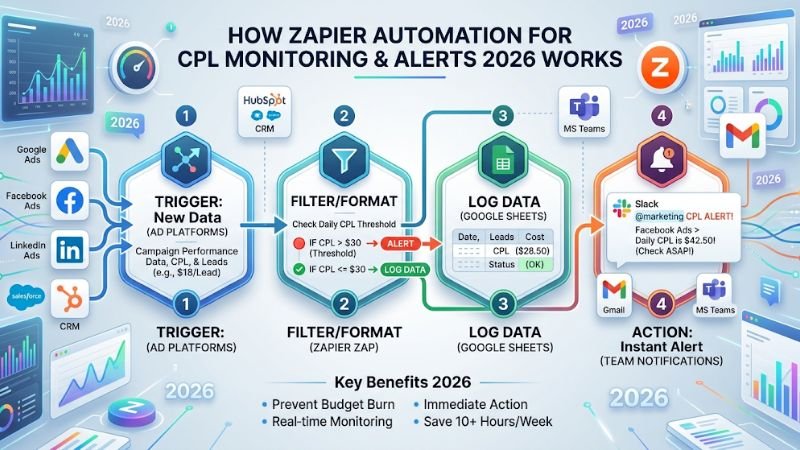
Setting up a Zapier automation for CPL monitoring and alerts 2026 workflow isn’t complicated once you understand the basic building blocks: a trigger, a data pull, a calculation step, a filter, and an alert action. Here’s a practical walkthrough.
Step 1: Connect Your Ad Platforms
Start by connecting the ad accounts you want to track — Google Ads, Meta Ads, LinkedIn Ads, or any platform that generates leads. Zapier’s native integrations or its Ads-related connectors pull campaign spend and lead volume data on a schedule you define.
Step 2: Pull Spend and Lead Data on a Schedule
Use a Schedule by Zapier trigger to pull fresh data every hour, every few hours, or daily, depending on how aggressively you’re spending. For high-budget campaigns, hourly checks are common; for smaller accounts, a few times a day is usually enough.
Step 3: Calculate CPL Automatically
Once spend and lead count are pulled, a Formatter by Zapier step can divide total spend by total leads to generate a live CPL figure. This number becomes the core metric that your entire Zapier automation for CPL monitoring and alerts 2026 workflow revolves around.
Step 4: Set Filter Conditions
This is where the real automation magic happens. Using Zapier’s Filter or Paths feature, you set a rule such as: “Only continue if CPL is greater than $25” (or whatever threshold fits your campaign goals). If the condition isn’t met, the Zap simply stops — no noise, no unnecessary notifications.
Step 5: Trigger Instant Alerts
When CPL crosses your defined threshold, Zapier sends an alert through your channel of choice:
- A Slack message to your marketing channel
- An email to the campaign manager
- A row added to a Google Sheet dashboard for historical tracking
- A task created in Asana, Trello, or ClickUp for immediate follow-up
Step 6: Log Historical Data
A smart addition is logging every CPL check into Google Sheets or Airtable automatically, whether or not it triggers an alert. Over time, this builds a historical CPL tracking tool inside your own spreadsheet, giving you trend data for reporting and future budget planning — a core benefit of any solid Zapier automation for CPL monitoring and alerts 2026 setup.
Key Features to Look For in a Zapier Automation for CPL Monitoring and Alerts 2026 Workflow
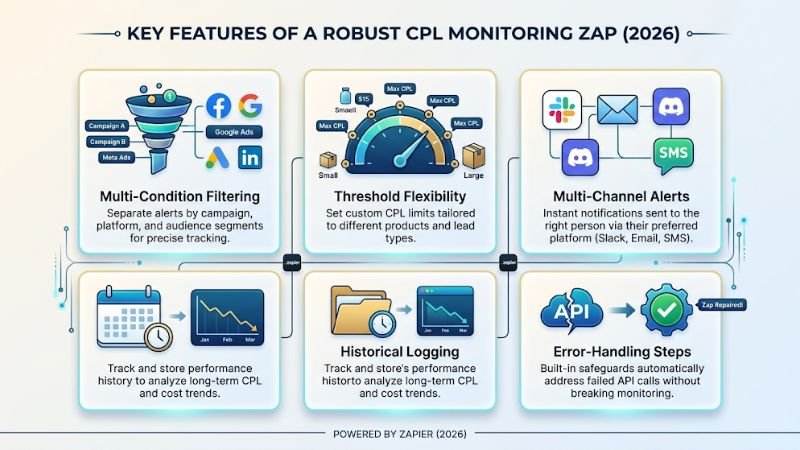
Not every Zap setup is built the same way. When designing your Zapier automation for CPL monitoring and alerts 2026 workflow, keep these features in mind:
- Multi-condition filtering so you can separate alerts by campaign, platform, or audience segment
- Threshold flexibility to set different CPL limits for different products or lead types
- Multi-channel alerts so the right person gets notified through the right app
- Historical logging to track lead cost trends over weeks and months
- Error-handling steps so a failed API call doesn’t silently break your monitoring
Getting these features right early on is what separates a reliable Zapier automation for CPL monitoring and alerts 2026 system from one that quietly fails in the background.
Pros and Cons of Zapier Automation for CPL Monitoring and Alerts 2026
Every automation approach comes with trade-offs, and a Zapier automation for CPL monitoring and alerts 2026 setup is no exception. Here’s an honest breakdown.
Pros
- Fast setup – Most CPL alert Zaps can be built in under an hour, even by non-technical marketers.
- No developer dependency – Marketing teams stay self-sufficient and don’t need to wait on IT or engineering support.
- Huge integration library – Almost every ad platform, CRM, and messaging tool marketing teams already use is supported.
- Scalable across campaigns – Adding new ad accounts or lead sources is a matter of duplicating and adjusting a Zap.
- Reduces wasted ad spend – Catching CPL spikes early can save significant budget over a campaign’s lifetime.
- Centralized reporting – Combined with Google Sheets or a dashboard tool, it becomes an easy way to visualize lead cost trends.
Cons
- Task-based pricing can get expensive – Frequent polling (like hourly checks across many campaigns) consumes Zapier “tasks” quickly, which can raise costs on higher-volume accounts.
- Polling delay, not truly instant – Zapier checks data on intervals rather than reacting to live events the second they happen, so there’s always a small lag.
- Complex logic can get messy – Advanced multi-condition alerts across many campaigns can turn into a tangle of Zaps that’s harder to maintain.
- Dependent on third-party API limits – If an ad platform’s API has rate limits or downtime, your monitoring can be delayed or interrupted.
- Limited deep customization – For very advanced statistical alerting (like anomaly detection based on trends), Zapier’s built-in logic can feel restrictive compared to a custom-built script.
Zapier Automation for CPL Monitoring and Alerts 2026 vs Alternatives: Comparison Table
| Feature | Zapier | Make (Integromat) | Native Platform Alerts | Custom API/Script |
|---|---|---|---|---|
| Ease of setup | Very easy, no-code | Easy, slightly more technical | Easiest (built-in) | Hard, requires developer |
| Real-time speed | Near real-time (interval-based) | Near real-time, often faster | Instant | Instant (fully custom) |
| Cost at scale | Can get costly with high task volume | Generally cheaper per operation | Free (built into ad platform) | Depends on hosting/dev cost |
| Cross-platform alerts | Excellent, wide app support | Excellent, wide app support | Limited to that one platform | Unlimited, fully flexible |
| Customization depth | Moderate | High | Low | Very high |
| Maintenance effort | Low | Low to moderate | Very low | High (ongoing dev needed) |
| Best for | Marketers, small-mid teams | Technical marketers, complex logic | Single-platform advertisers | Enterprises with dev resources |
For most marketing teams and agencies, Zapier hits the sweet spot between ease of use and functionality, which is why a Zapier automation for CPL monitoring and alerts 2026 setup remains the go-to choice heading into the new year.
Best Practices for Setting Up a Zapier Automation for CPL Monitoring and Alerts 2026
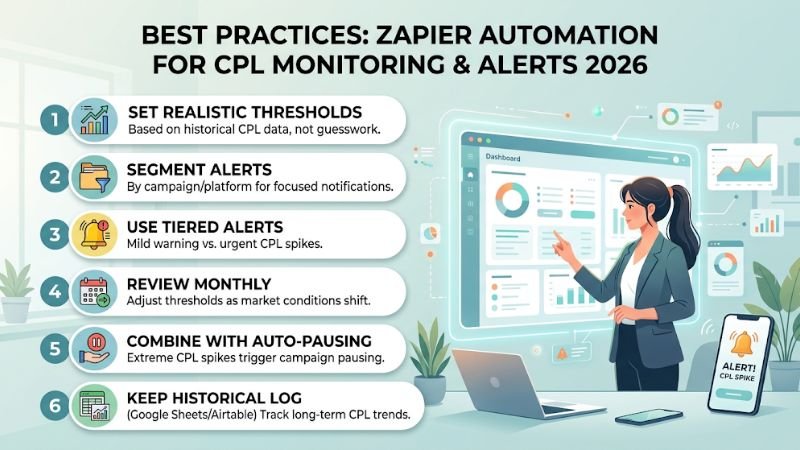
To get the most reliable results from your Zapier automation for CPL monitoring and alerts 2026 setup, keep these best practices in mind:
- Set realistic thresholds based on historical CPL data rather than guesswork.
- Segment alerts by campaign or platform so you’re not overwhelmed by a single generic notification stream.
- Use tiered alerts — a mild warning at a moderate CPL increase, and an urgent alert at a critical level.
- Review and adjust thresholds monthly as ad costs and market conditions shift.
- Combine alerts with automatic pausing (where platform APIs allow) so extreme CPL spikes can trigger a campaign pause, not just a notification.
- Keep a historical log in Google Sheets or Airtable so you can spot long-term CPL trends, not just react to daily noise.
Common Mistakes to Avoid With Zapier Automation for CPL Monitoring and Alerts 2026
- Setting thresholds too tight, causing alert fatigue where the team starts ignoring notifications
- Polling too frequently on low-budget campaigns, which wastes Zapier tasks unnecessarily
- Forgetting to add error handling, so a broken API connection goes unnoticed for days
- Sending every alert to one person instead of the right stakeholder for that campaign
- Not reviewing and refining the automation after the first month of real-world data
Tools and Apps Commonly Paired with This Setup
Building a solid Zapier automation for CPL monitoring and alerts 2026 system usually involves more than just Zapier alone. Here are the tools marketing teams most often pair with it:
- Google Sheets or Airtable – for historical CPL logging and simple dashboards
- Slack or Microsoft Teams – for instant team notifications
- Google Ads and Meta Ads Manager – as the primary data sources for spend and lead volume
- HubSpot, Pipedrive, or Salesforce – to cross-check lead quality alongside lead quantity
- Data Studio (Looker Studio) or Google Sheets charts – for visualizing CPL trends over time
- Formatter by Zapier – for the actual CPL calculation step within the workflow
Pairing these tools with a well-structured Zap turns a simple alert system into a complete lead cost tracking tool that supports both day-to-day decisions and long-term campaign optimization.
Real-World Example: How a Small Agency Used Zapier for CPL Monitoring
To understand the practical value of a Zapier automation for CPL monitoring and alerts 2026 setup, consider a small performance marketing agency running Google Ads and Meta Ads campaigns for five clients. Before automation, the account manager checked each client’s dashboard manually every morning, which meant CPL spikes that happened overnight or over a weekend often went unnoticed until Monday.
After building a Zapier automation for CPL monitoring and alerts, the agency connected each client’s ad account to a central Google Sheet that calculated CPL every two hours. A Filter step flagged any campaign where CPL rose more than 30% above its seven-day average, and a Slack alert was sent directly to the account manager responsible for that client.
Within the first month, the team caught two campaigns that had spiked overnight due to increased auction competition, allowing them to pause and adjust bids before the weekend spend ran out of control. The agency estimated it saved close to 15% of wasted ad spend across those two accounts alone — a direct result of automated, real-time lead cost tracking rather than manual daily checks.
This kind of result is fairly typical. Once a CPL monitoring and alert system is in place, most teams report faster reaction times, fewer budget surprises, and better overall campaign optimization simply because the data reaches decision-makers immediately instead of during a weekly report.
The Future of CPL Monitoring and Marketing Automation
Looking ahead, CPL monitoring is likely to become even more predictive rather than purely reactive. Instead of waiting for cost per lead to cross a fixed threshold, automation platforms are increasingly incorporating trend analysis, so alerts can fire based on the direction a metric is moving, not just its current value.
Zapier itself has been expanding its AI-powered features, allowing Zaps to include natural-language conditions and smarter data interpretation. Combined with growing native AI tools inside ad platforms, the next generation of CPL alert systems may flag likely cost increases before they even happen, based on early auction and engagement signals.
For now, though, a well-built Zapier automation for CPL monitoring and alerts 2026 workflow remains one of the most accessible ways for marketing teams to move from manual spreadsheet checks to genuine automated workflows — without hiring a developer or investing in expensive enterprise software. Whether you manage one campaign or fifty, the core idea stays the same: track cost per lead continuously, define clear thresholds, and let automation carry the burden of watching the numbers so your team can focus on strategy, creative, and ROI.
FAQs
1. What is CPL monitoring in digital marketing? CPL monitoring is the ongoing tracking of cost per lead across ad campaigns, so marketers can react quickly to cost increases instead of discovering the problem after the budget is already spent. A Zapier automation for CPL monitoring and alerts 2026 setup automates this entire process.
2. Can Zapier really send real-time CPL alerts? Zapier works on scheduled intervals rather than true instant triggers, but for most CPL monitoring use cases, checking every 30–60 minutes is close enough to real time to catch problems early.
3. Is Zapier automation expensive for CPL tracking? It depends on your task volume. Low-frequency checks on a handful of campaigns are usually affordable, but very frequent polling across many accounts can increase your monthly Zapier plan cost.
4. What apps work best with Zapier for CPL alerts? Google Ads, Meta Ads, Google Sheets, Slack, Gmail, and CRM tools like HubSpot or Pipedrive are among the most commonly used apps in CPL alert workflows.
5. Do I need coding skills to set this up? No. Zapier is a no-code platform, meaning marketers without any programming background can build a full Zapier automation for CPL monitoring and alerts 2026 system using its visual interface.
6. How is Zapier different from Make (Integromat) for this use case? Both are no-code automation tools, but Make often offers more advanced logic and lower per-operation cost, while Zapier is generally easier for beginners and has a larger app library.
7. Can Zapier automatically pause a campaign if CPL gets too high? In some cases, yes — if the ad platform’s API supports pausing campaigns and that action is available through Zapier’s integration, you can add it as a step after your alert trigger.
Conclusion
CPL monitoring is no longer something marketing teams can handle by checking dashboards once a day. With a Zapier automation for CPL monitoring and alerts 2026 setup, teams can build a reliable, no-code system that watches lead costs continuously and sends instant notifications the moment something needs attention. It’s not a perfect solution — polling delays and task-based pricing are real limitations — but for the vast majority of marketers and agencies, it offers the best balance of simplicity, flexibility, and cost-effectiveness compared to alternatives like Make, native platform alerts, or fully custom scripts.
If you’re still tracking CPL manually in 2026, now is the time to set up your first Zap. Start small with one campaign, define a sensible threshold, and let automation do the watching so your team can focus on strategy instead of spreadsheets.
Cost per lead (CPL) is one of the numbers that can make or break a marketing budget, and in 2026, watching it manually is no longer realistic. Campaigns run across Google Ads, Meta, LinkedIn, TikTok, and half a dozen landing pages at once, and CPL can spike within hours if something goes wrong. This is exactly where Zapier automation for CPL monitoring and alerts 2026 becomes a game changer for marketers, agencies, and growth teams who need to catch cost spikes before they burn through the budget.
In this guide, we’ll break down what CPL monitoring actually means, why Zapier is one of the best no-code tools for building automated alert systems, how to set it up step by step, the pros and cons of relying on Zapier for this task, and a detailed comparison with other automation platforms. By the end, you’ll have a clear roadmap to build your own Zapier automation for CPL monitoring and alerts 2026 without writing a single line of code.
