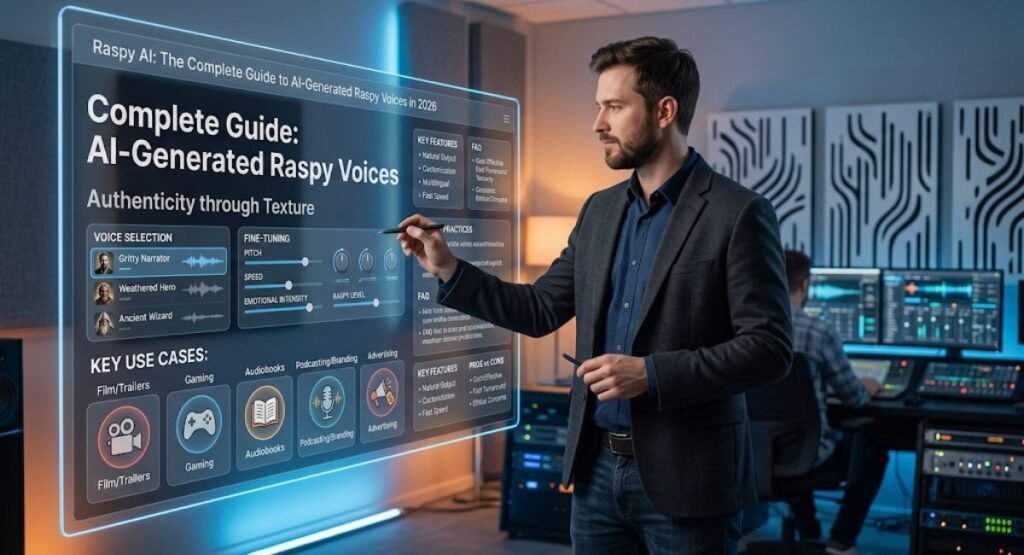
If you’ve ever listened to a movie trailer with a gravelly, weathered narrator, or heard a video game villain speak in a voice that sounds like it’s been through decades of hard living, there’s a good chance that voice was created — or at least enhanced — using Raspy AI technology. This category of voice synthesis has quickly become one of the most talked-about tools in the audio world, and creators, marketers, game developers, and podcasters are all trying to figure out how to use it effectively.
In this guide, we’ll break down exactly what this technology is, how it works, where it shines, where it falls short, and how it compares to traditional voice recording. By the end, you’ll have a complete picture of whether it’s the right fit for your next project.
What Is Raspy AI?
Raspy AI refers to artificial intelligence voice generation technology that produces a rough, gritty, textured voice output — commonly known as a “raspy” tone. Unlike smooth, polished text-to-speech (TTS) voices, this kind of tool is designed to replicate the natural imperfections of a human voice: breathiness, vocal grain, cracks, and a worn-in quality that feels lived-in and authentic.
This category of AI voice generator sits at the intersection of text-to-speech technology and voice cloning. Instead of producing a clean, corporate-sounding voice, it intentionally introduces texture and grit, making it ideal for storytelling, character voicing, and dramatic narration.
Platforms offering these gritty voice models typically let you type or paste a script, choose a raspy voice profile, and generate a fully synthesized audio file within seconds. Some tools even let you upload your own voice and apply a raspy filter on top of it, essentially turning a smooth voice into a husky, textured one.
How Does Raspy AI Voice Technology Work?
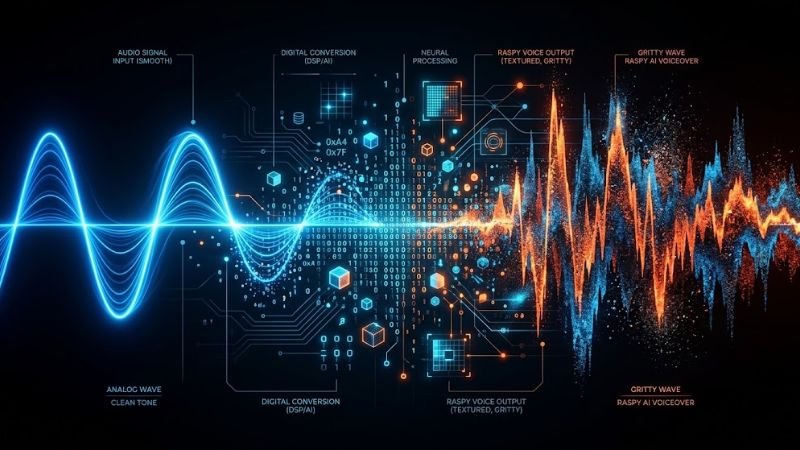
At its core, this AI voice technology relies on deep learning models trained on large datasets of human speech, including voices that naturally carry a rough or husky quality. These models learn the acoustic patterns associated with raspiness — irregular vocal fold vibration, added breath noise, subtle pitch instability — and then apply those patterns to new text input.
Here’s a simplified breakdown of the process:
- Text input — You type the script you want spoken.
- Voice selection — You choose a raspy voice from a library (male, female, young, old, accented, and so on).
- Synthesis — The model converts the text into audio, layering in raspy vocal characteristics like grain, huskiness, and breath control.
- Fine-tuning — Many generators in this space allow you to adjust pitch, speed, tone, and emotional intensity before finalizing the output.
- Export — The final audio is rendered as an MP3 or WAV file, ready for use in your project.
Because this synthesis approach is built on neural text-to-speech architecture, the more advanced platforms can also interpret punctuation and context, adding natural pauses and stress patterns so the final voice doesn’t sound robotic or flat.
Why These Gritty AI Voices Are So Popular Right Now
There’s a simple reason Raspy AI has exploded in popularity: authenticity sells. Audiences are drawn to voices that sound human, flawed, and full of character — and a raspy tone naturally conveys wisdom, danger, mystery, or emotional depth without a single word being spoken differently.
Content creators are increasingly turning to this technology because it removes the need to hire a professional voice actor with a naturally gritty voice, which can be expensive and time-consuming. With a good raspy voice generator, you get studio-quality output on demand, at a fraction of the cost.
Key Features to Look for in a Raspy AI Voice Generator
Not all tools in this category are created equal. If you’re evaluating platforms, here are the features that separate a good raspy voice generator from a mediocre one:
- Natural-sounding output — The raspy texture should sound organic, not glitchy or artificial.
- Voice customization — Ability to adjust pitch, pace, tone, and roughness level.
- Multiple accents and languages — A strong generator should support several languages and regional accents.
- Emotional range — Look for options like “commanding,” “intense,” “playful,” or “ominous” to match your project’s mood.
- Speech-to-speech conversion — Some platforms let you upload existing audio and convert it into a raspy voice.
- Fast rendering speed — Studio-quality audio should be generated within seconds, not minutes.
- Commercial usage rights — Especially important if you’re using the output in monetized content.
Best Use Cases for Raspy AI Voices
This kind of voice synthesis isn’t just a novelty — it has genuine practical applications across multiple industries.
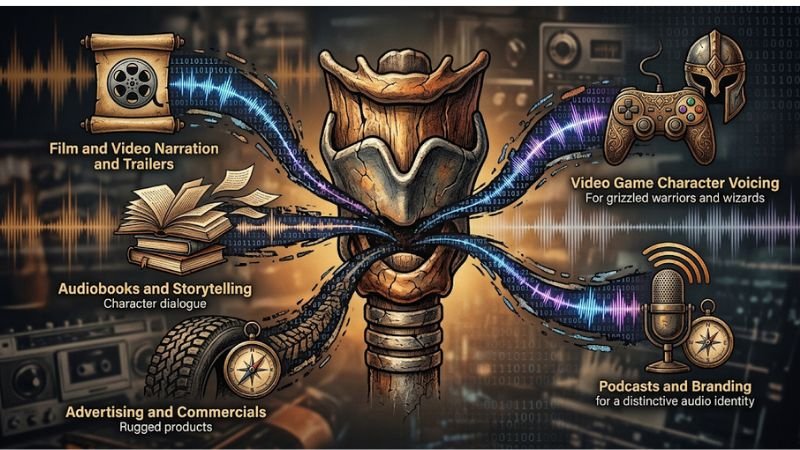
1. Film and Video Narration
A raspy voice adds gravity to documentary narration, movie trailers, and dramatic voiceovers. Raspy AI makes it possible to achieve that Hollywood-trailer sound without booking a voice actor.
2. Video Game Character Voicing
Game developers use these tools to voice grizzled warriors, ancient wizards, or menacing villains, especially in indie games where hiring a full voice cast isn’t financially feasible.
3. Audiobooks and Storytelling
Textured, gritty voices work exceptionally well for character dialogue in audiobooks, particularly for older, wiser, or morally complex characters.
4. Podcasts and Branding
Some podcasters use a raspy AI-generated voice for intros, outros, or recurring segments to create a distinctive, memorable audio identity.
5. Advertising and Commercials
A raspy voiceover can make a product feel rugged, trustworthy, or edgy — perfect for outdoor gear, automotive, or lifestyle brands.
Pros of Using Raspy AI
Like any technology, this approach comes with a clear set of advantages:
- Cost-effective — No need to pay per-project voice actor fees.
- Fast turnaround — Generate a raspy voiceover in seconds instead of scheduling studio time.
- Consistency — The same textured voice can be reused across multiple projects without variation.
- Customizability — Adjust tone, pitch, and emotion to match your exact creative vision.
- Scalability — Perfect for creators who need large volumes of voiceover content, like audiobook publishers or game studios.
- No recording equipment needed — Everything happens through the browser or app.
- Multilingual support — Many of these voice generators work in multiple languages and accents.
Cons of Using Raspy AI
That said, this technology isn’t without its limitations:
- Occasional unnatural artifacts — Some AI-generated gritty voices can sound slightly synthetic on close listening.
- Limited emotional nuance — Even the best models can struggle to match the subtlety of a professional human voice actor.
- Subscription costs — Many premium platforms operate on recurring subscription models rather than one-time payments.
- Ethical concerns — Voice cloning technology, including raspy voice generation, raises questions around consent and misuse if used to mimic real individuals without permission.
- Learning curve for fine-tuning — Getting the “perfect” rough tone sometimes requires trial and error with pitch and pacing settings.
- Dependence on internet connectivity — Most tools in this space are cloud-based, so offline access is limited, with a few exceptions.
Raspy AI vs Traditional Human Voice Recording
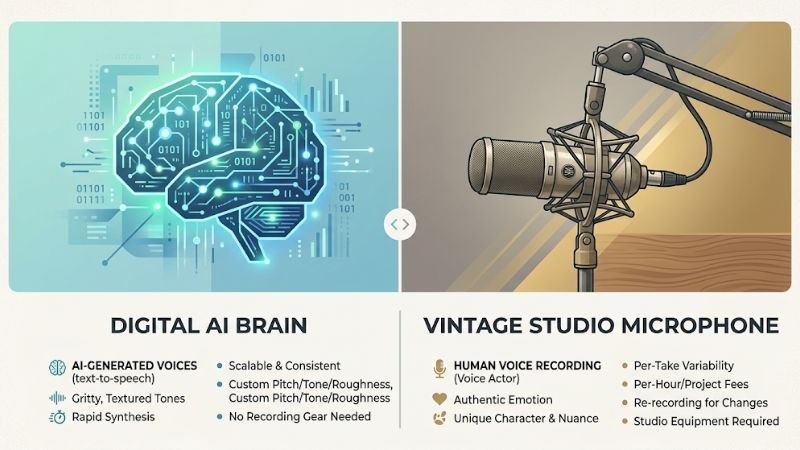
To help you decide which approach fits your project, here’s a side-by-side comparison of AI-generated gritty voices against hiring a human voice actor:
| Feature | Raspy AI Voice Generator | Traditional Human Voice Actor |
|---|---|---|
| Cost | Low to moderate (subscription-based) | High (per-project or hourly fees) |
| Turnaround time | Seconds to minutes | Days to weeks |
| Consistency | Identical output every time | Can vary between takes |
| Customization | Adjustable pitch, tone, emotion | Requires re-recording for changes |
| Language/accent range | Wide, instantly switchable | Limited to actor’s ability |
| Emotional authenticity | Good, improving rapidly | Excellent, naturally nuanced |
| Equipment needed | None (browser-based) | Studio, microphone, editing |
| Best for | Bulk content, indie projects, quick turnarounds | High-budget films, flagship brand campaigns |
As the table shows, this technology wins on speed, cost, and scalability, while traditional voice actors still hold the edge in raw emotional depth for premium, high-stakes productions.
How to Create a Raspy AI Voice: Step-by-Step
If you’re ready to try this approach for your own project, here’s a simple workflow:
- Choose a platform that fits your budget and use case — some are free with limits, others are subscription-based.
- Browse the voice library and select a raspy profile that matches your character or brand tone — options often include labels like “commanding,” “storytelling,” or “raw.”
- Paste or type your script into the text box.
- Adjust settings such as pitch, speed, and emotional intensity to fine-tune the raspy effect.
- Generate a preview and listen carefully for any unnatural artifacts.
- Re-adjust if needed — small tweaks to punctuation or pacing can dramatically improve how natural the voice sounds.
- Export your final audio in MP3 or WAV format and integrate it into your video, game, or podcast.
Tips for Getting the Most Natural-Sounding Output
A few practical tips can make a huge difference in output quality when working with Raspy AI:
- Break long sentences into shorter ones — the model tends to sound more natural with concise phrasing.
- Use punctuation intentionally, since commas and periods influence pacing and breath placement.
- Test multiple voice profiles before settling on one, since tone varies significantly between models.
- Lower the pitch slightly for a more “weathered” or aged effect.
- Avoid overly technical or jargon-heavy scripts, as these voice models perform best with natural, conversational language.
Is Raspy AI Free to Use?
Many platforms offer a free tier for this kind of voice generation, usually with limited characters per month or watermarked output. Full access — including commercial rights, extended voice libraries, and higher-quality rendering — typically requires a paid subscription. Pricing varies widely depending on the provider, so it’s worth comparing a few options based on your monthly usage needs before committing.
Is a Raspy AI Voice Legal to Use Commercially?
Generally, yes — as long as the platform grants commercial usage rights and you’re using a licensed, AI-generated voice rather than cloning a real person’s voice without consent. Always check the specific provider’s terms of service, since licensing rules differ from platform to platform.
Popular Categories of Platforms Offering These Voices
The market for gritty, textured voice generation has grown fast, and today’s options generally fall into a few broad categories.
All-in-one AI audio suites combine text-to-speech, voice cloning, and sound editing in a single dashboard, making them a good fit for podcasters and video editors who want everything in one place. Dedicated voice-library platforms focus purely on offering a large catalog of character-style voices, including raspy, husky, and gravelly options sorted by mood, age, and accent. Speech-to-speech converters let you record your own voice and transform it into a raspy version, which is useful if you want to keep your natural cadence while changing the texture. Finally, open-source and local-first tools run entirely on your own machine, appealing to developers and privacy-conscious users who don’t want to rely on cloud servers.
Choosing between these categories usually comes down to how much control you need, whether you’re working with a fixed budget, and whether your project requires cloning a specific real voice or simply picking from a pre-built library. Comparing a couple of options side by side before committing to a subscription is generally the smartest approach, since free trials make it easy to test output quality firsthand.
Ethical Considerations to Keep in Mind
Because this technology can also power voice cloning, it’s worth pausing on the ethical side before diving in. Cloning a real person’s voice — including adding a raspy effect to it — without their explicit permission raises serious consent issues and, in many regions, legal ones too. Reputable platforms require verification or a signed release before allowing voice cloning features to be used, and responsible creators should always disclose when a voice in their content is synthetic rather than passing it off as a real human performance.
There’s also the broader question of authenticity in media. As gritty, weathered-sounding narration becomes easier to produce at scale, audiences may start to expect transparency about which voices are AI-generated, particularly in advertising, journalism, or political content. Using this kind of voice generation responsibly means sticking to licensed voices, respecting platform terms of service, and being upfront with your audience whenever it’s relevant.
The Future of Raspy AI Voice Technology
Voice synthesis is advancing quickly, and the gritty, textured segment of the market is no exception. Expect future models to offer finer control over breathiness and vocal grain, more accurate emotional shifts mid-sentence, and better real-time performance for live streaming or gaming applications. Multilingual support is also likely to expand, with more regional accents represented natively rather than through generic translation layers.
As competition between providers increases, pricing should become more accessible too, with more generous free tiers and flexible one-time-purchase options replacing today’s subscription-heavy landscape. For creators keeping an eye on this space, it’s worth periodically revisiting the voice library on your chosen platform, since new and improved raspy voice options are typically added on a rolling basis.
Frequently Asked Questions About Raspy AI
What exactly does “Raspy AI” mean? It refers to artificial intelligence-powered voice generators that produce a rough, gritty, textured voice output, mimicking the natural huskiness of a raspy human voice.
Can these AI voices sound completely natural? Modern models come very close to natural human speech, especially with fine-tuning of pitch, pace, and emotion. However, extremely close listening may still reveal minor synthetic qualities in some tools.
What industries use Raspy AI the most? Film, gaming, podcasting, audiobook production, and advertising are the biggest adopters of this voice technology.
Do I need technical skills to use it? No. Most platforms in this category are designed with simple, user-friendly interfaces — you just type your text, pick a voice, and generate the audio.
Can I clone my own voice and make it sound raspy? Yes, several tools support speech-to-speech conversion, allowing you to upload your own voice recording and apply a raspy transformation to it.
Is Raspy AI better than hiring a voice actor? It depends on your budget and project scale. It’s faster and cheaper, making it ideal for high-volume content, while human voice actors still offer superior emotional nuance for premium productions.
Are there free tools available in this category? Yes, several platforms offer free trials or limited free tiers, though full commercial features usually require a paid plan.
Conclusion
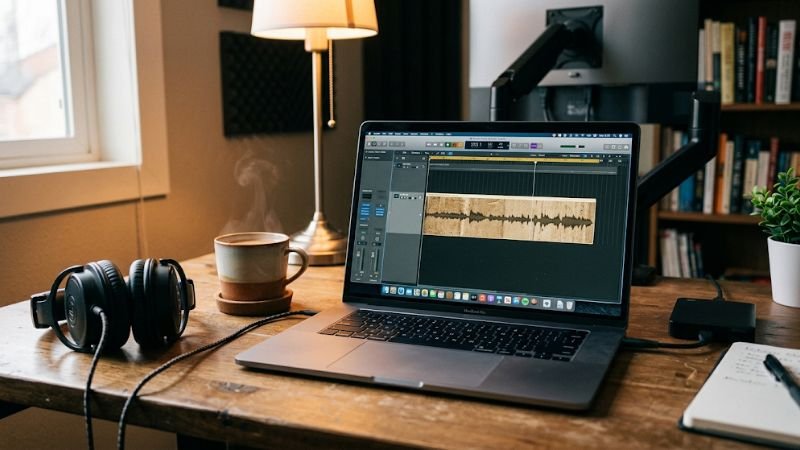
Raspy AI has carved out a genuine niche in the world of synthetic voice technology, offering creators an affordable, fast, and highly customizable way to add texture, grit, and authenticity to their audio projects. Whether you’re building a video game villain, narrating a documentary, or adding a signature voice to your podcast, this technology gives you the tools to achieve a professional, weathered sound without booking a recording studio.
That said, it isn’t a perfect replacement for human voice talent in every scenario — high-budget productions may still benefit from the emotional depth only a trained voice actor can deliver. But for indie creators, game developers, and content producers working with tight timelines and budgets, it offers an impressive balance of quality, speed, and flexibility.
As this branch of AI audio continues to evolve, expect these voice models to become even more lifelike, with better emotional range and finer control over vocal texture — making Raspy AI an increasingly valuable tool in any creator’s toolkit.
