
If you search for an AI moderated focus group tool new 2026, you will find a dozen platforms that all promise the same thing: faster, cheaper, “unbiased” qualitative research. Read the product pages closely, though, and a different picture appears. Most of these tools do not put people in a room together at all.
That matters. A focus group exists to show how people react to each other. A tool that interviews hundreds of people one at a time can be excellent, but it answers a different research question. Picking the wrong format is the most expensive mistake you can make when buying an AI-moderated focus group tool, far more expensive than picking the wrong brand. Before choosing a research platform, it is also worth understanding how AI-driven search visibility is measured with an AI Overviews Rank Checker, especially if you plan to evaluate how these tools are discovered in Google’s AI-powered results.
This guide separates the formats, compares every new AI-moderated focus group tool launched or updated in 2026, shows the pricing that vendors actually publish, and gives you a short decision path. It is written for researchers, product teams, agencies and students who need to choose a platform without wading through marketing copy.
Quick answer: An AI-moderated focus group tool uses an AI system to ask questions, probe answers and summarise findings with real participants. In 2026, most tools sold under that name run many parallel one-on-one conversations rather than one shared discussion. Choose parallel AI interviews for scale and speed, a live group with a human moderator when interaction is the point, and synthetic groups only for piloting. That is the short version of what any AI moderated focus group tool new 2026 buyer needs to know.
How we evaluated each AI-moderated focus group tool
Transparency first. This review of the AI moderated focus group tool new 2026 market is built from public vendor pages, product documentation, press releases and published studies, reviewed in early November 2026. We did not run paid studies on every platform, so we do not claim hands-on results we do not have. Where vendors disagree about how a competitor works, we say so. Where pricing is not published, we say that too instead of guessing.
We judged each AI-moderated focus group tool on five questions:
- Format: do participants hear each other, or is every conversation separate?
- Real people or simulated: are the respondents human?
- Depth: does the AI probe with follow-up questions, or collect one-shot answers?
- Analysis: do you get themes and traceable quotes, or only a summary?
- Cost and trust: is pricing visible, and how does the vendor handle consent and data protection?
Every AI-moderated focus group tool on this list is sold by a vendor that either reviews it or competes with someone who does. Treat any “best overall” label, including ones on competitor sites, with healthy scepticism.
AI moderated focus group tool new 2026: what it actually is
A traditional focus group is a moderated discussion among roughly 5 to 10 people. Its value lies in the interaction: how opinions shift, where consensus forms, which phrases the group adopts as its own.
An AI-moderated focus group tool keeps real participants but hands the moderator’s job to a large language model. The AI follows a discussion guide, asks follow-up questions, notices when an answer is vague and digs further, then helps summarise where people agree or split.
The label is used loosely, so it helps to know the four formats hiding behind it.
| Format | Participants | Do they interact? | Best for |
|---|---|---|---|
| Parallel one-on-one AI interviews | Real, each alone | No | Scale, honest opinions, multilingual fieldwork |
| Live large-group text session | Real, dozens to hundreds online together | Indirectly, by voting on others’ answers | Concept testing, prioritisation |
| Human-moderated group with an AI co-pilot | Real, 5 to 8 together | Yes, fully | Group norms, shared language, academic designs |
| Synthetic focus group | AI-generated personas | Simulated only | Piloting a guide, hypothesis generation |
Notice that only the second and third rows involve any real interaction. If your research question is about group dynamics, that single fact should drive your shortlist.
What makes an AI moderated focus group tool new 2026 different?

Three shifts define the AI moderated focus group tool new 2026 market.
Adoption is mainstream. According to the Greenbook GRIT data cited in several 2026 industry reports, around 72% of insights teams now use AI somewhere in qualitative research, up from 31% two years earlier. The question has moved from “should we use AI?” to “how much depth does this tool actually deliver?”
“Qualitative” no longer means “small.” Studies that once capped at eight people per session now run with hundreds of participants. Perspective AI describes its studies as running at 100 to 500 real customers each, and other vendors report similar ranges.
New entrants and new modules keep arriving. Recollective added an adaptive AI moderator task in late 2025 that holds one-on-one dialogues with many participants at once. SmartFocus.ai announced an on-demand AI focus group product in June 2026, aimed at teams without a five-figure research budget. Its public material does not make clear whether respondents are real or simulated, so ask before you trust the output.
AI moderated focus group tool new 2026: comparison table
Features change quickly. Use this table of every AI moderated focus group tool new 2026 to build a shortlist, then confirm details with each vendor.
| Tool | Format (as publicly described) | Real participants? | Public pricing |
|---|---|---|---|
| Remesh | Live sessions with large groups, voting on each other’s answers | Yes | Not listed |
| Perspective AI | Parallel AI-moderated conversations, 100 to 500 per study | Yes | Not verified, check vendor |
| Koji | Parallel voice and chat interviews, aggregated into themes | Yes | €1 per qualified text interview, €3 per qualified voice interview |
| User Intuition | Parallel depth interviews, 30 to 45 minutes each | Yes | From $30 per interview with your own sample, $60 with panel recruitment |
| Outset.ai | One-on-one AI interviews by video, voice or text | Yes | Not listed |
| Recollective | Adaptive AI moderator, one-on-one at scale | Yes | Not listed |
| Listen Labs | Voice-first AI interviews | Yes | Reported as quote-based |
| Discuss.io | Live virtual groups led by human moderators, plus AI analysis | Yes | Not listed |
| Qualitati | Human-moderated groups with a real-time AI co-pilot, plus separate synthetic groups | Yes (co-pilot), no (synthetic) | Free tier with 30 monthly credits, paid from €9 per month |
| SmartFocus.ai | On-demand AI focus groups (launched June 2026) | Unclear | Not verified |
One caution: sources disagree on some classifications. A competitor’s ranking article labels Outset.ai as a synthetic-plus-real hybrid, while other public descriptions call it an AI interviewer for real participants. When a vendor’s category matters to you, ask for a demo and check.
Reviews of each AI moderated focus group tool new 2026
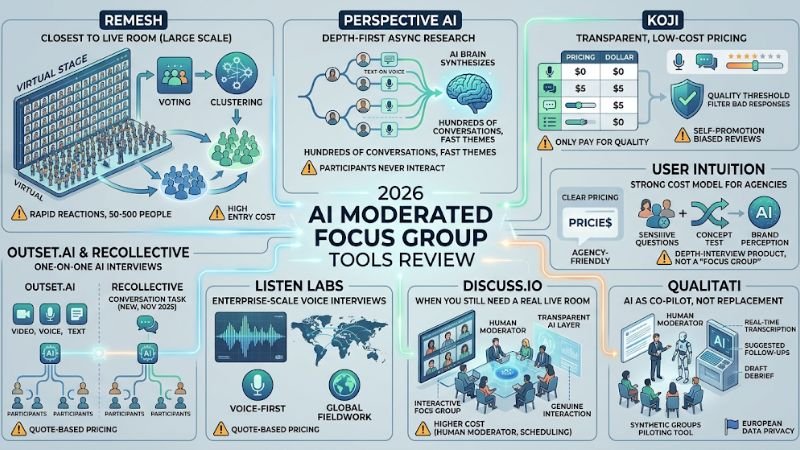
Remesh: the closest AI-moderated focus group tool to a live room
Remesh is built for sessions where many participants answer together and vote on each other’s responses, with the system clustering the results. Search results describe sessions of 50 to 500 people at once. It is the strongest option here when you need rapid reactions from a large live audience, but it is closer to structured polling than a deep conversation.
Watch out: pricing is demo-based, and small teams may find the entry cost high.
Perspective AI: depth-first async research
Perspective AI focuses on AI-moderated conversations with real customers at scale, then automatic synthesis. Its blog content is extensive and positions it as the depth leader, which you should read as a claim, not a verdict. It is a good fit when your team wants hundreds of conversations and fast themes.
Watch out: like all parallel-interview tools, participants never hear each other.
Koji: transparent, low-cost pricing
Among every AI moderated focus group tool new 2026 we reviewed, Koji’s strongest point is that its pricing is public and low. It supports voice and chat, mixes open questions with ratings and rankings, and only charges for conversations that pass a quality threshold. That last feature is useful because it protects you from paying for low-effort responses.
Watch out: its own “best overall” ranking article is, unsurprisingly, written by Koji. Compare it with independent reviews.
User Intuition: strong cost model for agencies
User Intuition publishes a clear per-interview price and a balanced limitations section, which is rare. It suits agencies running concept tests, brand perception and audience profiling, and it recommends blending AI interviews with human-led groups for sensitive questions.
Watch out: this is a depth-interview product, so the vendor itself advises against calling it a “focus group” with clients.
Outset.ai and Recollective: one-on-one AI interviews
Both run adaptive AI interviews with many participants. Outset.ai offers video, voice and text. Recollective’s conversation task is newer, launched in November 2025, and suits teams already using its community platform.
Watch out: neither lists prices publicly, so request a quote early.
Listen Labs: enterprise-scale voice interviews
Listen Labs focuses on voice-first interviews and fast global fieldwork. It is aimed at larger insights teams.
Watch out: pricing is reported as quote-based, which can slow comparison.
Discuss.io: when you still need a real live room
If you want a live room, this is the AI moderated focus group tool new 2026 buyers should shortlist first, with the caveat that a person still moderates. Discuss.io runs live virtual groups with human moderators and layers AI analysis on top. Because a person still moderates and sessions still need scheduling, costs stay closer to traditional groups. In return, you get genuine participant interaction.
Qualitati: AI as co-pilot, not replacement
Qualitati takes a different approach. A human moderator runs the live group while the tool transcribes in real time, suggests follow-up questions and drafts a debrief. It also offers synthetic groups, clearly labelled as piloting tools, and is built around European data-privacy requirements. It is the better pick for academic teams and anyone whose ethics approval specifies a human moderator.
Watch out: it does not put several real participants in one live session with an AI moderator.
AI moderated focus group tool new 2026 pricing: what does it cost?
Traditional costs are driven by people and logistics. Drive Research put focus groups at roughly $7,000 to $20,000 or more per group, with participant incentives of $75 to $150 each. Other providers quote $15,000 to $30,000 per in-person session once recruitment and facilities are included.
An AI-moderated focus group tool removes the facility and most moderator time, but not recruitment or incentives. Any AI moderated focus group tool new 2026 should show you the cost per completed participant before you launch. Where per-interview prices are public, they are strikingly low: a few euros per completed conversation at Koji, $30 to $60 at User Intuition. A 100-interview programme that would cost tens of thousands of dollars with human moderators can land in the low thousands.
Two practical points keep your budget honest:
- Compare cost per completed participant, not list price. Recruiting niche audiences costs far more than recruiting general consumers.
- Budget for human review. AI summaries still need someone who understands your market to check them against transcripts.
AI-moderated focus group tool vs human moderator: where each wins
AI moderation is strongest where consistency, scale and candour matter. Every participant gets the same guide and the same probing depth, tiredness never affects question four, and people often admit more to a machine about topics like switching brands or price sensitivity because they feel less judged.
Human moderation wins where reading the room matters. Emotionally sensitive topics, group dynamics, specialised B2B research and executive interviews still favour a skilled person. The published evidence agrees. A 2025 study in the Qualitative Research Journal by Chen, Wang and Chang found that human-moderated groups produced the most emotionally rich responses, while AI summaries with human oversight kept comparable thematic depth. Fully AI-only summaries reduced engagement.
Other research points to a useful middle path. Two preregistered experiments by Vuk, Sarasua and Gilardi found that an AI bot adding missing arguments to online group chats widened the range of ideas discussed, which suggests AI can help counter groupthink without running the whole session.
| Research goal | Better fit |
|---|---|
| Concept and message testing | AI-moderated interviews |
| Brand perception, audience profiling | AI-moderated interviews |
| Churn and win-loss research | AI-moderated interviews |
| Sensitive topics (health, grief, finances) | Human moderator |
| Group dynamics, social influence | Live human-moderated group |
| Specialised technical B2B | Human moderator |
| Early guide piloting | Synthetic group, then real people |
Synthetic focus groups: useful, but not evidence
A synthetic focus group simulates participants with AI personas instead of recruiting people. Industry benchmarks report that synthetic responses can correlate with real data at roughly 80 to 95 percent on directional questions. The same benchmark notes that about 43 percent of researchers say they are not excited about synthetic respondents.
That scepticism is healthy. Synthetic groups reproduce patterns already in their training data, so they rarely surface a genuinely new signal. The sensible pattern is to use them for the first rough pass and then validate the decisions that matter with real participants. Never present synthetic output as findings about real customers. A synthetic group is also not an AI-moderated focus group, because no real person takes part.
How to choose an AI moderated focus group tool new 2026: a five-question path
Use this path to decide which AI-moderated focus group tool fits your study. Answer in order and stop at the first yes.
- Do you need to see how participants influence each other? Run a live group with a human moderator, ideally with an AI co-pilot.
- Is the topic sensitive or are participants vulnerable? Use careful one-on-one interviews with human oversight, not a group.
- Do you need reactions from 50 or more people quickly? Choose parallel AI interviews or a live large-group text session.
- Do you need several languages at once? Parallel AI interviews work well, with a native-speaking researcher reviewing transcripts.
- Are you still drafting your guide or hypotheses? Pilot with a synthetic group, then move to real participants.
Then test each AI-moderated focus group tool on your shortlist against this checklist before you sign anything:
- Does the vendor say plainly whether participants see each other?
- Can a researcher observe and step in during sessions?
- Are participants told the moderator is AI, and is consent recorded?
- Where is data stored and processed, and does that fit your ethics approval and GDPR duties?
- Can you export full transcripts, not just AI summaries?
- Is pricing published, or do you need a quote?
Limitations of any AI-moderated focus group tool
Even the best AI moderated focus group tool new 2026 cannot fix a weak research question. Every tool has limits, and being honest about them is what separates a good methodology from a sales pitch.
- Construct drift. If participants never interact, you cannot report group dynamics. Describe your method accurately in reports and papers.
- Thin validation. Published evaluations of AI moderators in live groups involve few sessions. Treat vendor depth claims about any AI moderated focus group tool new 2026 as unproven until you pilot.
- Serendipity. AI follows the guide and is less likely to chase a surprising tangent. Patterns emerge across hundreds of interviews rather than from a single breakthrough moment.
- Guide quality. The AI is only as good as the discussion guide you give it. Invest more time in guide design than you would for a human moderator.
- Ethics and consent. Disclose the AI moderator at recruitment and again at the start of each session, and check your ethics board’s position before fielding with students, patients or other vulnerable groups.
Our recommendation: the AI moderated focus group tool new 2026 verdict
For most product, marketing and agency teams, an AI moderated focus group tool new 2026 built on parallel AI interviews is the practical default: they are fast, inexpensive and easy to scale. Start with a pilot of 20 to 30 interviews, read the raw transcripts yourself, and only then commit to a larger study.
If your question is genuinely about group interaction, keep a human moderator and add an AI co-pilot for transcription and analysis. If you are exploring early ideas, use synthetic groups as a cheap rehearsal, never as proof. Either way, the goal is simple: pick the AI moderated focus group tool new 2026 that fits the question.
Whichever route you choose, the best AI moderated focus group tool new 2026 is the one whose format matches your research question, whose pricing you can see, and whose output you can trace back to real quotes.
Frequently asked questions
What is an AI moderated focus group tool new 2026?
It is a qualitative study where an AI system moderates conversations with real participants: asking questions, probing answers and summarising agreement and disagreement. Many tools run it as parallel one-on-one conversations rather than one shared discussion.
Are AI focus groups the same as synthetic focus groups?
No. AI-moderated groups involve real people. Synthetic groups simulate participants with AI personas and are best used for piloting, not for evidence about real populations.
How much does an AI-moderated focus group tool cost?
Published prices range from about €1 to €3 per interview at some vendors and $30 to $60 at others, while enterprise platforms usually quote per project. Traditional in-person groups typically cost $7,000 to $20,000 or more each.
Can an AI moderator replace a human moderator?
Not with every AI moderated focus group tool new 2026, and not for every study. Human moderators remain stronger for sensitive topics, group dynamics and specialised research. AI works best for scale, consistency and speed.
Which AI moderated focus group tool new 2026 is best?
There is no single winner. Remesh suits large live sessions, Koji and User Intuition offer visible low pricing, Perspective AI and Listen Labs target depth at scale, and Qualitati suits human-led academic work.
Are AI-moderated interviews biased?
An AI-moderated focus group removes moderator fatigue and inconsistent probing, but they inherit biases from the model and the discussion guide. Review transcripts yourself and pilot before scaling.
Do participants know they are talking to an AI?
They should. Disclose the AI moderator at recruitment and at the start of every session, and record consent, whichever AI-moderated focus group tool you use.