
If you work for yourself in France, the Indy AI finance tool is probably the closest thing to a bookkeeper that never sleeps. It connects to your bank, sorts your transactions and keeps your tax figures ready, so you can get back to paying work. I looked at how the Indy AI finance tool works, who it suits and where it falls short, and I kept the review practical rather than promotional.
Below you will find a plain explanation of the product, its main features, a comparison table against popular accounting software, honest pros and cons, and a short FAQ. If you only have a minute, here is the quick answer: it is a strong pick for solo professionals who want automation and simplicity, but a weaker one if you run a larger team or work outside France.
What Is the Indy AI Finance Tool?
Indy is an accounting platform built for freelancers and independent professionals. It is headquartered in France, and Crunchbase describes it as an accounting robot that aims to automate the bookkeeping of self-employed people. The company was founded by Come Fouques, who serves as CEO, together with tech co-founder Pablo Larvor. Funding trackers list about €75 million raised over two rounds, the latest in November 2023, which tells you this is not a hobby project.
One thing is worth clearing up early: the name Indy is shared by several unrelated products. Cambridge Investment Research launched an internal AI chat assistant called Indy, short for Independence, for its financial advisors. A newer startup, Indywealth, works on AI-driven personal wealth planning. Neither of those is what this article covers. When people search for the Indy AI finance tool, they usually mean the accounting software from indy.fr, and that is the one reviewed here.
Key Features of the Indy AI Finance Tool
Features change over time, so treat this list as a guide and confirm the current details on the official site. The core idea has stayed the same, though: take the repetitive money admin that freelancers hate and automate as much of it as possible.
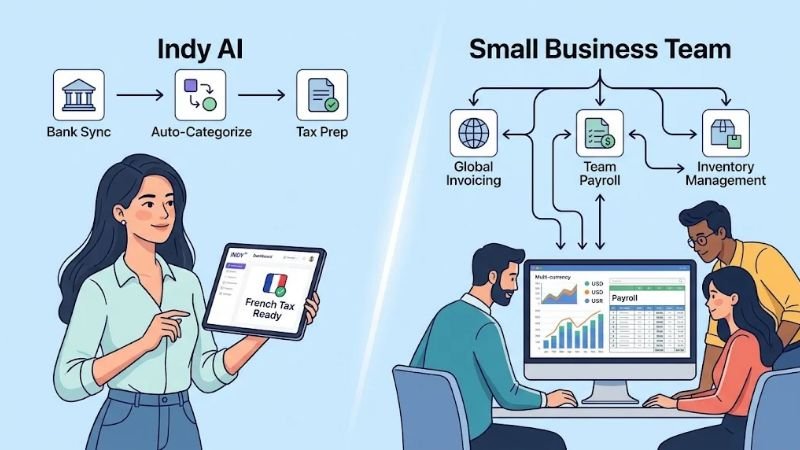
Automatic bank sync. Through open banking connections, the software pulls in your transactions without manual uploads. One third-party analysis of the company says it relies on open banking APIs and machine-learning categorization, which matches how the product is pitched.
Smart categorization. Instead of tagging every coffee and software subscription by hand, the system suggests a category and learns from your corrections. After a few weeks, expense tracking becomes a quick review rather than data entry.
Tax and VAT preparation. Tax is where automation pays off most. The product is designed to help you see what you owe and when, which supports better cash flow planning and fewer end-of-year surprises.
Income and expense overview. A clear dashboard shows what came in, what went out and what is left. That is the kind of financial visibility most solo workers never get from a bank app alone.
Accountant-ready records. Clean books mean less back and forth if you hire an accountant later, and often a smaller bill.
That mix of bank sync, categorization and tax awareness is what makes the Indy AI finance tool useful day to day.
How AI Improves Everyday Financial Management
AI sounds like a buzzword until you see where it saves time. In accounting, the gains show up in three places.
First, speed. Categorizing hundreds of transactions by hand takes hours every quarter. Machine learning does the first pass in seconds, and you only fix the exceptions.
Second, accuracy. Manual bookkeeping is full of small slips: a missed receipt, a wrongly tagged expense, a duplicated entry. Automated rules reduce those errors because they apply the same logic every time.
Third, foresight. Predictive models can estimate upcoming tax payments from your income pattern. That turns taxes from a yearly shock into a monthly number you can plan around. For people with irregular income, this forecasting side is a big part of the appeal.
The wider market is moving the same way. One third-party blog puts growth in AI-powered financial technology at roughly 22.5% a year through 2029. It is not an official report, so treat it as a rough signal, but the direction is clear: more finance admin will be automated, not less.

A Typical Month With the Indy AI Finance Tool
Features make more sense in a real scenario, so here is an illustrative month for a freelance designer. The details will vary, but the rhythm is typical. Early in the month she sends three invoices, and one client pays late. Her bank transactions appear in the software automatically, so she does not retype anything. Midway through, she buys a laptop accessory and renews two software subscriptions. By the weekend, those are already sorted into categories, and she only has to confirm a couple of them.
At the end of the month she opens the dashboard for five minutes. She sees her income, her expenses and the amount set aside for tax. Because the numbers are current, she can decide whether she can afford a short break or should chase the late payment first. That small habit is where the Indy AI finance tool earns its place: it turns bookkeeping from a once-a-year panic into a light routine, and it gives her a clear picture of her cash flow while there is still time to act.
Who Should Use the Indy AI Finance Tool?
It fits best if you recognize yourself in one of these groups:
- Freelancers and consultants who invoice a handful of clients and want simple books.
- Self-employed professionals in France who deal with local tax rules and deadlines.
- Side hustlers who just started earning and do not have an accountant yet.
- People who want financial automation without learning a full accounting suite.
It is a weaker fit for companies with employees, complex stock or several legal entities, and for freelancers based outside France who need local tax support. In those cases a broader platform may serve you better. Whatever you pick, match the tool to your tax situation first and its features second.
Pros and Cons of the Indy AI Finance Tool
Every tool has trade-offs, so here is the honest version.
Pros
- Saves hours of manual bookkeeping through bank sync and auto-categorization.
- Simple enough for beginners who have never used accounting software.
- Built around the needs of solo professionals rather than large companies.
- French comparison sites have listed its core accounting as free, which lowers the cost of trying it.
Cons
- Strongly focused on France, so it may not suit freelancers elsewhere.
- Not designed for teams, payroll or complex business structures.
- AI categorization still needs a human glance, especially for unusual expenses.
- Plans and features can change, so always verify pricing before you commit.
Indy AI Finance Tool vs Alternatives: Comparison Table
Here is how it stacks up against common alternatives. I kept the comparison qualitative because prices and plans change often.
| Tool | Best for | Automation focus | Main market | Watch out for |
|---|---|---|---|---|
| Indy | Solo freelancers | Bank sync, auto-categorization, tax prep | France | Not built for larger teams |
| Pennylane | Small businesses and their accountants | Accounting and finance collaboration | France and Europe | May be more than a solo freelancer needs |
| Tiime | Freelancers and small firms | Simple bookkeeping and invoicing | France | Similar niche, so compare features closely |
| QuickBooks | Small businesses worldwide | Invoicing, reports, integrations | Global | Setup effort and a steeper learning curve |
| Xero | Growing small businesses | Cloud accounting and bank feeds | Global | Not tailored to French freelance tax rules |
The short version: pick Indy if you are a French freelancer who values simplicity, and look at a global platform if you work internationally or plan to hire.
How to Get Started in Five Steps
Setting up the Indy AI finance tool is mostly a matter of connecting your bank and reviewing the first batch of categories.
- Confirm that your activity and country are supported on the official site.
- Create your account and enter your basic business details.
- Connect your bank account through the secure open banking link.
- Review the first automatic categories and correct anything that looks off.
- Set a weekly reminder to check your numbers and your upcoming tax amounts.
Spending ten minutes a week on that last step is what keeps your books clean without turning bookkeeping into a chore.
Common Mistakes to Avoid
Even good software cannot fix careless habits. These are the mistakes that come up most often with automated bookkeeping:
- Trusting every category blindly. The AI is good, not perfect, so skim the list weekly.
- Mixing personal and business spending. Use a separate account where you can. It keeps your numbers clean and tax preparation simpler.
- Ignoring tax reminders. A forecast only helps if you actually set the money aside.
- Skipping the fine print. Check pricing, limits and data policies before you rely on any finance app, including the Indy AI finance tool.
Frequently Asked Questions
Is the Indy AI finance tool free? Some French comparison sites list its core accounting as free, but plans change. Check indy.fr for current pricing before you commit.
Can I use it outside France? It is built around French freelancers and French tax rules. If you are based elsewhere, a local or global accounting platform is usually the safer choice.
Is my bank data safe? Open banking connections are regulated in Europe and are typically read-only, but you should still read the privacy policy and security page of any finance app before linking an account.
Does it replace an accountant? For simple freelance situations it can handle most routine bookkeeping. For complicated cases or big decisions, a professional is still worth paying for.
Is the Indy AI finance tool the same as Cambridge’s Indy? No. Cambridge’s Indy is an internal chat assistant for financial advisors, while this review covers the accounting software for freelancers.
Conclusion: Is the Indy AI Finance Tool Worth It?
For French freelancers and independent professionals, the Indy AI finance tool makes a convincing case. It removes the dull parts of bookkeeping, keeps your tax picture visible and stays simple enough that you do not need an accounting degree. It is not the right answer for larger teams or for people working outside France, and you should always confirm current pricing and features yourself.
No software replaces good habits: review weekly, keep personal and business money apart, and ask a professional when something looks unusual. If you are tired of spreadsheets and last-minute tax panic, try the Indy AI finance tool with your own bank data for a few weeks. The time you save will tell you more than any review can.