
AI for qualitative research is changing how interview transcripts, survey comments and focus group notes turn into real insight. In 2026 the biggest shift is not simply more software. It is a new way of working, where automated coding, summarisation and theme detection sit beside the researcher instead of replacing them.
This guide explains what is new, which tools deserve your attention, how they compare and how to apply AI for qualitative research without losing methodological rigour. Whether you are a PhD student, a UX researcher or a market research lead, you will find a practical path below.
What Is AI for Qualitative Research?
Qualitative research turns unstructured data such as interviews, diaries, open-ended survey answers, audio and video into themes and meaning. Doing that by hand has always meant weeks of reading, tagging and re-reading transcripts.
AI for qualitative research uses large language models and natural language processing to speed up the slowest steps: transcription, first-pass coding, thematic analysis, sentiment analysis, summarisation and report drafting. The researcher still decides what a theme actually means. The AI handles the volume.
Why AI for Qualitative Research Looks Different in 2026
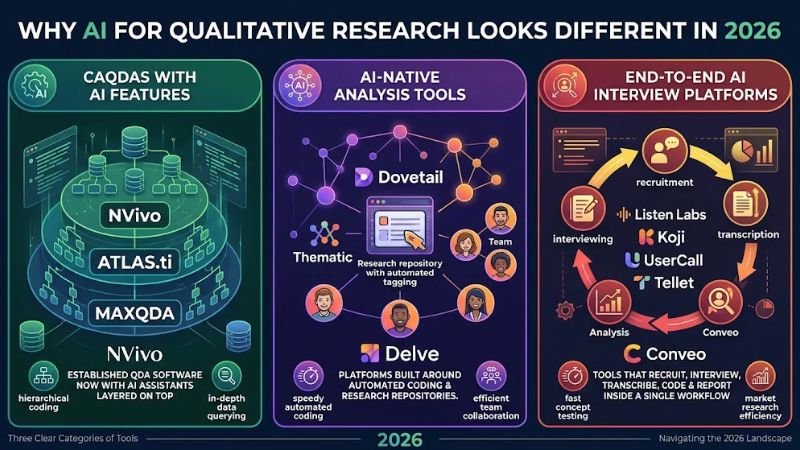
Industry guides in 2026 describe three clear categories of tools:
- CAQDAS with AI features: NVivo, ATLAS.ti and MAXQDA, the established computer-assisted qualitative data analysis software, now with AI assistants layered on top.
- AI-native analysis tools: Dovetail, Thematic, Delve and similar platforms built around automated coding and research repositories.
- End-to-end AI interview platforms: tools that recruit, interview, transcribe, code and report inside a single workflow.
Pricing has also become a battleground, with AI features now offered across several tiers. Picking the right category matters more than picking the right brand.
AI for Qualitative Research 2026 New Tools: Top Picks

NVivo
Often described as the most cited qualitative data analysis software in publications, NVivo remains a favourite for deep academic work and formal methodologies. It now offers AI-assisted transcription and thematic coding. It suits researchers who like hierarchical code structures and strong query tools, though it has a steeper learning curve and no meaningful free tier.
ATLAS.ti
ATLAS.ti was one of the first established CAQDAS packages to add generative AI, including AI coding powered by GPT models, sentiment analysis and opinion mining. Its network view lets you map relationships between codes, quotations and memos, which many grounded theory researchers appreciate.
MAXQDA
MAXQDA introduced AI Assist with code suggestions, segment summaries and question-answering across coded data. It is a strong choice for mixed-methods work because it connects qualitative coding with basic quantitative analysis, and it offers full Windows and Mac parity.
Dovetail
Dovetail combines a research repository with AI-driven analysis, tagging and team collaboration. It is popular with product and UX teams. The trade-off is that it is less customisable for deep academic methods such as grounded theory.
Thematic and Delve
Thematic focuses on high-volume survey verbatims and NPS comments, while Delve offers approachable manual coding with optional AI help for small teams.
End-to-End AI Interview Platforms
Tools such as Listen Labs, Koji, UserCall, CleverX, Conveo and Tellet go further than analysis. They run AI-moderated voice or text interviews, transcribe them and generate themes automatically. These platforms push AI for qualitative research all the way back to data collection, which is why UX and market research teams use them for fast concept testing and multi-market studies. Most accuracy and speed claims come from the vendors themselves, so test any platform on your own data before committing.
General-Purpose AI Assistants
Chat assistants such as ChatGPT or Claude work well for quick, exploratory analysis on small datasets. They are not a substitute for a dedicated QDA tool when you need traceable, auditable coding.
Taguette (Free Option)
If your budget is close to zero, Taguette is a free, open-source tool for basic tagging and coding, though it lacks advanced AI features.
AI for Qualitative Research 2026 New Tools: Comparison Table
| Tool | Category | Best for | AI features | Main limitation |
|---|---|---|---|---|
| NVivo | CAQDAS | Rigorous academic research | AI-assisted transcription and coding | Learning curve, no real free tier |
| ATLAS.ti | CAQDAS | Visual, network-based analysis | GPT-based auto-coding, sentiment analysis | Heavier setup than repositories |
| MAXQDA | CAQDAS | Mixed-methods studies | AI Assist: code suggestions, summaries, Q&A | Quantitative tools are basic |
| Dovetail | AI-native repository | UX and product teams | AI tagging and theme summaries | Less depth for academic methods |
| Thematic | AI-native | Survey verbatims and NPS | Automated theme detection | Not built for ethnography |
| Delve | Lightweight QDA | Small teams, manual coding | Optional AI assistance | Fewer advanced features |
| Listen Labs, Koji, UserCall | End-to-end platform | Fast interview-based insight | AI interviews, auto-coding, reports | Vendor claims need testing |
| Taguette | Open source | Zero budget | Minimal | No advanced AI |
Features and pricing change often, so verify details on each vendor’s website before buying. As a rough guide from a March 2026 comparison, student plans start around $10 per month for ATLAS.ti and about $15 per month for MAXQDA.
How to Choose the Right AI for Qualitative Research
Start with your data and your methodology, not the feature list.
- Academic or longitudinal study: NVivo, ATLAS.ti or MAXQDA, because auditability and citation requirements matter.
- Product and UX research: Dovetail or an end-to-end platform for speed.
- High-volume survey comments: Thematic or a similar text analytics tool.
- Small budget: Taguette, student pricing or free trials.
- Sensitive data: check data residency, consent terms and whether your data is used to train vendor models.
How to Use AI for Qualitative Research Step by Step
- Define your research questions and draft a codebook before opening any tool.
- Transcribe and clean your data, and remove names and sensitive details.
- Let the AI propose first-pass codes and themes. Treat its output as a first pass, never the final word.
- Review the output. One guide cites Nielsen Norman Group advice to have a researcher check roughly 15 to 20 percent of AI-coded segments.
- Refine codes, merge duplicates and write memos explaining your decisions.
- Link every theme to supporting quotes so findings stay traceable, then draft your report.
Common Mistakes to Avoid with AI for Qualitative Research
The most common mistake with AI for qualitative research is trusting the first output without checking it against the raw data. Teams often treat a neat list of themes as a finished analysis, when it is only a starting point.
- Skipping the codebook: without clear research questions and definitions, the AI produces generic themes that say little.
- Ignoring context: models can miss sarcasm, cultural nuance and domain jargon, so read the surrounding text before accepting a code.
- Uploading unprotected data: sharing identifiable transcripts without consent or anonymisation creates ethical and legal risk.
- Buying by hype: choose by methodology and data type, not by the longest feature list or the boldest accuracy claim.
- Hiding AI use: report which tool, which version and which steps were automated so reviewers can judge your method.
Key Benefits of AI in Qualitative Analysis
- Faster coding and thematic analysis on large datasets
- More consistent first-pass tagging across hundreds of transcripts
- Multilingual transcription and translation support
- Searchable repositories that connect insights across past studies
- More time left for interpretation, which is the real value of the researcher
Limitations and Ethical Risks
Accuracy drops on messy data. One 2026 buyer’s guide reports accuracy falling to roughly 60 to 75 percent on sarcasm, multilingual speech and jargon-heavy material, which is why human review is essential. Other risks include fabricated quotes, hidden bias and privacy leaks.
Responsible AI for qualitative research means informed consent, anonymisation, a clear audit trail and honest disclosure of AI use in your methods section.
Where the Tools Are Heading Next
Expect tighter links between data collection and analysis, live reports while interviews are still running, and more pressure on vendors to show transparent, auditable AI. Traditional tools will keep adding AI features, while AI-native platforms keep adding methodological depth. The two categories are slowly converging.
Frequently Asked Questions
Which AI for Qualitative Research 2026 New Tools Are Best?
There is no single winner. NVivo, ATLAS.ti and MAXQDA lead for academic rigour, Dovetail for UX repositories, Thematic for survey comments and end-to-end platforms for speed. Match the tool to your method, data size and budget.
Can AI Replace Qualitative Researchers?
No. AI speeds up coding and summarising, but interpretation, ethics and context remain human work.
How Accurate Is AI Qualitative Coding?
It is useful for first-pass coding on clean data, but accuracy falls on sarcasm, multilingual and specialised text. Always review a sample and verify every quote against the source.
Is There a Free Tool for Thematic Analysis?
Taguette is free and open source, and many paid tools offer trials or student discounts. Most free options are limited, so check what is actually included.
Is It Safe to Upload Interview Data to AI Tools?
Only if participant consent allows it and the vendor’s privacy terms are acceptable. Anonymise first and check retention and model-training policies.
Conclusion
AI for qualitative research in 2026 offers real speed, but it works best when paired with careful method and human judgement. Choose a tool that matches your data and methodology, test it on a small sample and keep a clear audit trail. Do that, and the technology becomes a reliable partner for deeper, faster insight.