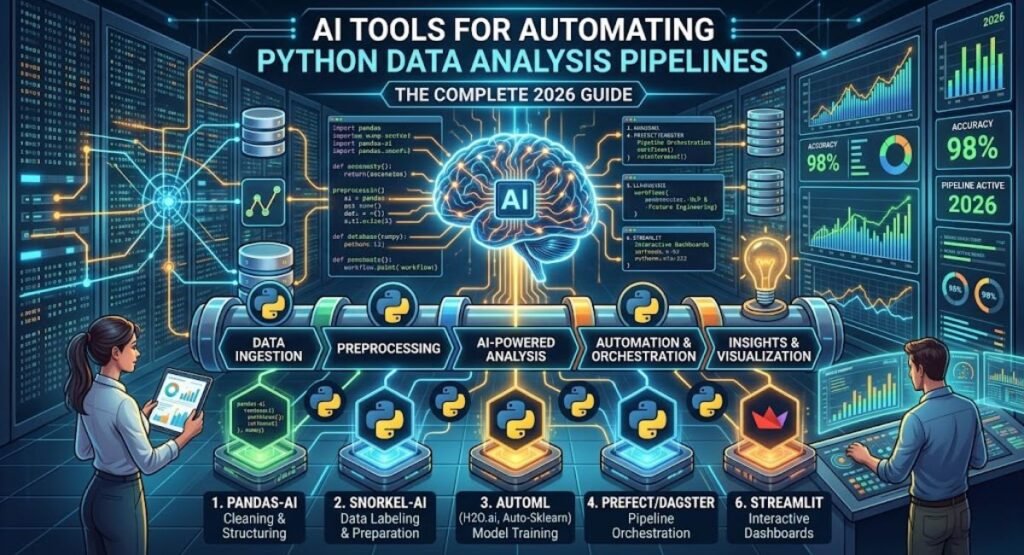
Data is growing faster than most teams can handle it manually. Every business, from small startups to large enterprises, is now sitting on massive amounts of raw information that needs to be cleaned, transformed, analyzed, and turned into insights. This is exactly where AI tools for automating Python data analysis pipelines step in and completely change the game.
If you have ever spent hours writing repetitive scripts, cleaning messy datasets, or manually scheduling ETL jobs, you already know how draining traditional data workflows can be. The good news is that modern AI-driven platforms now handle most of this heavy lifting automatically, letting data scientists and analysts focus on actual decision-making instead of grunt work.
In this guide, we will break down everything you need to know about AI tools for automating Python data analysis pipelines, including how they work, the best options available today, their pros and cons, a detailed comparison table, and answers to the most common questions people ask about this topic.
What Are AI Tools for Automating Python Data Analysis Pipelines?
Simply put, these are software platforms or libraries that use artificial intelligence and machine learning to automate the repetitive, time-consuming parts of a Python-based data workflow. This includes data ingestion, cleaning, transformation, feature engineering, model training, and even visualization.
Instead of writing every single line of code by hand, these tools use smart automation, pre-built templates, and AI-assisted suggestions to speed up the entire pipeline. Some tools even use large language models to generate Python code on the fly based on plain English instructions, which is a massive productivity boost for both beginners and experienced developers.
The rise of AI tools for automating Python data analysis pipelines is closely tied to the broader movement toward AutoML, no-code data science, and intelligent workflow orchestration. Businesses no longer want to wait weeks for a report; they want real-time, automated insights delivered continuously.
Why Automation Matters in Modern Data Analysis
Before diving deeper into specific tools, it is important to understand why automation has become such a big deal in the data science world.
Manual data pipelines are slow, error-prone, and difficult to scale. A single change in the source data format can break an entire script, and someone has to manually debug it. This is not sustainable when companies are dealing with terabytes of data updated in real time.
AI-powered automation solves this by:
- Detecting anomalies and schema changes automatically
- Suggesting or auto-generating cleaning and transformation code
- Scheduling and monitoring pipeline runs without human intervention
- Reducing the technical skill barrier for non-programmers
- Cutting down development time from weeks to hours
This is why so many data teams are actively searching for reliable AI tools for automating Python data analysis pipelines rather than sticking to old-school manual coding for everything.
Whether you work as a solo freelancer or inside a large analytics department, investing in AI tools for automating Python data analysis pipelines is quickly becoming a standard practice rather than a luxury.
Key Features to Look For in Automation Tools
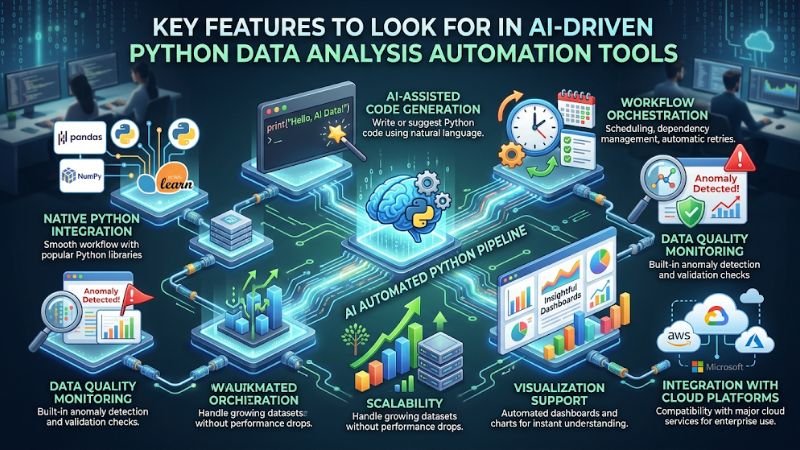
When evaluating any AI tool for automating Python data analysis pipelines, keep these features in mind:
- Native Python integration – The tool should work smoothly with popular libraries like Pandas, NumPy, and Scikit-learn.
- AI-assisted code generation – Look for tools that can write or suggest Python code using natural language prompts.
- Workflow orchestration – Features like scheduling, dependency management, and automatic retries are essential.
- Data quality monitoring – Built-in anomaly detection and validation checks save huge amounts of manual review time.
- Scalability – The tool should handle growing datasets without major performance drops.
- Visualization support – Automated dashboards and charts help you understand data trends instantly.
- Integration with cloud platforms – Compatibility with AWS, Google Cloud, and Azure is a big plus for enterprise use.
These features are the backbone of any strong data pipeline automation software and directly affect how much time and effort your team saves. In fact, most well-designed AI tools for automating Python data analysis pipelines combine several of these features into a single platform for maximum efficiency.
Top AI Tools for Automating Python Data Analysis Pipelines

Let’s go through some of the most popular and effective AI tools for automating Python data analysis pipelines currently used by data professionals around the world.
1. Apache Airflow with AI Plugins
Apache Airflow remains one of the most trusted workflow orchestration tools, and with newer AI-powered plugins, it now supports smart scheduling, automated failure recovery, and predictive resource allocation. It is widely used for building and managing complex Python data pipelines at scale, making it one of the most dependable AI tools for automating Python data analysis pipelines in production environments.
2. Prefect
Prefect is a modern alternative to Airflow that focuses on simplicity and dynamic workflows. Its AI-enhanced observability features help detect pipeline failures before they cause bigger issues, making it a strong choice for teams that need reliable AI tools for automating Python data analysis pipelines without a steep learning curve.
3. Pandas AI
Pandas AI brings conversational AI directly into your data analysis workflow. You can literally ask questions in plain English, and it generates the Pandas code to answer them. This tool has become extremely popular among analysts who want AI-powered data analysis without writing every line manually, and it is often the easiest entry point into AI tools for automating Python data analysis pipelines for beginners.
4. DataRobot
DataRobot is an enterprise-grade AutoML platform that automates everything from data preparation to model deployment. It integrates well with Python environments and is ideal for organizations looking for end-to-end machine learning data pipelines, positioning it among the most powerful AI tools for automating Python data analysis pipelines at an enterprise level.
5. H2O.ai
H2O.ai offers powerful AutoML capabilities combined with strong Python support. It automatically selects the best algorithms, tunes hyperparameters, and generates performance reports, saving data scientists countless hours of manual experimentation. It remains one of the top-rated AI tools for automating Python data analysis pipelines in the AutoML category.
6. Dagster
Dagster focuses on data-aware orchestration, meaning it understands the actual data assets moving through your pipeline, not just the tasks. Its AI-assisted debugging tools make it easier to catch issues early, making Dagster a solid pick among AI tools for automating Python data analysis pipelines that emphasize data quality.
7. GitHub Copilot for Data Science
While not exclusively a data tool, GitHub Copilot has become a favorite among Python developers for writing pipeline code faster. Its AI suggestions for Pandas, NumPy, and visualization libraries significantly reduce development time, which is why many developers pair it with dedicated AI tools for automating Python data analysis pipelines for a complete workflow.
Comparison Table: Best AI Tools for Automating Python Data Analysis Pipelines
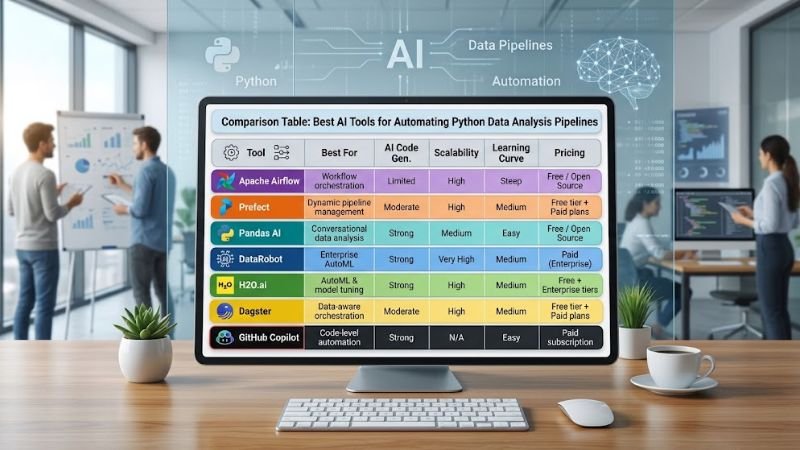
| Tool | Best For | AI Code Generation | Scalability | Learning Curve | Pricing |
|---|---|---|---|---|---|
| Apache Airflow | Workflow orchestration | Limited | High | Steep | Free / Open Source |
| Prefect | Dynamic pipeline management | Moderate | High | Medium | Free tier + Paid plans |
| Pandas AI | Conversational data analysis | Strong | Medium | Easy | Free / Open Source |
| DataRobot | Enterprise AutoML | Strong | Very High | Medium | Paid (Enterprise) |
| H2O.ai | AutoML & model tuning | Strong | High | Medium | Free + Enterprise tiers |
| Dagster | Data-aware orchestration | Moderate | High | Medium | Free tier + Paid plans |
| GitHub Copilot | Code-level automation | Strong | N/A | Easy | Paid subscription |
This comparison table should help you quickly identify which AI tool for automating Python data analysis pipelines fits your specific project needs and budget.
Pros and Cons of Using AI Tools for Python Data Pipeline Automation
Like any technology, AI tools for automating Python data analysis pipelines come with both advantages and limitations. Here is an honest breakdown.
Pros
- Massive time savings on repetitive coding and data cleaning tasks
- Reduced human error thanks to automated validation and monitoring
- Faster insights, since pipelines run continuously without manual triggers
- Lower entry barrier for beginners through AI-assisted code generation
- Better scalability for handling large and growing datasets
- Improved collaboration, as automated pipelines are easier to document and share across teams
Cons
- Initial setup complexity, especially for enterprise-grade tools like DataRobot or Airflow
- Cost concerns, since many advanced AI-powered platforms require paid subscriptions
- Over-reliance risk, where teams may lose deep technical understanding of their own pipelines
- Data privacy considerations, particularly with cloud-based AI tools processing sensitive data
- Occasional inaccuracies in AI-generated code that still require human review
- Integration challenges when combining multiple tools within one existing tech stack
Understanding these trade-offs is essential before fully committing your workflow to any single automation platform.
How to Choose the Right Tool for Your Team
Choosing the best AI tool for automating Python data analysis pipelines depends on a few key factors:
- Team size and skill level – Smaller teams with limited coding experience may prefer Pandas AI or GitHub Copilot, while larger teams with dedicated engineers might lean toward Airflow or Dagster.
- Budget – Open-source tools like Airflow and Pandas AI are great starting points, while enterprise needs may justify investing in DataRobot or H2O.ai.
- Data volume – If you’re dealing with massive datasets, prioritize tools known for strong scalability and cloud integration.
- Existing infrastructure – Make sure the tool integrates smoothly with your current cloud provider, database systems, and reporting dashboards.
There is no one-size-fits-all answer, so it often makes sense to test a couple of AI tools for automating Python data analysis pipelines on a small project before scaling up.
Real-World Use Cases
Many companies across finance, healthcare, e-commerce, and marketing are already using AI tools for automating Python data analysis pipelines to streamline their operations.
For example, e-commerce businesses use automated pipelines to track customer behavior in real time and adjust marketing campaigns instantly. Healthcare providers rely on automated data cleaning and anomaly detection to maintain accurate patient records. Financial institutions use AI-powered pipelines for fraud detection, where speed and accuracy are absolutely critical.
These real-world applications show just how valuable AI tools for automating Python data analysis pipelines have become across nearly every industry.
Best Practices for Implementing Automated Data Pipelines
Getting the most out of any automation platform requires more than just installing a tool and hoping for the best. Here are some best practices worth following:
Start with a clear data strategy. Before automating anything, map out exactly where your data comes from, how it flows through your systems, and what the final output should look like. Jumping straight into automation without this clarity often leads to messy, unreliable pipelines down the road.
Version control everything. Treat your pipeline code the same way you treat application code. Use Git or similar tools to track changes, roll back mistakes, and collaborate safely with your team.
Set up proper logging and alerting. Automated systems can fail silently if you are not watching them closely. Configure alerts for failed jobs, unexpected data volumes, or schema mismatches so your team can react quickly.
Test on smaller datasets first. Before deploying a fully automated pipeline on your entire dataset, run it on a smaller sample to catch bugs and edge cases early.
Document your workflow. Even the smartest automation tool becomes a liability if nobody on the team understands how it works. Clear documentation ensures continuity even when team members change.
Review AI-generated code carefully. Automated code suggestions are helpful, but they are not always perfect. Always review generated scripts for accuracy, security issues, and compliance with your organization’s coding standards.
Following these practices helps you avoid common pitfalls and get long-term value from your investment in automation.
Common Mistakes to Avoid When Automating Python Pipelines
Even experienced teams make mistakes when adopting new automation platforms. Here are a few of the most common ones:
- Automating too much too soon. Trying to automate an entire pipeline overnight often backfires. It is usually better to automate one stage at a time, test thoroughly, and expand gradually.
- Ignoring data quality checks. Automation speeds things up, but if the underlying data is inaccurate or incomplete, the results will be too. Always build in validation steps.
- Choosing a tool based on hype alone. Just because a platform is trending does not mean it fits your specific use case. Evaluate based on your actual requirements, not marketing buzz.
- Skipping security reviews. Automated pipelines often move sensitive data between systems. Failing to secure these connections can expose your organization to serious risks.
- Underestimating the learning curve. Some platforms look simple on the surface but require significant ramp-up time for advanced features. Budget time for proper training.
- Not planning for scale. A pipeline that works fine for a small dataset might completely break down under heavier loads. Always test with realistic data volumes before going live.
Avoiding these mistakes will save your team significant time, money, and frustration as you move toward a more automated, AI-driven workflow.
Future Trends in AI-Driven Data Automation
The future of data pipeline automation looks even more promising. We are already seeing a shift toward:
- Fully autonomous pipelines that self-heal without any human intervention
- Natural language interfaces where entire pipelines can be built just by describing requirements in plain English
- Tighter integration between LLMs and traditional data science libraries
- Increased focus on explainability, so AI-generated decisions remain transparent and auditable
As these trends continue, expect even more sophisticated AI tools for automating Python data analysis pipelines to enter the market over the next few years, reshaping how analysts and engineers approach everyday workflows.
Frequently Asked Questions (FAQs)
Q1: What are the best AI tools for automating Python data analysis pipelines in 2026? Some of the top choices currently include Pandas AI, Apache Airflow, Prefect, DataRobot, H2O.ai, and Dagster, each offering different strengths depending on your needs.
Q2: Do I need advanced coding skills to use these tools? Not necessarily. Tools like Pandas AI and GitHub Copilot are designed to help beginners by generating Python code based on simple natural language prompts.
Q3: Are AI-powered data pipeline tools expensive? It depends on the platform. Many options like Airflow and Pandas AI are free and open-source, while enterprise-grade tools like DataRobot usually require a paid subscription.
Q4: Can these tools completely replace human data analysts? No. While AI tools for automating Python data analysis pipelines handle repetitive tasks efficiently, human oversight is still essential for interpreting results, ensuring data quality, and making strategic decisions.
Q5: Is it safe to use AI tools with sensitive business data? Most reputable platforms follow strict data security protocols, but it’s always recommended to review their privacy policies and choose on-premise solutions if data sensitivity is a major concern.
Q6: How do I get started with automating my Python data pipeline? Start small by automating one repetitive task, such as data cleaning or scheduling, using a free tool like Pandas AI or Prefect. These are two of the most beginner-friendly AI tools for automating Python data analysis pipelines, and you can gradually scale up as your team gets comfortable.
Conclusion
The demand for AI tools for automating Python data analysis pipelines is only going to keep growing as businesses generate more data than ever before. Whether you are a solo data analyst trying to save time on repetitive tasks, or an enterprise team managing complex, large-scale pipelines, there is an AI-powered solution out there that fits your needs.
From open-source options like Apache Airflow and Pandas AI to enterprise platforms like DataRobot and H2O.ai, the choices are diverse and constantly improving. The key is to evaluate your team’s technical skill level, budget, and data volume before committing to a specific set of AI tools for automating Python data analysis pipelines.
At the end of the day, automation is not about replacing human expertise — it’s about freeing up time so data professionals can focus on what really matters: turning raw data into meaningful, actionable insights. If you haven’t already started exploring AI tools for automating Python data analysis pipelines, now is the perfect time to begin.
