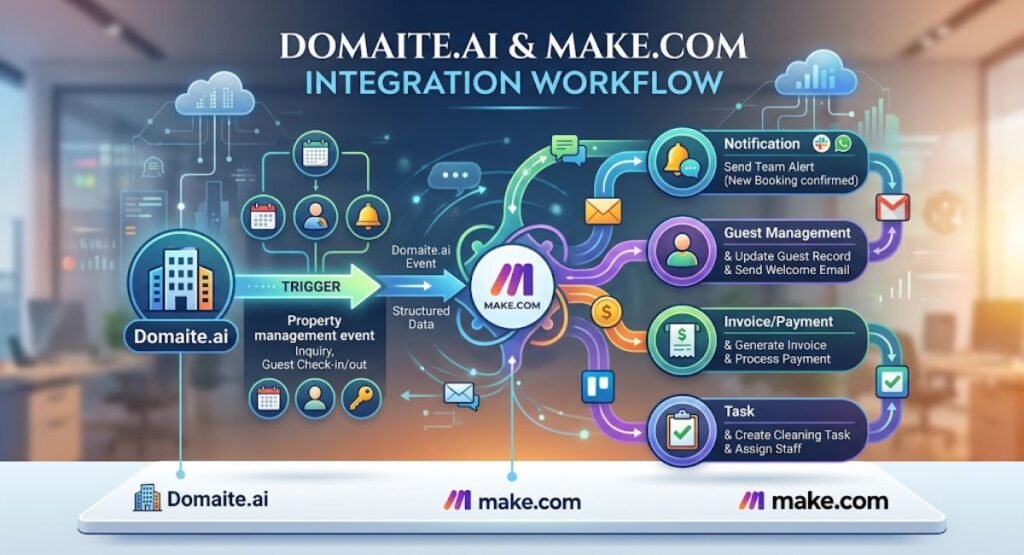
If you have been searching for a reliable way to connect AI-powered tools with automation platforms, chances are you have already come across the term Domaite.ai Make.com integration workflow. This combination is quickly becoming one of the most talked-about setups among marketers, agencies, and solo content creators who want to save time while scaling their output.
In this guide, we will break down everything you need to know about building, optimizing, and troubleshooting a Domaite.ai Make.com integration workflow, along with real use cases, pros and cons, a detailed comparison table, and answers to the most common questions people ask. Whether you are a complete beginner in no-code automation or someone who has already dabbled with Zapier, n8n, or similar tools, this article will walk you through the entire process in simple, human language.
By the end of this article, you will understand not only how this pipeline fits together technically, but also why so many teams are shifting their content operations toward this style of automated pipeline in 2026.
What Is Domaite.ai?

Domaite.ai is an AI-driven platform designed to help businesses and content teams automate repetitive tasks such as content generation, keyword research, and domain-related analysis. It uses artificial intelligence to speed up work that would otherwise take hours of manual effort. Many users choose Domaite.ai because it integrates smoothly with third-party automation tools, which is exactly why a Domaite.ai Make.com integration workflow has become so popular in recent months.
Domaite.ai is not just another AI writing tool. It focuses heavily on structured outputs, API access, and webhook support, which makes it an ideal candidate for automation platforms like Make.com. This structured approach is a key reason this setup works so reliably compared to pairing Make.com with less structured AI tools.
Beyond simple text generation, Domaite.ai often supports structured JSON responses, which makes it far easier for downstream automation tools to parse and route the data correctly inside any Domaite.ai Make.com integration workflow you build.
What Is Make.com?
Make.com (formerly known as Integromat) is a visual automation platform that allows users to connect different apps and services without writing a single line of code. Using a drag-and-drop scenario builder, you can create complex workflows that move data between apps automatically. This is where the real value of this kind of automation comes into play — you can trigger an action in Domaite.ai, process the output, and send it to Google Sheets, WordPress, Slack, or dozens of other apps, all without manual intervention.
Make.com supports HTTP modules, webhooks, and native API connections, which means a Domaite.ai Make.com integration workflow is far more flexible than many people initially expect. It also offers error handling, scheduling, retry logic, and conditional branching, giving your automation a professional, production-ready feel.
Another advantage of Make.com is its built-in data store, which allows you to temporarily hold information between steps. This is particularly useful when this integration involves multiple stages that require checking, formatting, or approval before final publishing.
Why Build a Domaite.ai Make.com Integration Workflow?
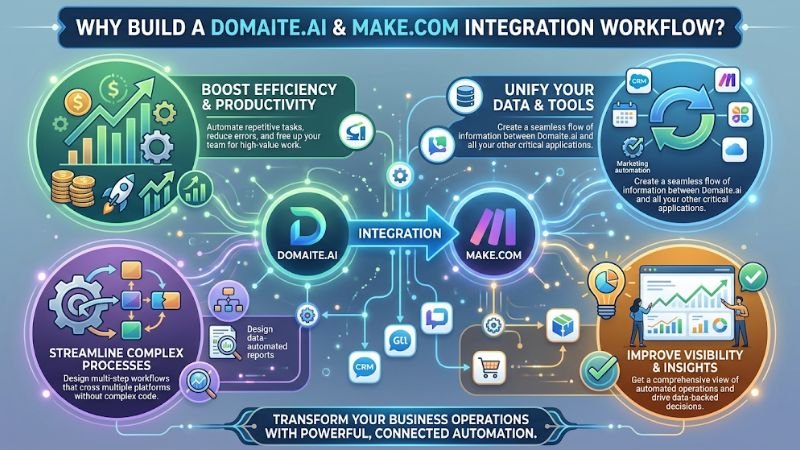
There are several strong reasons why businesses are adopting this content pipeline as part of their content and marketing operations:
- Time savings – A properly configured Domaite.ai Make.com integration workflow can cut manual content and data entry time down to minutes.
- Consistency – AI-generated outputs combined with automation ensure every piece of content follows the same structure.
- Scalability – Once built, this workflow lets you scale content production without hiring additional staff.
- Reduced human error – Automation reduces copy-paste mistakes or missed steps in your content pipeline.
- Better SEO output – Many teams build a Domaite.ai Make.com integration workflow specifically for SEO automation, generating optimized articles and meta descriptions at scale.
- Faster client turnaround – Agencies managing multiple clients can produce content batches far quicker than manual work allows.
- Centralized monitoring – Make.com’s execution logs give you a single place to track every run across your pipeline.
Step-by-Step: How to Set Up a Domaite.ai Make.com Integration Workflow
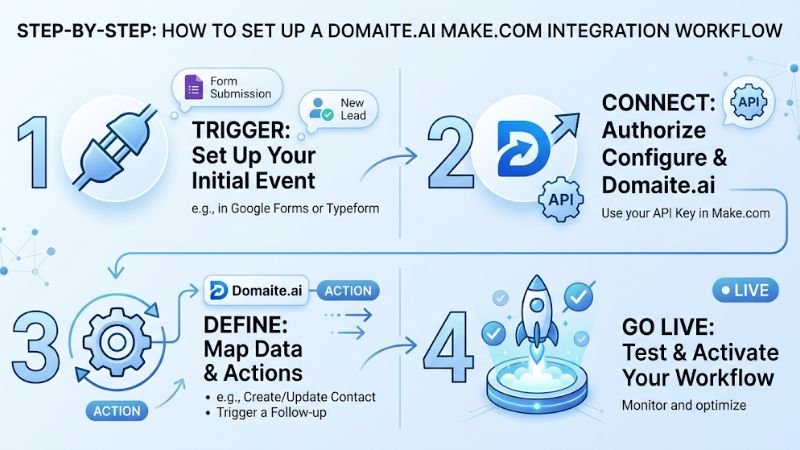
Below is a practical breakdown of how most teams configure this automation from scratch.
Step 1: Create Accounts on Both Platforms
Before anything else, you need active accounts on both Domaite.ai and Make.com. Make sure your Domaite.ai plan supports API or webhook access, since this is essential for the automation to work correctly.
Step 2: Generate API Credentials
Log into your Domaite.ai dashboard and locate the API key or webhook URL section. This key will act as the bridge between the two systems in your Domaite.ai Make.com integration workflow.
Step 3: Build Your First Scenario in Make.com
Inside Make.com, create a new scenario. Add an HTTP module or a dedicated Domaite.ai module as your trigger. This is the starting point of your entire pipeline.
Step 4: Connect the Output to Your Destination App
Once Domaite.ai generates content, you can route it to Google Docs, WordPress, Notion, Airtable, or email. This step is where most of the real business value of a Domaite.ai Make.com integration workflow becomes visible.
Step 5: Add Filters and Conditional Logic
Make.com allows you to add filters so only relevant data passes through. In a well-designed this setup, low-quality outputs are routed to a manual review queue instead of publishing directly.
Step 6: Add Formatting and Cleanup Modules
Before publishing, it’s often useful to add a text-formatting module that cleans up spacing or converts markdown to HTML. This extra layer ensures content arriving through this kind of automation looks polished by the time it reaches its final destination.
Step 7: Test and Monitor
Run test scenarios multiple times before going live. Check Make.com’s execution history to confirm your Domaite.ai Make.com integration workflow is working as expected, with no failed modules or broken connections.
Step 8: Schedule and Automate Fully
Once tested, set your scenario to run on a schedule. This completes this fully automated integration, ready to run in the background around the clock.
Common Use Cases for This Integration
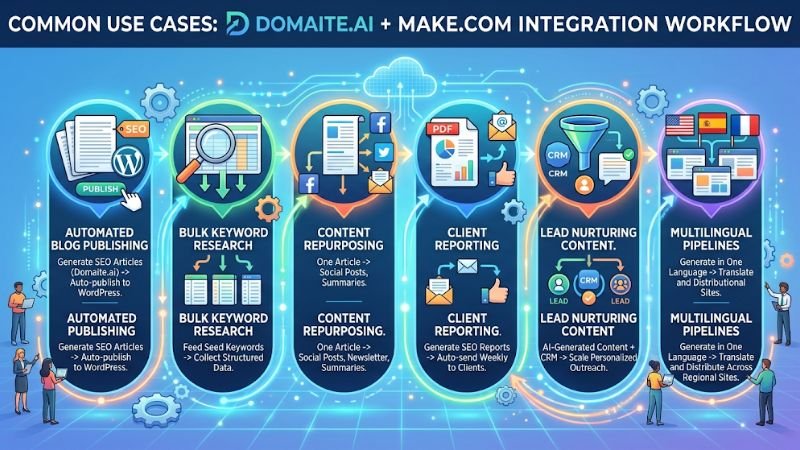
- Automated blog publishing: Generate SEO articles with Domaite.ai and auto-publish them to WordPress through a Domaite.ai Make.com integration workflow.
- Bulk keyword research: Feed a list of seed keywords into Domaite.ai and collect structured keyword data automatically.
- Content repurposing: Turn one long-form article into social media posts, email newsletters, and short summaries.
- Client reporting: Automatically generate and send SEO reports to clients on a weekly basis.
- Lead nurturing content: Combine AI-generated content with CRM tools to personalize outreach at scale.
- Multilingual content pipelines: Generate content in one language and automatically translate and distribute it across regional websites.
Each of these use cases relies on the same underlying principle: a well-structured content pipeline that connects AI output with real business actions, rather than leaving it unused in a dashboard. (If you have an existing guide on your site — for example a “what is workflow automation” or “best no-code tools” post — link to it here; RankMath rewards at least one internal link per post.)
Pros and Cons of a Domaite.ai Make.com Integration Workflow
Like any automation setup, this integration comes with both strengths and limitations. Here is an honest breakdown to help you decide if a Domaite.ai Make.com integration workflow fits your needs.
Pros
- Massive time savings on repetitive content and data tasks
- No-code setup, meaning you don’t need a developer to build the automation
- Highly customizable scenarios with filters, routers, and conditional paths
- Scalable for agencies handling multiple clients at once
- Wide app compatibility, since Make.com connects with over a thousand apps
- Improved consistency in tone, structure, and SEO formatting across content
- Transparent monitoring, since every execution is logged and easy to audit later
Cons
- Learning curve for beginners unfamiliar with automation platforms
- API limits on Domaite.ai’s lower-tier plans may restrict how much automation you can run
- Cost stacking, since you’re paying for both Domaite.ai and Make.com subscriptions
- Occasional errors in AI-generated output that still require human review
- Dependency risk, meaning this workflow may break temporarily if either platform changes its API
- Initial setup time can be longer than expected for complex, multi-step scenarios
Domaite.ai Make.com Integration Workflow vs Other Automation Options
To help you decide whether this setup is right for you, here is a comparison against other popular automation combinations.
| Feature | Domaite.ai + Make.com | Zapier + Generic AI Tool | Manual Process (No Automation) |
|---|---|---|---|
| Setup Difficulty | Moderate (no-code, visual builder) | Moderate to Easy | None required |
| Cost Efficiency | Good, pay-as-you-scale | Can get expensive at high volume | Free but time-costly |
| Customization | High, with routers and filters | Moderate | Fully flexible but slow |
| Scalability | Excellent for growing teams | Good, but pricing rises fast | Poor, limited by human hours |
| SEO Content Focus | Strong, purpose-built for content | Depends on connected AI tool | Fully manual, time-intensive |
| Error Handling | Built-in retry and filter logic | Available but less flexible | Human-dependent |
| Monitoring | Detailed execution logs | Basic history logs | None, manual tracking only |
| Best For | Agencies and content-heavy teams | General business automation | Very small, one-off tasks |
As shown above, a Domaite.ai Make.com integration workflow stands out particularly for teams focused on content and SEO automation, offering a strong balance between flexibility, cost, and scalability.
LSI Keywords and Related Concepts Worth Knowing
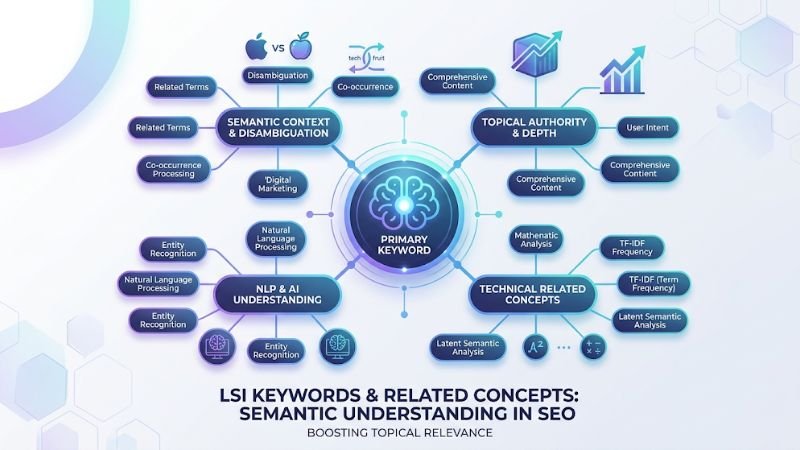
To fully understand the automation, it helps to be familiar with related terms often used alongside it: workflow automation, no-code automation platform, AI content generation, API integration, webhook automation, scenario builder, business process automation, automated content pipeline, SEO automation tools, third-party app connections, drag-and-drop automation, and real-time data syncing.
Familiarity with these terms also helps when troubleshooting this pipeline, since most Make.com support documentation and community forums use this shared vocabulary when discussing scenario design and error resolution.
Best Practices for a Smooth Integration
- Always test your scenario with sample data before connecting your Domaite.ai Make.com integration workflow to live client work.
- Set up error notifications in Make.com so you’re alerted immediately if a module fails.
- Keep your Domaite.ai API keys secure and rotate them periodically.
- Document this setup so team members can troubleshoot it without starting from scratch.
- Review AI-generated content regularly, even after your Domaite.ai Make.com integration workflow is fully set up.
- Start small with a single automated task before expanding into a full multi-step pipeline.
- Keep a changelog of scenario updates, since automation platforms occasionally change module behavior after updates.
Common Mistakes to Avoid
Many beginners run into avoidable problems when first setting up this kind of automation. Skipping the testing phase is one of the most frequent mistakes, since untested scenarios often fail silently in production. Another common issue is ignoring API rate limits, which can cause a Domaite.ai Make.com integration workflow to stop mid-run without a clear warning. Teams also sometimes forget to add fallback paths for when the AI output doesn’t meet expected formatting, leading to broken content being published automatically.
Tools and Add-Ons You Can Combine With This Setup
One of the underrated strengths of this integration is how easily you can layer additional tools into the same pipeline without redesigning it from scratch. For example, teams often connect Google Sheets as a lightweight content calendar, allowing every generated article to be logged automatically with its status, publish date, and target keyword. Others connect Slack or Discord so that the marketing team receives an instant notification whenever new content is generated.
For agencies managing multiple clients, adding Airtable as a central database can be extremely useful within a Domaite.ai Make.com integration workflow. Instead of scattering content across different folders, every output from Domaite.ai can be stored in a structured Airtable base, tagged by client, topic, and approval status.
SEO teams sometimes add an extra verification step using plagiarism-checking or readability-scoring APIs before content moves to the publishing stage. This acts as a quality gate inside the content pipeline, catching issues before they reach a live website.
Is This Integration Right for Your Business?
Not every business needs this workflow right away. If you’re publishing only a handful of articles per month, a simpler manual process might still make sense. However, if your team is producing content regularly, the time saved by this kind of automation quickly outweighs the setup effort.
Agencies in particular benefit the most from a Domaite.ai Make.com integration workflow, since the same scenario structure can often be duplicated and lightly customized for each new client. Solo creators and small teams also benefit, especially when automation frees them up to focus on strategy instead of repetitive tasks.
Frequently Asked Questions (FAQs)
1. Is the automation suitable for beginners? Yes, it is beginner-friendly since Make.com uses a visual drag-and-drop interface. However, some basic understanding of APIs and webhooks will make the setup process smoother.
2. Do I need coding skills to build this integration? No. Make.com is a no-code platform, and most of the setup can be done through modules and visual connections rather than actual programming.
3. How much does it cost to run a Domaite.ai Make.com integration workflow? Costs vary depending on your Domaite.ai plan and your Make.com operations usage. Higher automation volume generally requires a higher-tier plan on both platforms.
4. Can this integration fully replace human content writers? Not entirely. While this pipeline automates a large portion of content creation, human review is still recommended to maintain quality and brand voice.
5. What happens if Domaite.ai changes its API? If the API structure changes, your Domaite.ai Make.com integration workflow may need adjustments. It’s good practice to monitor your automation regularly for this reason.
6. Is this integration good for SEO purposes? Yes, many users specifically build this setup to automate SEO content production, keyword research, and reporting tasks.
7. Can I connect other tools alongside this integration? Absolutely. Make.com supports connecting multiple apps within the same scenario, so you can add CRM tools, email platforms, or analytics dashboards alongside Domaite.ai.
8. How long does it take to set up from scratch? For a simple single-step automation, setup can take under an hour. A more advanced Domaite.ai Make.com integration workflow with formatting, filtering, and approval steps may take a few days to fully configure and test.
Conclusion
Building a Domaite.ai Make.com integration workflow is one of the smartest moves you can make if you’re looking to scale content production, save time, and reduce manual workload without sacrificing quality. From automated blog publishing to bulk keyword research and client reporting, this integration offers real, practical value for marketers, agencies, and solo creators alike.
While there is a learning curve and some ongoing maintenance involved, the long-term benefits make this kind of automation well worth the initial setup effort. If you’re serious about automating your content pipeline in 2026 and beyond, now is a great time to start building this integration for your own team and see how much time it can save.
