I’ll be honest — I almost skipped writing about this month’s changes because “another AI update” headline is starting to feel like white noise. But after digging into what actually shipped, the AI writing tools updates April 2026 turned out to be more than the usual minor tweaks. A few of these changes genuinely shift how people write, edit, and rank content online.
If you use AI writing tools for blogs, ad copy, or long-form articles, you’ll want to know what changed this round. Some of it is exciting. Some of it is a little annoying (looking at you, pricing pages). Below, I’ve broken down the full list of AI writing tools updates April 2026, what it’s worth to you, the pros and cons, a comparison table you can skim in ten seconds, and the questions people keep asking about this update.
Why the April 2026 AI Writing Tools Update Matters
Here’s the thing about AI writing platforms: they update constantly, but most of those updates are cosmetic. A new button here, a slightly faster response there. The April 2026 AI writing tools update didn’t feel like that. This round leaned into deeper context retention, sharper SEO alignment, and — maybe most noticeably — output that reads less like a machine wrote it.
Ignore these AI writing tool updates at your own risk, honestly. Search engines are getting better at spotting thin, generic content, and rewarding the stuff that’s actually useful. So keeping up with AI writing tools updates April 2026 isn’t just something to file away for later. If you publish content regularly, it affects your rankings starting now.
Major AI Writing Tools Updates April 2026
Here’s a rundown of what actually moved the needle this round, without the marketing fluff.
1. New Flagship Language Models
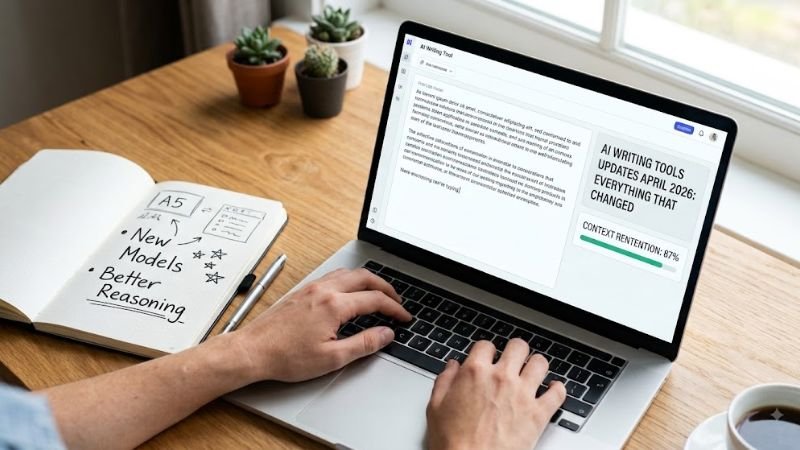
April brought a fresh crop of large language models powering many of the writing assistants people use daily. The improvements aren’t flashy on paper — better reasoning, fewer factual slip-ups, more consistency across longer documents — but you feel the difference when you’re three thousand words into a draft and the tone hasn’t drifted. Writers have been asking for this for a while, and it’s one of the more welcome pieces of the AI writing tools updates April 2026 brought to the table.
2. Smarter SEO and Search Visibility Features
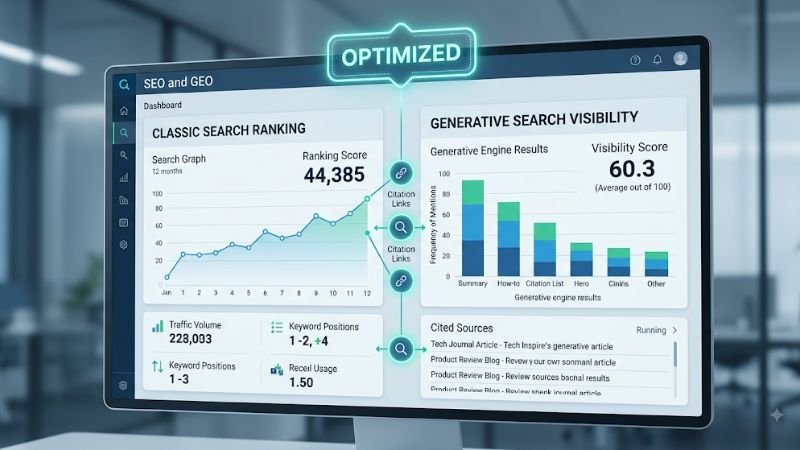
SEO tools didn’t just tweak their scoring — they expanded it. Content now gets evaluated not only for how it ranks in classic search but also for how likely it is to get cited by AI-powered search assistants. People are calling this generative engine optimization, or GEO, and it’s quickly becoming as unavoidable a term as “on-page SEO” was a decade ago. Most tools now check keyword density, readability, and this newer AI-citation potential all in one pass — a direct result of the AI writing tools updates April 2026 rolled out.
3. Improved Brand Voice and Personalization
This one matters more than it sounds. Marketing-focused tools upgraded their brand voice engines so teams can train the AI on their existing content and get drafts that actually sound like them, not like a generic template with the company name swapped in. If you’ve ever spent twenty minutes rewriting an AI draft just to make it sound less “corporate template,” this piece of the AI writing tools updates April 2026 is aimed squarely at you.
4. Fact-Checking and Citation Tools
AI hallucinations have been a real headache for anyone publishing content professionally, so it’s good to see platforms taking this seriously. Several tools now come with built-in fact-checkers that flag unverified claims and suggest sources before you hit publish. It’s not foolproof — nothing is — but it’s a meaningful step toward content that holds up to scrutiny, which also happens to help with E-E-A-T (Experience, Expertise, Authoritativeness, Trustworthiness) signals that Google cares about.
5. Faster Long-Form Content Generation
Speed was a quieter win this month, but a real one. Several platforms reported noticeably faster generation for long-form pieces, which sounds minor until you’re the one waiting on a 2,500-word draft to finish loading. Less waiting, more editing time — that’s a trade most writers will happily make, and it’s one of the more practical wins in this round of AI writing tools updates April 2026.
6. AI Detection Resistance
With detection tools becoming more common in newsrooms, schools, and client workflows, a few platforms focused specifically on making generated text sound more natural — fewer of those telltale robotic patterns that trip up both human readers and detection software — a quiet but useful part of the AI writing tools updates April 2026 cycle.
Key Features Introduced in the Latest Update
Pulling it all together, here’s what showed up across the industry in this batch of AI writing tools updates April 2026:
- Longer context windows for consistent multi-page writing
- Built-in SEO and generative search optimization scoring
- Advanced brand voice training for teams
- Automated fact-checking and citation suggestions
- Faster processing on long-form articles
- More natural, less “AI-sounding” sentence structure
- Better integration with existing content and workflow tools
None of these are revolutionary on their own. Together, though, they mark a shift — thanks to the AI writing tools updates April 2026, AI writing assistants are turning into something closer to a full content partner, not just a text generator you prompt and walk away from.
Pros and Cons of the April 2026 AI Writing Tools Update
Nothing’s perfect, and the AI writing tools updates April 2026 are no exception. Here’s the honest breakdown.
Pros
- Higher content quality: The newer models genuinely produce more coherent, natural writing with fewer of those repetitive phrasing patterns.
- Better SEO alignment: New optimization scoring helps content perform in both classic search and AI-driven search results.
- Real time savings: Faster generation means more content, more testing, less waiting around.
- Stronger brand consistency: Better brand voice tools mean less time spent rewriting drafts to sound like an actual human on your team wrote them.
- Improved accuracy: Built-in fact-checking catches more mistakes before they go live.
Cons
- Prices went up: Several platforms bundled these upgrades with price increases, which stings if you’re a solo creator on a tight budget.
- Setup takes time: Brand voice training and SEO scoring aren’t plug-and-play — you’ll need to feed them examples before they’re actually useful.
- Templates still feel templated: Some tools lean too hard on their old template libraries, so output can still sound familiar across different platforms.
- You still have to edit: Fact-checking helps, but it isn’t a replacement for actually reading your draft before you publish it.
- More features, more clutter: A few of the enterprise-heavy additions are overkill if you’re a one-person operation just trying to write a blog post.
Comparison Table: Top AI Writing Tools After the April 2026 Update
Here’s a quick side-by-side look at how the top platforms stack up after the AI writing tools updates April 2026.
| Tool | Best For | Standout Feature (April 2026 Update) | Pricing Starting At |
|---|---|---|---|
| ChatGPT | General writing & brainstorming | New flagship model with improved reasoning | Free / $20 per month |
| Claude | Long-form, human-sounding content | Extended context window for full manuscripts | Free / Paid tiers |
| Jasper | Marketing teams & brand consistency | Expanded AI agents and content pipelines | ~$39 per month |
| Writesonic | SEO-driven long-form articles | Built-in fact checker and citation engine | ~$19 per month |
| Copy.ai | Sales and GTM workflow automation | Workflow automation beyond basic copywriting | ~$36 per month |
| Grammarly (Superhuman) | Grammar, tone, and editing | Expanded document workspace features | ~$12 per month |
| Surfer SEO | On-page and AI search optimization | New GEO (generative engine) scoring | Paid tiers only |
What jumps out here is how differently each platform is approaching the same AI writing tools updates April 2026 moment — some are chasing raw writing quality, others are betting everything on workflow and optimization. Neither approach is wrong; it just depends on what you actually need.
How These Updates Affect Content Creators and SEO
Let’s talk about the part that actually matters for your traffic. The AI writing tools updates April 2026 aren’t just shiny new buttons — they change what “good content” looks like to a search engine. As AI-written content floods the web, search engines are leaning harder into originality, accuracy, and genuine usefulness as ranking signals.
Practically speaking, that means:
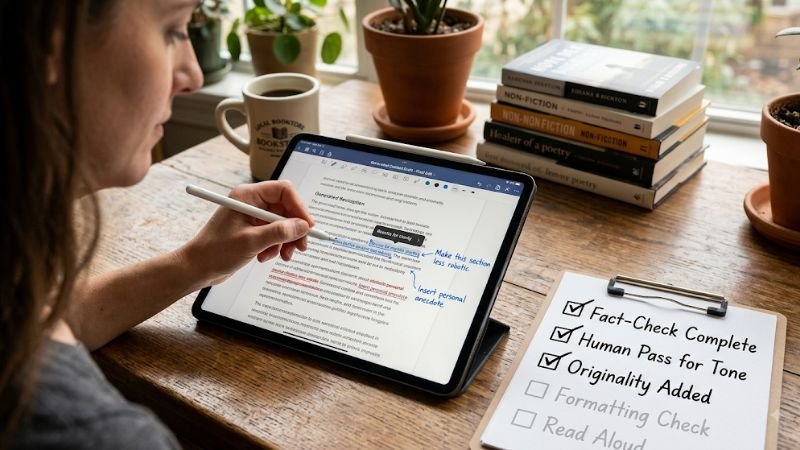
- Fact-check your AI drafts before publishing — don’t just trust the built-in checker blindly.
- Add something the AI can’t: your own examples, data, or opinion.
- Write like a person talks, not like a template fills in blanks.
- Optimize for both classic search and the newer AI-powered search assistants.
- Keep your brand voice consistent across everything you publish.
Do that, and you get the full benefit of the AI writing tools updates April 2026 brought without losing the human fingerprint that makes content worth reading in the first place.
How to Choose the Right AI Writing Tool After This Update
With this many AI writing tools updates April 2026 landing at once, picking a platform comes down to what you’re actually trying to do:
- Solo bloggers: A general-purpose assistant plus an SEO plugin will cover most of what you need — no reason to overspend.
- Marketing teams: Look at tools with strong brand voice training and workflow automation; that’s where the real time savings show up.
- Long-form and editorial writers: Prioritize extended context windows and natural-sounding output over flashy extras.
- SEO-heavy sites: You’ll want keyword optimization paired with the newer generative search scoring — that combo is becoming the standard.
There’s no universal “best” tool here, no matter what the review sites tell you. It comes down to your budget, your goals, and how much editing time you’re willing to put in afterward.
The Bigger Industry Trend Behind These Updates
Zoom out for a second, and a pattern becomes obvious. The AI writing tools updates April 2026 aren’t happening in isolation — they fit a broader shift the whole industry has been leaning into all year. It’s not just about smarter chatbots anymore. It’s about AI becoming an actual collaborator across the entire content process, from the first outline to the final published piece.
Three trends stand out:
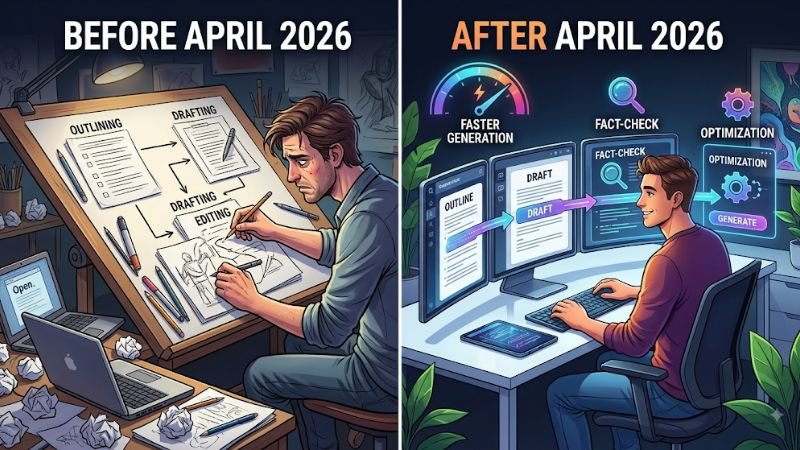
- From single prompts to full workflows: Instead of generating one paragraph and calling it done, platforms now handle outlining, drafting, editing, and optimization as one connected process.
- From generic to personal: Brand voice training and longer memory mean a tool can carry a company’s tone across dozens of articles instead of forgetting everything the moment a new session starts.
- From generation to verification: Fact-checking and citation features are a direct response to the trust problem AI content has had for years now.
Put together, that’s why this round of AI writing tools updates April 2026 feels bigger than the last few. It’s not one flashy feature — it’s the whole industry moving in the same direction at once.
What This Means for Different Types of Users
Not everyone gets the same value out of the AI writing tools updates April 2026. Here’s how it breaks down depending on who you are.
Freelance writers and bloggers will notice faster drafts and less robotic phrasing thanks to the AI writing tools updates April 2026, which cuts down on rewriting time. The downside? A few subscription price hikes might push budget-conscious folks toward free tiers or a different tool altogether.
Small business owners using AI for marketing copy, product descriptions, or email campaigns will probably get the most out of the brand voice improvements — consistent messaging without needing to hire another writer just to keep things “on brand.”
Content marketing teams and agencies stand to benefit the most, honestly. Workflow automation, brand voice enforcement, and built-in SEO scoring working together means scaling content production without everything sounding scattered across ten different writers and tools.
Students and researchers will appreciate the fact-checking and citation upgrades, since bad information in academic work is a much bigger problem than it is in a marketing blog post.
Common Mistakes to Avoid When Using Updated AI Writing Tools
Even with all the progress from the AI writing tools updates April 2026, people still trip over the same few things:
- Publishing without a real fact-check: The automated checkers help, but they miss things. Read your draft before it goes live — every time.
- Leaning on default templates: New features only help if you actually customize them. Skip that step and you’re back to generic, forgettable content.
- Ignoring how the keyword sits in the sentence: SEO scoring tools are handy, but a keyword stuffed in awkwardly still reads awkwardly, no matter what the score says.
- Skipping the editing pass entirely: An AI draft is a starting point, not a finished article. A quick human pass fixes tone and catches what the AI missed.
- Chasing every new feature: Not every part of the AI writing tools updates April 2026 cycle applies to your workflow. Pick what’s actually useful and ignore the rest.
Avoid these, and you’ll actually get value out of the AI writing tools updates April 2026 instead of just adding noise to your process.
Frequently Asked Questions
What are the biggest AI writing tools updates April 2026 brought? The standouts are new flagship language models, sharper SEO and generative search optimization, better brand voice training, built-in fact-checking, and faster generation on long-form content.
Are AI writing tools better at SEO after the April 2026 update? Pretty much, yes. Thanks to the AI writing tools updates April 2026, most tools now score content for both traditional search and AI-powered search results, which makes it easier to write something that performs well across the board.
Do I still need to edit AI-generated content after these updates? Yes — no way around it. Fact-checking has improved, but human review is still what catches the stuff that actually matters: tone, accuracy, and whether the content sounds like a real person wrote it.
Which AI writing tool is best after the April 2026 update? Depends what you’re doing. General-purpose assistants win on writing quality. Dedicated marketing tools win on workflow and brand consistency. There’s no single winner across the board.
Will AI writing tools replace human writers? Not anytime soon. They’re getting better at assisting, not replacing. Judgment, creativity, and knowing when a fact-checker got something wrong — that’s still on you.
Conclusion
The AI writing tools updates April 2026 are a genuine step forward, not just another press release full of buzzwords. Smarter models, sharper SEO tools, and better fact-checking all point in the same direction: AI-generated content that’s more accurate, more natural, and more likely to actually perform in search.
Whether you’re writing solo or running content for a whole team, it’s worth staying on top of updates like this one. Tools change fast, and the people who adapt their workflow — instead of just switching tools every month out of FOMO — tend to come out ahead. That’s really the whole story behind these AI writing tools updates: less about the tools themselves, more about how you choose to use them.
