
Managing a Google Business Profile effectively is no longer just about adding business information and responding to reviews. Modern AI tools can help businesses optimize listings, improve local search visibility, automate customer engagement, and gain valuable insights from customer interactions. In this guide, we explore the best AI tools for Google Business Profile optimization and how they can help businesses attract more local customers in 2026.
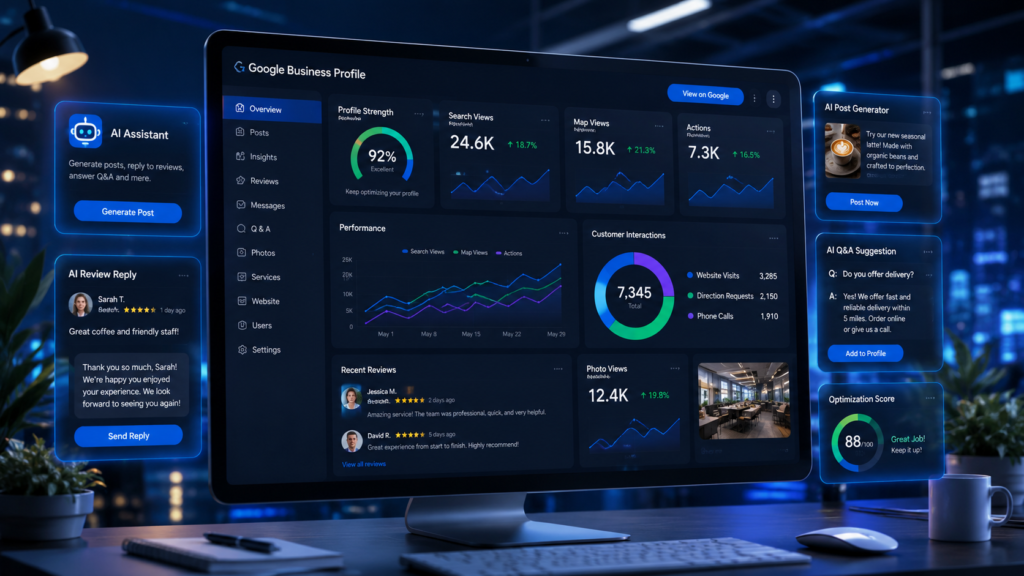
If you run a local business, you’ve probably noticed how much weight Google gives to that little map pack at the top of search results. Someone types “plumber near me” or “best bakery in Dallas,” and three businesses pop up before anyone even scrolls.
Whether yours is one of them usually comes down to how well you’ve been keeping up your Google Business Profile (GBP). These days, a lot of owners and local SEO folks are turning to AI tools for Google Business Profile optimization so it doesn’t eat up their week.
But here’s the honest truth before we go any further: AI can speed up local SEO. It cannot replace real business proof.
No AI tool can fake genuine customer trust, real photos of your storefront, or an honest five-star review from someone who actually walked through your door. What the right AI tools for Google Business Profile optimization can do is take the repetitive, time-consuming parts of GBP management — writing posts, drafting review replies, answering Q&A, generating service descriptions — and turn hours of work into minutes.
This guide walks through the best AI tools for Google Business Profile optimization available right now. You’ll see how they compare, where each one shines, and how to combine AI efficiency with human judgment so your profile stays accurate, trustworthy, and genuinely helpful to real customers.
Why AI Tools for Google Business Profile Optimization Matter for Local SEO
Your Google Business Profile is often the very first impression a potential customer has of your business. Before they visit your website, before they call you, they see your profile: your hours, your photos, your reviews, your services, and your recent posts.
Google’s local ranking system weighs three main factors — relevance, distance, and prominence. A well-maintained, active profile directly influences all three.
An outdated profile with no recent posts, unanswered questions, and ignored reviews sends a signal to Google (and to customers) that the business isn’t actively engaged. A profile that’s updated weekly, responds quickly to reviews, and has a complete Q&A section tends to earn more visibility in the local map pack.
This is exactly where AI tools for Google Business Profile optimization have become so valuable — they help small business owners keep up with a task that used to require hours every week.
How AI Tools for Google Business Profile Optimization Are Changing Local SEO
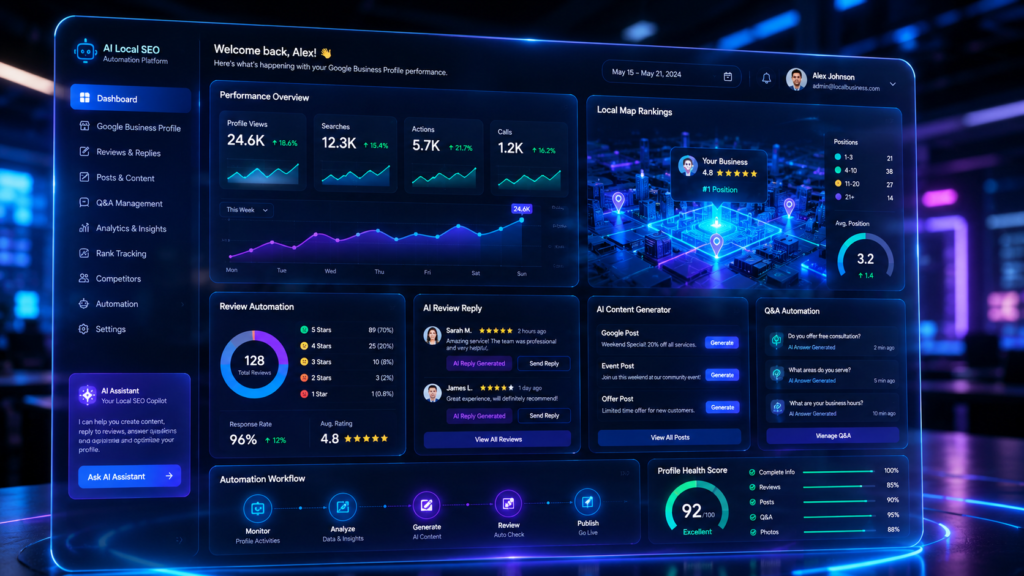
Traditionally, managing a GBP profile meant manually writing every post, checking for new reviews every day, thinking up Q&A content, and updating service descriptions whenever something changed. For a single-location business, that’s manageable but tedious.
For multi-location businesses or agencies managing dozens of client profiles, it’s a full-time job. The best AI tools for Google Business Profile optimization now handle much of this repetitive workload:
- Drafting weekly Google Posts based on services, seasons, or promotions
- Suggesting review responses tailored to the sentiment of each review
- Generating Q&A content based on common customer questions
- Writing service descriptions optimized with relevant local keywords
- Auditing a profile to flag missing sections, outdated info, or weak spots
- Turning blog and website content into ideas for ongoing local SEO
The result is that business owners and marketing teams can maintain a consistently active profile without spending every spare hour doing it by hand.
Local SEO Automation vs. Manual Profile Management
Before AI tools became common, local SEO automation mostly meant scheduling tools for social posts. Almost none of it was built specifically for Google Business Profile.
Now, dedicated GBP platforms combine automation with actual local search intelligence. They track keyword rankings by geography, monitor review sentiment, and recommend fixes based on real ranking data.
The difference matters. A generic AI writing assistant can draft a decent-sounding post, but purpose-built AI tools for Google Business Profile optimization understand things like map pack ranking factors, review response timing, and how to naturally weave in your city name and core service keywords without sounding robotic or spammy.
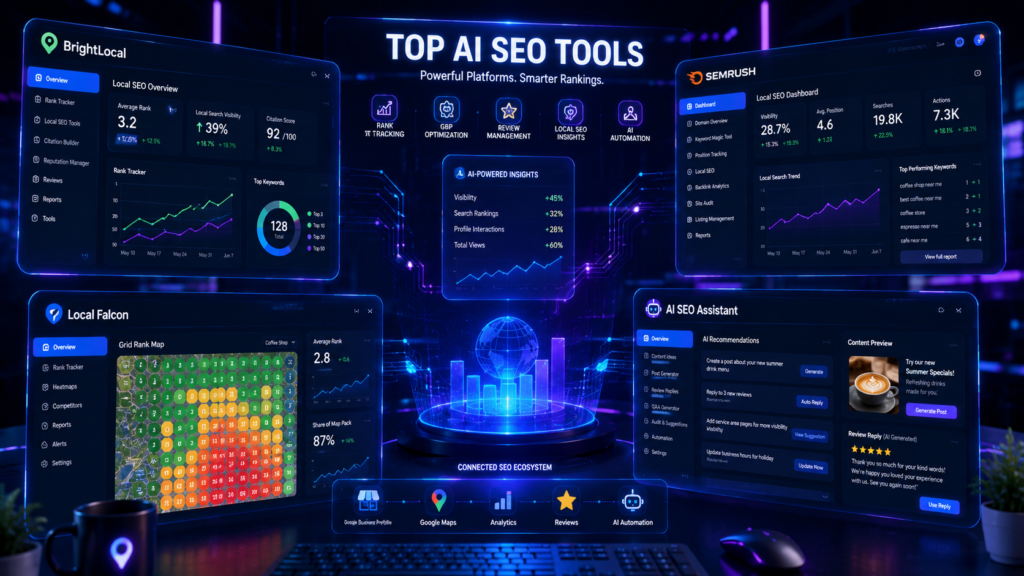
Top AI Tools for Google Business Profile Optimization
Below is a breakdown of some of the most widely used AI tools for Google Business Profile optimization in 2026, based on their core strengths.
1. BrightLocal
BrightLocal has long been a trusted name in local SEO, and its AI-assisted features now support GBP audits, citation tracking, and review monitoring. It’s especially useful for agencies that need to run quick, structured audits across many client profiles.
Best for: Agencies and consultants who need fast, repeatable profile audits alongside citation and rank tracking.
Pros:
- Strong reporting and white-label options for agencies
- Reliable citation tracking across multiple directories
- Good historical ranking data over time
Cons:
- Interface can feel dense for beginners
- AI content generation is more limited than dedicated content-focused tools
2. Local Falcon
Local Falcon is built around geo-grid ranking visualization. It shows exactly where your business ranks in the map pack across different points on a map, not just from one central address.
Its AI layer helps interpret this data and suggests which areas need attention.
Best for: Businesses that want to understand exactly where they’re winning and losing visibility across their service area.
Pros:
- Very clear visual geo-ranking data
- Helps identify underperforming neighborhoods or zip codes
- Useful for service-area businesses without a storefront
Cons:
- Focused mainly on ranking visibility, not full content generation
- Best used alongside another tool for posts and reviews
3. Whitespark
Whitespark has built a strong reputation around citation building and local search audits. Its tools help ensure your business information is consistent across the web, which is a foundational trust signal for both Google and customers.
Best for: Businesses focused on fixing inconsistent NAP (Name, Address, Phone) data and building strong local citations.
Pros:
- Deep citation-building expertise
- Good for cleaning up duplicate or inconsistent listings
- Trusted, long-standing local SEO reputation
Cons:
- Less focused on day-to-day content like posts and Q&A
- More of a foundational tool than an all-in-one platform
4. Semrush Local
Semrush’s local SEO toolkit brings AI-assisted listing management, review tracking, and local keyword research into one dashboard. This is helpful for businesses that already use Semrush for broader SEO.
Best for: Businesses already using Semrush for SEO who want local and organic strategy in one place.
Pros:
- Combines local SEO with broader keyword and content tools
- Good for connecting GBP strategy to website SEO
- Useful competitor tracking features
Cons:
- Can be pricier for businesses that only need local features
- Slight learning curve for the full platform
5. Synup
Synup is built as a complete local marketing suite for multi-location brands and agencies. It combines listings management, reputation monitoring, and social scheduling — including GBP Posts — into one dashboard.
Best for: Multi-location brands and agencies managing several profiles at once.
Pros:
- Real-time listing sync across many directories
- Clean dashboard for managing multiple locations
- Social and GBP post scheduling in one place
Cons:
- Can be more than a single-location small business needs
- Pricing scales with number of locations
6. Birdeye
Birdeye leans heavily into reputation and customer experience. It offers AI-assisted review management, messaging, and GBP optimization built around growing and responding to reviews at scale.
Best for: Businesses where review volume and fast review responses directly drive bookings, like healthcare, home services, and retail chains.
Pros:
- Strong AI review response drafting
- Ties GBP visibility to broader reputation management
- Good for multi-location customer messaging
Cons:
- Pricing typically requires a custom quote
- More reputation-focused than pure content generation
7. Podium
Podium isn’t a dedicated GBP tool, but its AI-powered review and messaging features make it valuable for local service businesses. Fast replies to Google reviews and customer texts translate directly into booked jobs.
Best for: Local service businesses (home services, auto repair, dental) that rely on fast customer communication.
Pros:
- Strong text messaging and webchat integration
- AI-assisted review request automation
- Good for converting reviews into repeat business
Cons:
- Not a full GBP management platform on its own
- Quote-based pricing can be less transparent
8. Localo
Localo focuses specifically on Google Business Profile optimization with a score-based audit system and AI-generated post ideas. It’s approachable for small business owners who want quick wins without a steep learning curve.
Best for: Small business owners who want a simple, guided way to improve their profile score.
Pros:
- Easy-to-understand profile scoring
- Weekly AI post suggestions
- Beginner-friendly interface
Cons:
- Fewer advanced features for large agencies
- Limited multi-location support compared to enterprise tools
9. Merchynt
Merchynt is built around AI-generated GBP content and review management specifically for multi-location businesses and agencies. Bulk post creation is one of its standout features.
Best for: Agencies managing GBP content across many client accounts at once.
Pros:
- Bulk content generation saves significant time
- Good for standardizing tone across multiple locations
- Review automation built in
Cons:
- Bulk-generated content still needs human review for accuracy
- Less suited for single-location businesses
10. General AI Writing Assistants (ChatGPT, Claude, and similar tools)
Beyond dedicated local SEO platforms, general-purpose AI assistants are widely used to draft Google Posts, review responses, Q&A answers, and blog topic ideas from scratch. They’re flexible and often free or low-cost, but they don’t connect directly to your profile or pull in ranking data.
Best for: Business owners who want full control and are comfortable prompting AI manually, without paying for a dedicated platform.
Pros:
- Highly flexible for any type of content
- Low cost or free for basic use
- Great for brainstorming blog and post topics
Cons:
- No direct GBP integration or automated posting
- Requires more manual work to apply local SEO best practices
- Higher risk of generic-sounding content without careful prompting
Comparison Table: Best AI Tools for Google Business Profile Optimization
| Tool | Best For | Key AI Feature | Multi-Location Support | Learning Curve |
|---|---|---|---|---|
| BrightLocal | Agencies needing fast audits | AI-assisted profile audits | Yes | Moderate |
| Local Falcon | Geo-ranking visibility | Geo-grid ranking insights | Yes | Moderate |
| Whitespark | Citation consistency | Citation audit automation | Yes | Low |
| Semrush Local | Connecting local + website SEO | Local keyword and competitor AI | Yes | Moderate-High |
| Synup | Multi-location brands | Listing sync and post scheduling | Strong | Moderate |
| Birdeye | Review-driven businesses | AI review response drafting | Strong | Moderate |
| Podium | Fast customer communication | AI review request automation | Yes | Low-Moderate |
| Localo | Small business quick wins | Score-based audits + post ideas | Limited | Low |
| Merchynt | Agencies, bulk content | Bulk AI post and review generation | Strong | Moderate |
| ChatGPT / Claude | Manual, flexible content drafting | General AI content generation | N/A | Low |
Pros and Cons of Using AI Tools for Google Business Profile Optimization
Pros
- Saves significant time. Tasks that used to take 30–60 minutes, like writing a single post, can be drafted in a couple of minutes.
- Keeps profiles consistently active. Weekly posting and fast review responses are much easier to maintain.
- Reduces the guesswork. AI audit tools point out exactly what’s missing from a profile.
- Scales well for agencies. Managing dozens of client profiles by hand simply isn’t realistic without automation.
Cons
- AI can sound generic if not reviewed. Without human editing, AI content can feel repetitive or robotic.
- Accuracy isn’t guaranteed. AI may draft a service description or answer that isn’t fully correct for your business.
- It cannot replace real trust signals. No AI tool can generate a genuine customer review, a real project photo, or authentic local credibility.
- Over-reliance risks keyword stuffing. Left unchecked, AI content can overuse keywords in a way that reads unnaturally.
Real Use Cases: How Local Businesses Are Using AI Tools for Google Business Profile Optimization
A home services company uses an AI-assisted platform to draft weekly Google Posts about seasonal promotions. A team member then reviews and adds specific project details before publishing, keeping the profile active without asking technicians to write marketing copy.
A dental clinic uses AI review response drafting to reply to every review within 24 hours, a habit that used to slip during busy weeks. The front desk staff still personalizes each reply before sending it, which keeps the tone genuinely human.
A multi-location retail brand relies on a bulk content tool to standardize Google Posts and Q&A answers across a dozen store locations. This saves the marketing team from manually customizing dozens of near-identical updates each week.
A solo-owned bakery uses a general AI assistant like ChatGPT to brainstorm blog topics and Q&A ideas, then manually publishes them. A full platform subscription isn’t cost-effective for a single location.
In each case, the pattern is the same: AI handles the repetitive drafting, but a real person still checks, edits, and approves before anything goes live.
AI vs. Human: Finding the Right Balance

The businesses that get the best results from AI tools for Google Business Profile optimization don’t treat AI as a replacement for genuine effort. They treat it as an assistant.
AI is excellent at generating a first draft, suggesting ideas, and flagging gaps. It is not good at knowing the small, specific details that make a business unique — the regular customer’s name, the exact story behind a five-star review, or the tone that actually matches your brand.
A simple rule that works well in practice: let AI create the draft, let a real person add the truth. That might mean editing a post to reference an actual project, rewriting a review reply to sound less templated, or double-checking that a Q&A answer about pricing is accurate.
Common Mistakes to Avoid When Using AI Tools for Google Business Profile Optimization
- Publishing AI content without review. Even the best AI tools occasionally get details wrong — a wrong service area, an inaccurate claim, or a tone that doesn’t match your brand.
- Using AI to fake reviews. This is one of the fastest ways to damage trust and violate Google’s policies. Genuine reviews from real customers should always be the goal.
- Letting every post sound identical. If AI-generated posts start to feel copy-pasted, customers (and Google) notice. Mix up formats, add real photos, and vary the calls to action.
- Ignoring keyword stuffing. AI models can lean on the same keyword repeatedly if not guided carefully. Content should read naturally, the way a real person would describe their business.
- Forgetting to connect GBP content to your website. Posts, Q&A, and service descriptions should align with your actual website content and local SEO strategy.
How to Choose the Right AI Tools for Google Business Profile Optimization
Choosing the right tool depends on the size of your business and how much you’re already managing:
- Single-location small businesses often do best with a simple, affordable tool like Localo, or even a general AI assistant paired with manual publishing.
- Service-area businesses benefit from geo-ranking tools like Local Falcon to understand exactly where visibility is weak.
- Businesses with citation or consistency issues should prioritize a tool like Whitespark before investing heavily in content generation.
- Multi-location brands and agencies typically need a full platform like Synup, Birdeye, or Merchynt that can scale across many profiles at once.
- Businesses that also want website and organic SEO integration may prefer Semrush Local, since it connects local and broader SEO efforts in one dashboard.
Whichever tool you choose, the goal should always be the same: a profile that looks and feels genuinely active, accurate, and human — not one that’s obviously running on autopilot.
Frequently Asked Questions
1. Can AI fully manage my Google Business Profile without human input? No. AI can draft posts, review responses, and Q&A content, but a real person needs to verify accuracy and add genuine, business-specific details before anything is published.
2. Is it against Google’s policy to use AI tools for Google Business Profile optimization? Using AI to draft content is generally acceptable as long as the information is accurate and not misleading. What violates policy is using AI to create fake reviews or misleading business information.
3. Which AI tool is best for a small, single-location business? For most small businesses, a lightweight, easy-to-use tool like Localo, or simply using a general AI assistant manually, offers the best balance of cost and simplicity.
4. Can AI tools for Google Business Profile optimization help improve my Google Maps ranking directly? AI doesn’t directly control rankings, but it supports the activities that do — consistent posting, fast review responses, complete profile information, and relevant local keywords.
5. How often should I post on Google Business Profile using AI-assisted tools? Weekly posting tends to outperform occasional or monthly posting for keeping a profile active in Google’s eyes. AI tools make it realistic to maintain that cadence without it becoming a burden.
6. Should I let AI respond to negative reviews automatically? It’s best to have AI draft a response and have a real person personalize it before posting, especially for negative reviews, where tone matters most.
7. Do AI tools for Google Business Profile optimization work for service-area businesses without a physical storefront? Yes. Tools like Local Falcon are specifically useful here, since they show ranking visibility across different geographic points rather than just one central address.
8. Is it worth paying for a dedicated AI tool for Google Business Profile, or is a free AI assistant enough? It depends on scale. A single-location business may get by with a free general AI assistant and manual publishing, while multi-location businesses usually save enough time with a dedicated platform to justify the cost.
Final Thoughts
AI tools for Google Business Profile optimization have genuinely changed how local businesses manage their online presence, turning hours of weekly work into a much faster process. The top tools covered here — from BrightLocal and Local Falcon to Birdeye, Synup, and general AI assistants — each bring something different to the table.
But the tools themselves are only half the story. The businesses that see real, lasting results are the ones that use AI to move faster without cutting corners on truth.
Real photos. Real reviews. Real, accurate business details. AI accelerates the work; it’s still the human behind the business who builds the trust that actually converts a Google search into a paying customer.
If you’re ready to combine smart AI workflows with a solid local SEO foundation, pairing the right tool with a strong website and consistent profile strategy will always outperform relying on AI content alone.
