
You post a video. It hits 100K views. Two days later, the same format barely crosses 3K. The hook that worked last week already feels old.
This is how social media works today — it rewards speed, consistency, and volume, not one lucky video. It’s not a creativity problem, it’s a production problem. This is exactly why creators and growth teams are searching for the best AI-driven tool for scalable social media video production: a real system that helps them make more content, faster, without burning out.
This guide explains what scalable video production really means, how algorithms have changed, and which AI video generator tools actually help you stay consistent on TikTok, Reels, and Shorts.
Why Social Media Video Production Needs the Best AI-Driven Tool for Scalable Social Media Video Production
Social platforms don’t work the way they used to. One viral video used to be enough to grow an account. Today, that same video can disappear from the feed within hours if you don’t follow it up.
Going from five videos a month to fifty exposes every gap in your process — slow scripting, manual editing, format issues, and inconsistent branding. Most people think the problem is a lack of ideas. It’s usually a lack of a scalable video production system.
A workflow that can actually scale needs to do a few simple things:
- Turn an idea into a script quickly using an AI script writer
- Create or edit a video without hours of manual work
- Format the video for vertical, mobile-first feeds
- Test different hooks and angles for the same idea
- Keep voice, branding, and characters consistent across videos
Without this kind of system, creators burn out trying to keep up. With it, content starts to feel less like a daily scramble and more like a routine you can repeat.
There’s also a hidden cost most creators don’t talk about: decision fatigue. When every video needs manual scripting, editing, and formatting, you’re not just losing time — you’re losing energy. By the time you’ve resized a video for three platforms and written three captions, your creative spark is gone. A good batch video production system removes this friction so your energy goes into the idea and the hook, not the busywork.
This is also why agencies and growth teams managing multiple accounts care so much about scale. One creator might survive a slow workflow. A team running ten or twenty accounts can’t. For them, an AI-driven video production tool isn’t a bonus — it’s the only way the business actually works.
Think about it this way: if it takes three hours to make one video, a single creator might manage five videos a week before burning out. An agency managing fifteen client accounts, each needing daily posts, would need over 300 videos a week at that same pace. That math simply doesn’t work without content automation. This is the real reason scalability has become the top priority for anyone serious about social media growth — not because AI is trendy, but because the old way of making videos physically cannot keep up with what the algorithm now demands.
How Social Media Algorithms Reward Consistent Video Content

Before you can build a system built around the best AI-driven tool for scalable social media video production, it helps to understand how today’s algorithms actually work. The rules have changed, but a lot of creators are still playing the old game.
Here’s what’s actually different now:
- Retention over reach — Watch time and completion rate matter more than follower count or past viral hits.
- Hook speed — The first one to three seconds decide if your video gets pushed further or buried.
- Content clustering — Accounts that post around the same themes and formats get stronger support from the algorithm.
- Iteration signals — Posting a few variations of the same idea helps the algorithm learn faster what works.
- Native formatting — Vertical, captioned, platform-native videos beat repurposed horizontal clips almost every time.
- Posting frequency — Regular posting gets steadier, more predictable reach than random posting.
- Engagement quality — Saves, shares, and real comments matter more than passive likes now.
These shifts decide how much video you need to make and how fast you need to test new ideas using AI-assisted video editing. Creators who still wait for “one big viral hit” are losing visibility to accounts that post in structured, repeatable batches. The more consistently you publish and test, the more data the algorithm has to push your content to the right people — and the faster your audience grows. This is exactly why understanding the algorithm is step one before adopting the best AI-driven tool for scalable social media video production.
How the Best AI-Driven Tool for Scalable Social Media Video Production Is Changing Social Media
AI-generated and AI-assisted videos aren’t a side experiment anymore. They’re shaping what actually performs on every short-form platform.
Short-form storytelling at high volume. Creators are publishing daily episodic content without traditional filming schedules. AI tools let them test several hook variations of the same idea in a fraction of the time it used to take.
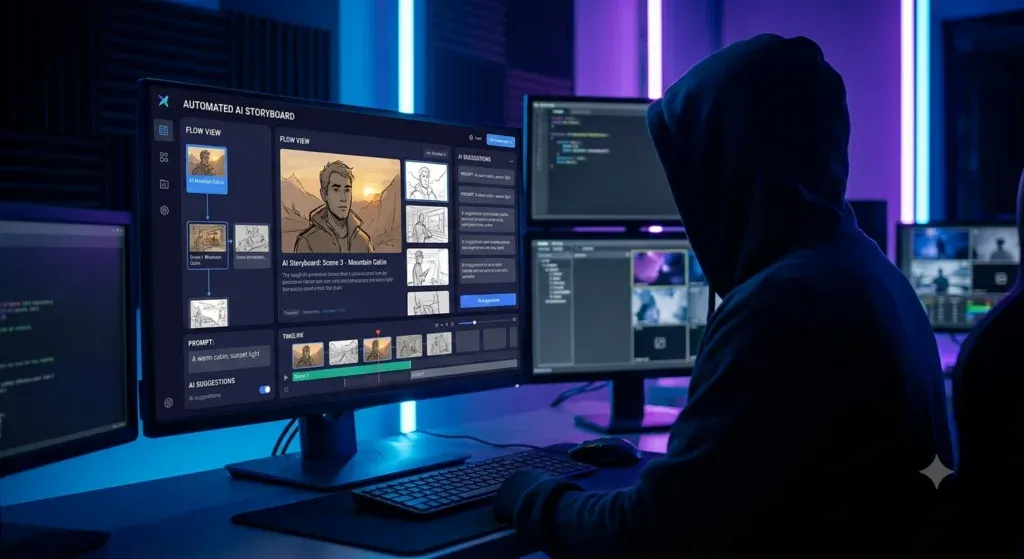
Faceless and voice-led channels. AI voiceovers now power explainer pages, finance accounts, history pages, and product review channels. Creators are building large audiences without ever showing their face, simply because script-to-video tools remove the need for filming.
Trend replication and speed. Trends don’t last long. AI helps creators turn a viral format into a new angle within hours instead of days, while auto captions and formatting remove editing delays during peak trend windows.
Hyper-localized content. AI dubbing lets creators publish the same video in multiple languages almost instantly. This helps small brands reach global audiences without hiring a localization team.
Data-driven creative testing. AI-generated variations make it easy to test hooks, pacing, and visual styles at scale, so growth teams can spot what works much faster.
AI isn’t replacing creators. It’s changing how fast they can produce, test, and publish — and that speed is becoming the real edge in scalable content creation.
What Most “Best AI Video Tool” Lists Get Wrong
Most articles ranking AI video tools focus on flashy features, not what actually matters when you’re trying to scale. Here’s where they usually go wrong:
- Feature hype over real workflow — They compare transitions and templates instead of asking if the tool supports consistent weekly output.
- No real scale test — Few lists ask if you can actually produce 30 to 100 videos a month without getting stuck.
- Templates aren’t a strategy — Hundreds of templates don’t fix content fatigue or help you test real hook variations.
- Ignoring platform differences — Tools get praised in general without looking at how they actually perform on TikTok, Reels, Shorts, or paid ads.
- No speed test — Growth depends on testing hooks quickly, yet most reviews never check how fast you can revise a video.
- Ignoring brand consistency — Scaling often breaks visual identity, but most lists never check style control across batches.
- Missing repurposing power — Turning long videos into short clips is essential for scale, yet many tools are judged only on basic text-to-video output.
If you genuinely want to find the best AI-driven tool for scalable social media video production, you need more than a feature checklist. You need to know if it fits into a real, repeatable video production workflow — because most “best AI video tool” lists never actually test for the best AI-driven tool for scalable social media video production under real, daily posting conditions.
Frameo — The Best AI-Driven Tool for Scalable Social Media Video Production
Frameo is built for creators who want to go from script to a finished, ready-to-post video without using five different tools. Instead of stitching together a script writer, a video generator, a voice tool, and an editor, Frameo puts story structuring, video generation, editing, voice, and formatting in one place.
Key Tools Inside Frameo, the Best AI-Driven Tool for Scalable Social Media Video Production
- Script to Video Maker — Turns structured scripts into short-form videos ready for Reels, Shorts, and TikTok.
- Story to Video Maker — Converts raw ideas into visual scenes with pacing handled automatically.
- YouTube Shorts, Instagram & TikTok Generators — Exports platform-ready vertical videos with no manual resizing.
- AI Video Editor — Refines pacing and transitions without switching to traditional editing software.
- AI Voice & Voiceover — Generates narration for faceless channels and UGC-style ads.
- AI Script Writer & Storyboarder — Plans content before production, making batch creation faster.
- UGC & AI Video Ads Tools — Builds product demos and short ad creatives for paid campaigns.
- Template Library — Starts you off with formats for viral clips, ads, and short-form stories.
Why Creators Choose Frameo as the Best AI-Driven Tool for Scalable Social Media Video Production
What makes Frameo different isn’t one single feature. It’s how the whole workflow works together:
- It supports repeatable output, not one-off generation.
- It keeps the same characters, voices, and visuals consistent across videos.
- It cuts down on switching between scripting, editing, voice, and formatting tools.
- It works for faceless channels, brand pages, and paid ad accounts alike.
- It lets you test hooks and pacing quickly.
- It keeps every video vertical-first and platform-native from the start.
For creators posting daily, or agencies running multiple accounts, this kind of simplicity becomes the real edge — not just video quality.
Where Frameo Fits Into a Scalable Content System
Frameo works best when you’re building an actual content engine, not just one video at a time. Write a script once, generate a few variations, adapt it for different platforms, and test angles — all without restarting your process every time. This is what sets the best AI-driven tool for scalable social media video production apart from a simple video editor.
If you’re searching for the best AI-driven tool for scalable social media video production, the real value isn’t just speed on a single video. It’s whether the tool can keep up week after week without breaking down.
Comparing AI Video Tools for Social Media Scale: Finding the Best AI-Driven Tool for Scalable Social Media Video Production
Not every AI video generator does the same job, and that’s where most creators go wrong. They pick a tool because it’s trending or a friend recommended it, without checking if it actually fits their content workflow.
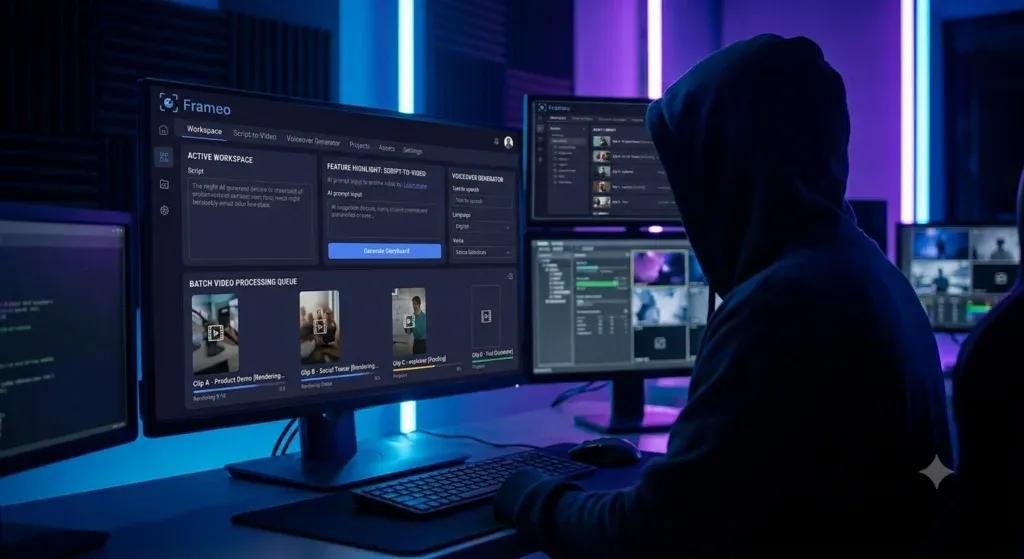
The table below breaks down how the major players compare when it comes to scripting, batch output, native formatting, and branding consistency — the four things that matter most for scalable content creation.
| Tool | Best For | Script-to-Video | Batch Production | Native Vertical Formatting | Branding Consistency |
|---|---|---|---|---|---|
| Frameo | Full end-to-end scalable video production | Yes | Yes (high volume) | Yes, built-in | Strong (consistent voice, characters, visuals) |
| Vizard | Repurposing long-form footage into clips | No | Limited | Partial | Weak |
| Adobe Firefly | Enhancing footage inside Premiere Pro | No | No | No | Depends on editor |
| InVideo AI | Quick videos for beginners | Yes | Limited | Yes | Weak (stock-heavy, feels generic) |
| HeyGen | AI avatar-led corporate videos | Yes | Limited | Partial | Moderate |
| Synthesia | Training videos and explainers | Yes | Limited | Partial | Moderate |
| Runway Gen-4.5 | Cinematic, artistic clips | No | No | No | N/A |
| Pika Labs | Short creative/experimental clips | No | No | No | N/A |
Some tools, like Vizard, are built mainly for repurposing — they’re great at pulling short clips from a long podcast or webinar, but they won’t help you write a script or keep a character consistent. Adobe Firefly leans more toward enhancing footage inside Premiere Pro, so it works as an extra layer for editors already in Adobe’s ecosystem, not as a standalone AI video generator.
InVideo AI is fast and easy for beginners, but it leans heavily on stock footage, which makes videos feel generic once you’re posting at volume. HeyGen and Synthesia are built around AI avatars, which is great for training videos or corporate explainers, but doesn’t work well for fast, trend-driven platforms like TikTok. Runway Gen-4.5 and Pika Labs make striking, cinematic clips, but neither is built for batch production or weekly posting.
Frameo stands apart here because it’s not trying to be one piece of the puzzle — it’s trying to be the whole workflow. Scripting, video generation, voiceover, editing, and formatting all live in one place, which is exactly what’s missing from the other tools above.
So the real question isn’t “which tool has the most features.” It’s “which tool fits how I actually want to produce content.” Vizard works for repurposing old footage. Synthesia or HeyGen work for corporate videos. But for creators and teams building a real content engine, Frameo is the best AI-driven tool for scalable social media video production.
Common Mistakes Creators Make When Scaling AI Video Production
Even with the right tools, scaling can go wrong if you fall into a few common traps. These usually show up once volume increases and the workflow starts to crack.
Treating AI as a one-click solution. Many creators expect AI to generate a perfect video with zero guidance. The best results still come from a clear script and some editing afterward. AI speeds things up — it doesn’t remove the need for direction.
Skipping the planning stage. Jumping straight into video generation without batching scripts leads to messy, inconsistent output. A good workflow always starts with a short planning step, even if it’s just twenty minutes.
Ignoring platform formatting. A video that works on TikTok might flop on Reels simply because of pacing or aspect ratio differences. Native formatting for each platform matters more than people think.
Sacrificing branding for speed. When output increases, it’s tempting to cut corners on visual identity. But inconsistent voices or colors across videos make an account feel disorganized.
Not testing enough hooks. Since the first few seconds decide everything, posting only one version of a hook means missing out on useful data. Testing two or three hooks per video is one of the fastest ways to improve.
Relying only on stock footage. Heavy use of generic stock visuals makes an account feel templated. Original, story-driven visuals build a stronger connection with your audience.
Avoiding these mistakes matters as much as picking the right tool. Even the best AI-driven tool for scalable social media video production won’t fix a broken workflow on its own — it needs smart planning and consistent execution alongside it. Most creators don’t fail because the tool was bad. They fail because they tried to scale output without scaling their process first.
Who Needs the Best AI-Driven Tool for Scalable Social Media Video Production the Most?
Not everyone needs the same level of automation. A hobbyist posting once a week can survive on manual editing. But once you cross into serious growth territory, things change fast.
Solo creators going full-time. If you’re trying to turn social media into a real income source, you need daily or near-daily output. Manual editing simply can’t keep up with that pace forever.
Faceless content channels. These accounts depend entirely on scripts, voiceovers, and visuals. Without an AI video generator handling these parts, faceless channels become almost impossible to run at scale.
Small marketing teams. Brands without a big in-house video team still need to post consistently across platforms. A scalable AI tool lets two or three people do the work of a much bigger team.
Agencies managing multiple clients. This is where scalability matters most. Each client needs their own brand voice, posting schedule, and content style — all running at the same time.
E-commerce and product brands. Constant product drops, promotions, and UGC-style ads require fast turnaround. AI tools help these brands stay visible without slowing down their marketing calendar.
If any of these sound like you, the best AI-driven tool for scalable social media video production isn’t optional anymore. It’s the difference between staying consistent and falling behind.
Tips to Build a Workflow Around the Best AI-Driven Tool for Scalable Social Media Video Production
If you want to actually use AI to scale your output, these habits make a real difference:
- Script in batches, not one at a time. Writing five or ten scripts in one sitting keeps your tone consistent and saves time.
- Build a repeatable format. A simple structure — hook, build-up, payoff — makes testing variations much easier.
- Test hooks aggressively. Create two or three hook versions for every video before you publish.
- Keep your visual identity consistent. Same voice, same characters, same colors — consistency builds recognition.
- Repurpose everything. One long-form idea can usually become three to five short clips across platforms.
- Track what actually performs. Use retention and completion rate, not just likes, to decide what to repeat.
- Set a simple weekly routine. Pick fixed days for scripting, generating, and posting. A routine removes the guesswork and keeps your output steady, even on busy weeks.
Conclusion
Social media has moved past chasing one great video. Real growth now comes from structured volume — posting consistently, testing fast, adapting formats, and staying recognizable across platforms without burning out your team. The tool you pick decides whether your process feels chaotic or solid.
The best AI-driven tool for scalable social media video production isn’t the one with the flashiest effects or the biggest template library. It’s the one that strengthens your whole workflow — script-to-video, batch output, native formatting, and fast testing. When all of this comes together, scaling stops feeling overwhelming.
Tools like Frameo are built around this exact idea, which is why more creators now treat Frameo as the best AI-driven tool for scalable social media video production — turning content production into a repeatable system instead of a weekly scramble. At the end of the day, the goal isn’t to chase one lucky upload. It’s to build a process strong enough that even your average video still does its job — and your best ones become the new normal.
Frequently Asked Questions (FAQs)
1. What is an AI-driven tool for social media video production? It’s a platform that uses AI to turn ideas, scripts, or footage into short-form videos automatically — handling scripting, editing, captioning, and formatting so you can publish faster. In short, the best AI-driven tool for scalable social media video production is the one that removes manual bottlenecks from your entire content pipeline.
2. Why do creators need a scalable AI video tool instead of regular editing software? Regular editing software is built for single projects. A scalable AI tool is built for repeat output — letting you make multiple videos, test hooks, and stay consistent without starting over each time.
3. Can AI video tools fully replace human editors? Not fully. AI speeds up scripting, captioning, and rough editing, but human creativity still matters for storytelling, brand voice, and final polish.
4. Which is the best AI-driven tool for scalable social media video production? Tools that combine script-to-video creation, batch output, native formatting, and consistent branding work best for scale. Frameo is built specifically around these needs, which makes it a strong pick for creators and teams aiming for high-volume output.
5. Do AI video generators offer free plans? Many platforms offer free trials or limited free plans, often with watermarks or fewer features. Paid plans usually unlock higher quality, more exports, and batch tools.
6. What should I look for when choosing an AI video tool for social media? Look for script-to-video workflows, native vertical formatting, batch production, branding consistency, and fast hook testing — these are the exact traits that define the best AI-driven tool for scalable social media video production, not just a big template library.
7. How many videos should a creator aim to produce per month to scale effectively? There’s no fixed number, but moving from a handful of videos a month to a steady weekly or daily output (often 20 to 50+ videos monthly) is usually where creators start seeing real algorithmic benefits.
