Best AI Music Generation Tools 2026: 7 AI Music Creators Worth Using This Year
Meta Title: Best AI Music Generation Tools 2026 | Top AI Music Generators Compared Meta Description: Discover the best AI music generation tools 2026. Compare features, pricing, copyright policies, and use cases to choose the right AI music creator. URL Slug: best-ai-music-generation-tools-2026
Artificial intelligence has completely changed how music is created. Whether you’re a YouTuber searching for royalty-free background tracks, a podcaster who needs custom intro music, or an independent artist looking for fresh inspiration, today’s best AI music generation tools 2026 can save hours of work.
The biggest challenge isn’t finding an AI music tool—it’s choosing the right one. Every platform promises studio-quality music, commercial licensing, and easy workflows, but they all excel in different areas, and their free plans are far more different from each other than most comparison articles let on.
In this guide, you’ll discover the best AI music generation tools 2026, compare their real pricing, strengths, and limitations, and learn which platform is best for your specific needs—along with the copyright risks you should know about before publishing anything commercially.
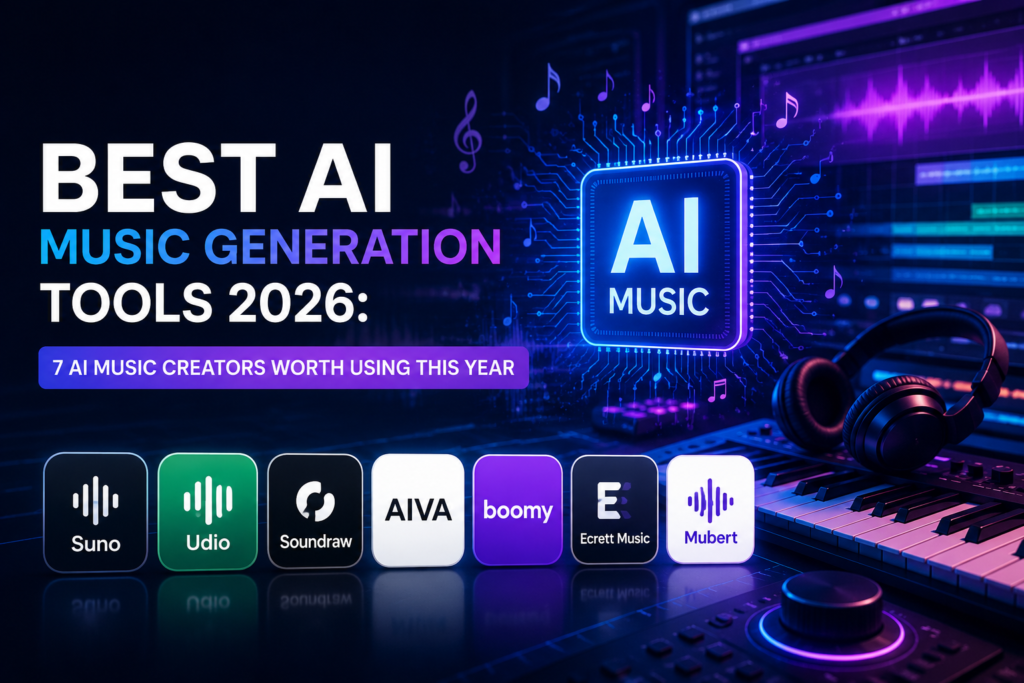
Why AI Music Generation Is Growing So Fast
AI music tools have become significantly more advanced over the last few years. Instead of producing generic loops, modern platforms can generate complete songs, cinematic scores, electronic beats, ambient music, and even vocals from simple text prompts. This rapid progress is exactly why so many creators are now actively searching for the best AI music generation tools 2026 has to offer.
Creators across the United States are increasingly using AI music for:
- YouTube videos
- TikTok content
- Podcasts
- Advertising campaigns
- Indie games
- Mobile apps
- Social media reels
- Business presentations
These tools reduce production costs while allowing creators to publish content much faster.
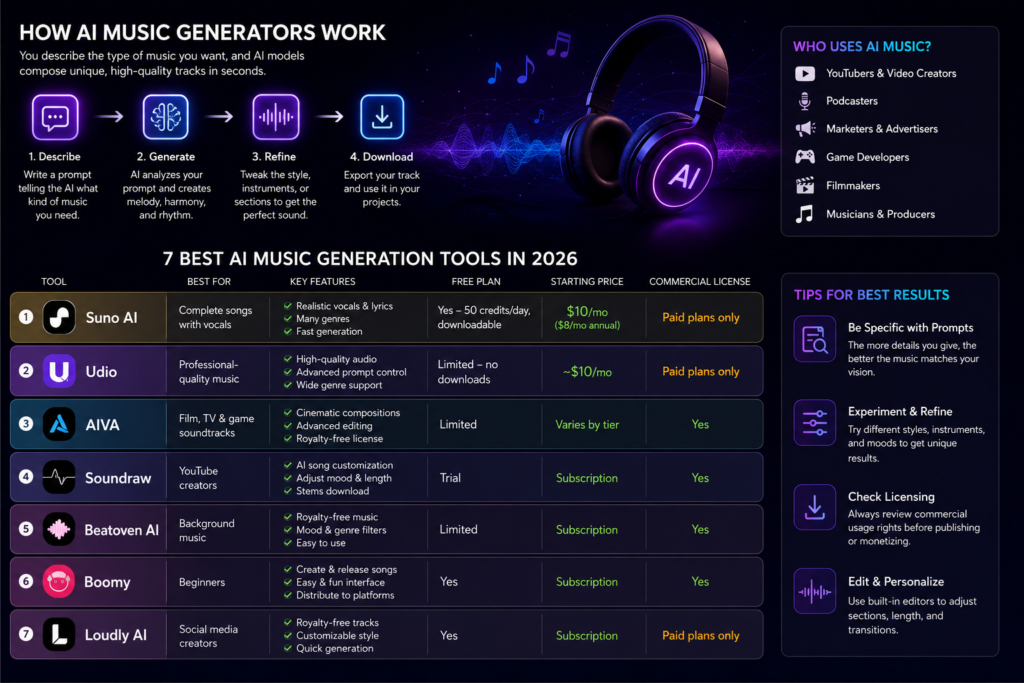
Best AI Music Generation Tools 2026 (Quick Comparison)
| Tool | Best For | Free Plan | Entry Paid Plan | Commercial License |
|---|---|---|---|---|
| Suno AI | Complete songs with vocals | Yes — 50 credits/day, downloadable | $10/mo ($8/mo annual) | Paid plans only |
| Udio | Professional-quality music | Limited — no downloads on free tier | ~$10/mo | Paid plans only |
| AIVA | Film scoring | Limited | Varies by tier | Yes |
| Soundraw | YouTube creators | Trial | Subscription | Yes |
| Beatoven AI | Background music | Limited | Subscription | Yes |
| Boomy | Beginners | Yes | Subscription | Yes |
| Loudly AI | Social media creators | Yes | Subscription | Paid plans only |
Pricing changes frequently—always confirm current rates on each platform’s official pricing page before subscribing.
1. Suno AI
Best For: Complete AI-generated songs with realistic vocals.
Suno AI remains one of the most-used AI music generators in 2026 and is widely considered among the best AI music generation tools 2026 for anyone who wants finished songs, not just instrumentals. Users describe the song they want, and the platform generates lyrics, vocals, instruments, and structure within about a minute.
Pricing Suno runs on a credit system across three tiers: a Free plan with 50 credits that reset daily (enough for roughly 10 songs), Pro at $10/month ($8/month billed annually) with 2,500 monthly credits, and Premier at $30/month ($24/month annually) with 10,000 monthly credits plus access to Suno Studio, a multitrack editing environment. A typical song costs around 5 credits to generate, though heavy editing and regeneration can burn through credits much faster than the headline numbers suggest.
Pros
- Genuinely usable free tier—you can generate and download tracks, not just preview them
- Fast generation (often under a minute)
- Supports many genres
- Beginner-friendly
Cons
- Free-tier output is restricted to personal, non-commercial use
- Free users get the older V4.5 model, not the latest V5
- Active copyright litigation (see below) adds uncertainty for high-stakes commercial use
Ideal for: YouTubers, content creators, marketing agencies, independent musicians
2. Udio
Best For: Professional music production.
Udio is Suno’s closest competitor and one of the best AI music generation tools 2026 for creators who prioritize audio fidelity over speed. It’s known for highly realistic instrumentals and strong audio quality. It excels in pop, rock, hip-hop, country, jazz, and electronic music, and its prompt system gives creators more granular control over mood, style, instruments, and song structure.
Pricing Udio’s paid plans run from roughly $10/month at the entry tier up to around $30/month for higher-volume access. Worth flagging: Udio’s free plan currently does not allow track downloads—you can preview generations in the browser, but to actually use a track you need a paid subscription.
Pros
- Strong audio fidelity and instrument separation
- More creative control per generation than some competitors
- Wide genre support
Cons
- Free tier is a demo, not a usable plan—no downloads
- Slower to build a full song (shorter clips that need manual extension)
- Same active copyright litigation exposure as Suno
3. AIVA
Best For: Film, television, and game soundtracks.
If your focus is orchestral or cinematic music, AIVA remains one of the strongest choices among the best AI music generation tools 2026 for composers who need a licensing-safer option.
Popular industries include:
- Game development
- Film production
- Documentary creators
- Advertising
AIVA offers detailed editing options beyond simple text prompts and is generally positioned as a licensing-safer option for cinematic and orchestral work, since it isn’t currently named in the major-label lawsuits affecting Suno and Udio.
4. Soundraw
Best For: YouTube creators
Soundraw is another strong entry among the best AI music generation tools 2026, focusing on royalty-free background music rather than full songs with lyrics. Users customize:
- Mood
- Length
- Tempo
- Genre
- Instrumentation
This makes it an excellent option for creators producing long-form videos who need predictable, licensable background tracks rather than vocal-driven songs.
5. Beatoven AI
Best For: Podcasts and presentations
Beatoven AI specializes in emotional background music and stands out among AI music generation tools for how precisely it matches mood to content.
Popular moods include:
- Inspirational
- Relaxing
- Corporate
- Dramatic
- Happy
- Calm
Businesses frequently use Beatoven for marketing videos and explainer content where mood-matching matters more than vocal performance.
6. Boomy
Best For: Complete beginners
Boomy allows users to create songs in just a few clicks, with no music production experience required, making it one of the most approachable AI music generation tools for first-time creators.
Features include:
- Fast generation
- Streaming distribution (built-in pipeline to platforms like Spotify)
- Easy editing
- Commercial use options
For beginners exploring AI-generated music—especially those who want to release a track to streaming with minimal extra steps—Boomy offers one of the easiest learning curves.
7. Loudly AI
Best For: Social media creators
Loudly AI rounds out our list of the best AI music generation tools 2026, focusing on producing short, engaging tracks optimized for platforms such as Instagram, TikTok, and YouTube Shorts.
Its library includes multiple genres and moods, making it easy to match music with different types of content.
How to Choose the Best AI Music Generation Tool
The best platform depends on your goals. Here’s a quick breakdown to help you pick from the best AI music generation tools 2026 based on your specific needs.
Choose Suno AI if:
- You want full songs with vocals and a free plan you can actually use.
- You prefer text-to-song generation.
- You create music for social media or YouTube.
Choose Udio if:
- You need higher creative control and top-tier audio fidelity.
- You’re ready to pay—the free plan won’t get you a usable file.
- You enjoy experimenting with different genres.
Choose AIVA if:
- You compose cinematic music.
- You work on films or games.
- You need orchestral arrangements and want a comparatively lower-risk licensing story.
Choose Soundraw if:
- You mainly need royalty-free background music, not vocal songs.
- You publish YouTube videos regularly.
Choose Beatoven AI if:
- You create podcasts.
- You need mood-based background music.
- You produce business presentations.
AI Music Copyright Explained
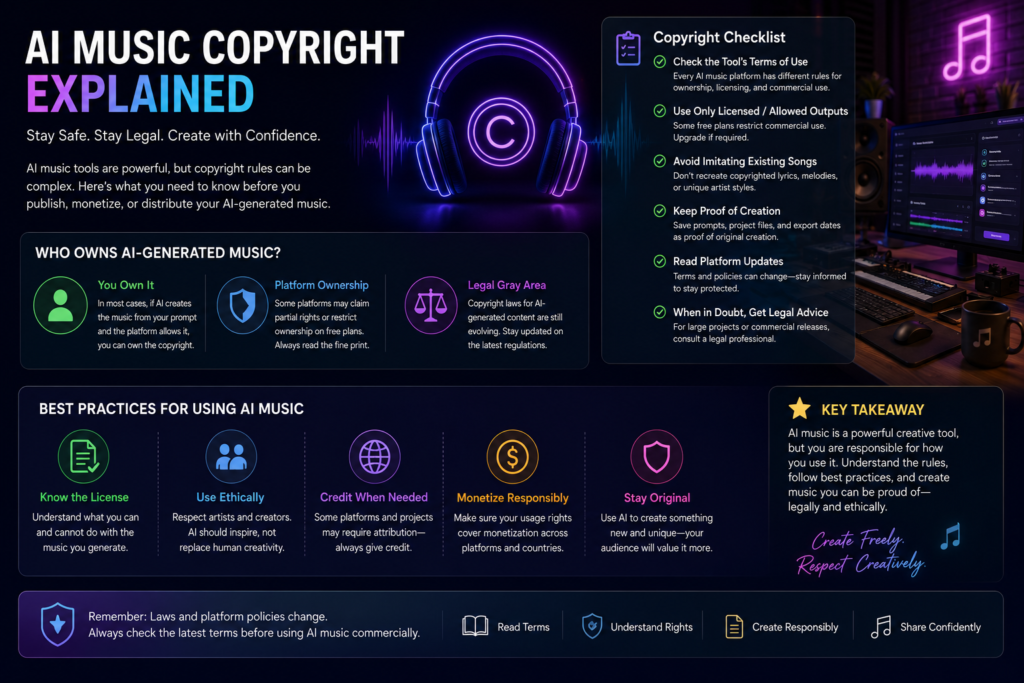
One of the biggest questions creators ask is: Can I legally use AI-generated music?
The answer depends on the platform’s licensing terms—and, increasingly, on ongoing litigation in this space.
The lawsuits you should know about In 2024, major record labels—Sony Music, Universal Music Group, and Warner Records—filed federal copyright infringement lawsuits against both Suno and Udio, alleging the companies trained their AI models on copyrighted recordings without permission. Warner has since reached a settlement with Suno, but the Universal and Sony cases remain active as of mid-2026. This doesn’t mean you can’t use these tools, but it does mean the legal picture around training-data rights is still being settled in court, and platform terms have been changing in response.
Before publishing AI-generated music commercially, always check:
- Commercial licensing (does your specific plan tier actually grant it?)
- Whether free-tier output is restricted to personal/non-commercial use
- Ownership rights (some platforms assign you rights only for paid-tier generations, not retroactively)
- Distribution rules
- Monetization permissions
- Attribution requirements
If you create content for clients or businesses, reviewing these terms—and re-checking them periodically, since they change—is especially important to avoid future copyright issues. For client work where copyright risk genuinely cannot be tolerated, platforms that license from curated artist pools rather than training on open internet data (such as Mubert) are worth considering as a lower-risk alternative.
Are AI Music Tools Worth Paying For?
For casual users, some free plans are genuinely enough to experiment with AI-generated music—Suno’s free tier in particular lets you generate and download real, usable tracks. Others, like Udio’s current free tier, are closer to a product demo than a usable plan. That said, most of the best AI music generation tools 2026 reserve their strongest features for paid subscribers.
Paid plans usually unlock:
- Better audio quality and access to newer models
- More monthly generations
- Commercial licensing
- Faster rendering and priority processing
- Advanced editing tools (e.g., multitrack studios, stem exports)
Professional creators typically find the upgrade worthwhile because it saves time, unlocks commercial rights, and expands creative options.
Tips for Getting Better Results
Even the best AI music generator depends on the quality of your prompt.
Instead of writing: “Make a happy song.”
Try: “Create an upbeat indie pop song with acoustic guitar, energetic drums, female vocals, and an inspirational summer vibe suitable for a travel vlog.”
The more detail you provide, the better the generated music is likely to match your vision. If you’re editing heavily after generation (extending intros, regenerating choruses), budget extra credits on credit-based platforms—iteration adds up faster than the per-song price suggests.
These internal links help users explore related topics and strengthen your site’s topical authority.
Frequently Asked Questions
What is the best AI music generation tool in 2026? For most users, Suno AI and Udio stand out because they produce high-quality songs with realistic vocals and support a wide range of music styles. Suno currently has the more usable free tier; Udio leans on stronger audio fidelity for paying users.
Can I use AI-generated music on YouTube? Often yes, but the exact permissions depend on your subscription tier and the platform’s current licensing terms—free-tier output on platforms like Suno is typically restricted to non-commercial use. Always review the terms before monetizing your videos, and be aware that major labels have active copyright lawsuits against some platforms over training data, which could affect future terms.
Are AI music generators free? It depends heavily on the platform. Suno’s free plan lets you generate and download a meaningful number of tracks daily. Udio’s free plan currently does not allow downloads at all, functioning more as a demo. Paid plans across platforms typically include commercial licenses, higher-quality exports, and more customization options.
Which AI music tool is best for beginners? Boomy is one of the easiest tools for beginners thanks to its simple interface, quick song creation process, and built-in distribution to streaming platforms.
Is AI-generated music replacing musicians? AI music tools are better viewed as creative assistants rather than replacements. They help speed up brainstorming, prototyping, and content production, while human creativity remains essential for artistic direction and originality.
Is AI-generated music legally safe to use commercially? It’s a developing area. Several major AI music platforms are currently facing copyright lawsuits from record labels over how their models were trained, and these cases are still working through the courts. Using a paid plan that explicitly grants commercial rights reduces your personal exposure, but it doesn’t eliminate all uncertainty in this space. For high-stakes commercial projects, consider platforms with clearer licensing provenance, and keep records of your plan tier and generation dates.
Conclusion
The best AI music generation tools 2026 offer something for every type of creator, from beginners experimenting with AI-generated songs to professionals producing music for films, podcasts, games, and marketing campaigns.
If you want realistic vocals, fast song creation, and a free plan you can actually use, Suno AI is a strong choice. Udio delivers impressive quality for users seeking more creative control and audio fidelity, provided you’re ready to pay. AIVA excels at cinematic compositions, while Soundraw, Beatoven AI, Boomy, and Loudly AI each serve different creative needs, making it easier than ever to produce original music without traditional production skills.
As AI music technology continues to evolve—and as copyright litigation against major platforms continues to play out in court—choosing one of the best AI music generation tools 2026 with clear licensing, reliable audio quality, and features that match your workflow will help you get the most value while minimizing legal risk.
Next step: Explore our related guides on AI video generators, AI voice tools, and AI writing assistants to build a complete AI-powered content creation toolkit. tools, and AI writing assistants to build a complete AI-powered content creation toolkit.
